Squirrels
Hot pepper bird seed, examined honestly
Sold as the no-hardware squirrel answer. The company that makes it does not claim that, and the research does not support it.
By Scooter M. · Published · Last updated
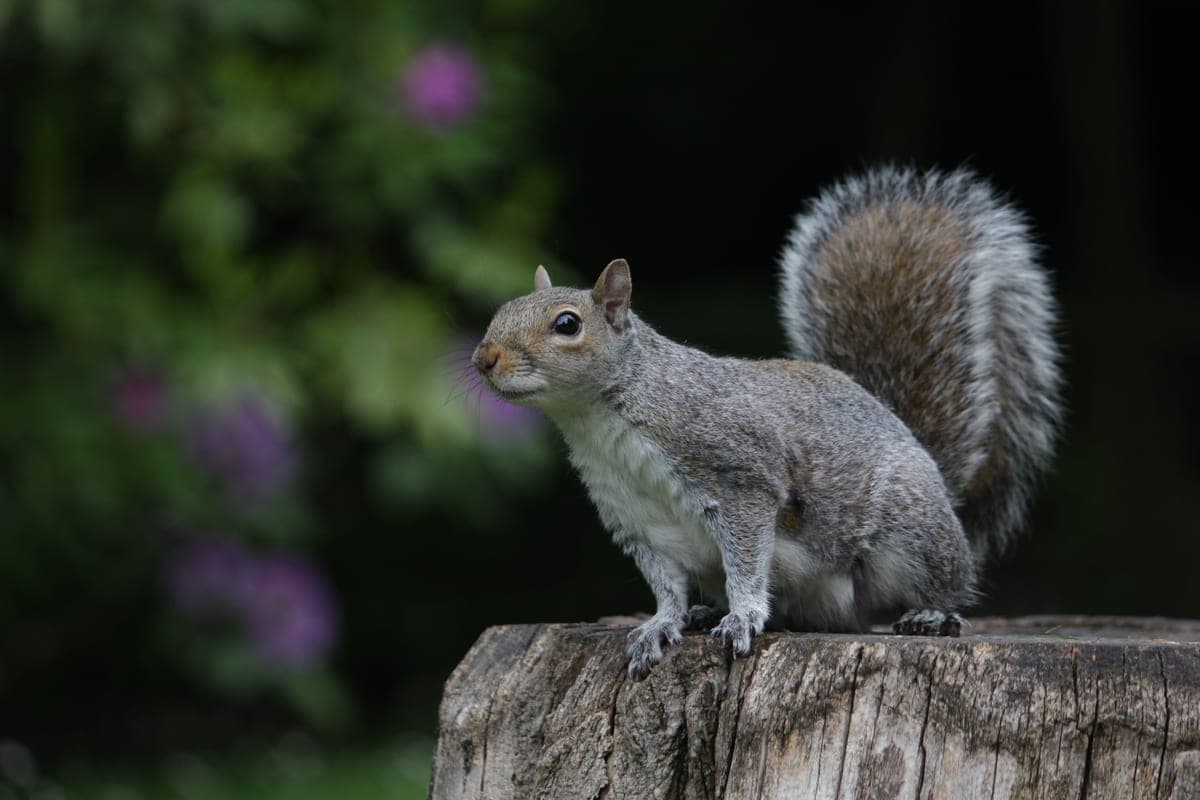
Not reliably. Cole's, which makes the best-known hot pepper seed, states plainly that chilies are not repellents. An experiment reported by Audubon found squirrels went back to eat even the spiciest seeds, while birds refused seed at ghost-pepper heat. It shifts preferences; it does not solve squirrels.
Seed & Sprig earns a commission when you buy through the links on this page, at no extra cost to you. It does not change which products we pick or the order we put them in — here is how we pick and here is how we are funded.
Hot pepper seed occupies a strange place in backyard bird feeding. It is sold on a promise that the manufacturers themselves decline to make, it is recommended constantly in forums, and the one published experiment we could find on the question found more or less the opposite of the folk wisdom.
It is also a real product that some people are genuinely happy with. So this page separates the three questions that usually get run together: does it work on squirrels, is it safe for birds, and is it worth your money.
What the manufacturer actually claims
This is the part that settles most of the argument, and almost nobody quotes it. Cole's makes the best-known hot pepper products in the United States, and its own product page for Hot Meats states that chilies are not repellents, and that within a short period of time most mammals simply decide they do not like the taste and move to other food sources.
Read that carefully, because it is a much weaker claim than the one the internet makes on the product's behalf. It is not a barrier. It is a preference nudge, operating over weeks, on animals that have somewhere else to go. If your yard is the only reliable food for a hundred yards, that last condition is not met.
What the research found
Audubon reported on an experiment by biologist Gabriel Colbeck that tested seed across a range of pepper heats. Two findings matter here, and they point in opposite directions from the marketing.
On squirrels: Colbeck found that squirrels would first eat the regular seeds, but would still go back to eat even the spiciest ones. That is the ranking behavior Cole's describes — a preference, not an exclusion — and it means a hungry squirrel with no alternative eats your expensive seed.
On birds: the conventional wisdom is that birds cannot taste capsaicin at all. Audubon's account is more careful. In mammals the vanilloid receptor connects spice with pain; in birds that receptor is far less sensitive, earlier studies have shown, but it is still there. Colbeck found birds tolerated peppers up to around 500,000 Scoville units with declining visits after that, and at ghost pepper heat refused the seeds altogether.
So the honest summary is: mild-to-hot commercial products are within the range birds tolerate, and the failure mode of going hotter is not a better squirrel deterrent — it is losing your birds. Audubon's own caution is that there might come a point where you could actually deter your birds from visiting your feeder.
The handling caveat nobody mentions
Cole's publishes a safety page for its hot products, and it is more serious than the cheerful packaging suggests. The company suggests wearing rubber gloves when directly handling chili-infused seeds. It advises against children and people with chronic lung conditions pouring or handling these products. It warns not to use hot water when cleaning, as this may cause chili vapors to get in your eyes and lungs.
None of that makes it a dangerous product. It does make it a product you should not buy for a household where a child does the refilling, and it is worth knowing before rather than after the first windy refill.
So what is it actually good for?
Three situations, and they are narrower than the marketing but they are real.
| Situation | Worth it? | Why |
|---|---|---|
| Suet being carried off whole | Yes — the best case | A cage is the easiest thing to raid and a treated cake is cheap insurance. |
| You cannot install a pole or baffle | Worth a try | Rented yards, balconies, HOA rules. Something beats nothing. |
| Squirrels have other food nearby | Reasonable odds | This is the condition Cole's describes: they move on if there is somewhere to move to. |
| One feeder, no alternatives, hungry squirrels | No | They eat it. This is the case the research describes. |
| Instead of buying a baffle | No | You are spending more per pound, permanently, to avoid a one-off purchase that works. |
What to buy instead, if you can
Placement and a baffle. This is not a fashionable answer and it remains the correct one: the 5-7-9 rule asks for a feeder about five feet up, seven feet from anything a squirrel can jump off, and nine feet of clearance below any overhang, and a pole meeting that with a long baffle on it defeats squirrels regardless of what is in the feeder.
The economics are not close, either. A baffle is bought once and works for a decade. Hot seed is bought every few weeks, costs more per pound than the sunflower it replaces, and on the evidence above may not do the job. Baffle sizing and geometry are here, and the full order of operations for a squirrel problem is here.
If hardware is genuinely impossible — a rented balcony, a fence-only yard — then the honest ranking is: a weight-closing feeder first, safflower second, hot products third. Safflower has a similar shape of claim and costs less, and it comes with no handling warnings at all.
Does it work on rats and mice?
Rodents are mammals, so the same capsaicin argument applies in theory, and the same caveat applies in practice: it is a preference, not a barrier. More importantly it addresses the wrong thing. Rodents at a feeder are eating spilled seed off the ground, and the fix is to stop the spillage and clear the ground, not to season it. That page goes through the mechanism.
One genuine side benefit
The best-known hot pepper seed is hulled sunflower — sunflower meats, in Cole's terminology. That means no shells under the feeder and nothing that can germinate, which are two real problems solved incidentally. If the patch under your feeder is the actual complaint, note that you can buy plain hulled seed for less and get the same benefit without the chili or the gloves.
Seed or suet — which version is worth buying
If you are going to try a hot product at all, the suet cake is the better bet, and the reasoning is about what each one is defending.
A tube or hopper of seed can be defended by hardware. A weight-closing mechanism works, a baffled pole works, and both are one-off purchases that keep working. Buying treated seed instead means paying a premium on every refill, forever, for a weaker result.
A suet cage is different. It holds a single solid object that a squirrel can grip through the wire and pull, and the cage itself is usually hanging from something rather than standing on a pole. There is genuinely less hardware available to defend it, and the cake is cheap enough that a treated one is not a big premium. That is the case where the chemistry is doing work the mechanics cannot.
| Approach | Cost shape | How well it works |
|---|---|---|
| Baffle on a pole | One-off | High, and permanent |
| Weight-closing feeder | One-off, higher | High, with a known failure mode |
| Treated suet cake | Small premium per cake | Variable, but the cage is hard to defend anyway |
| Treated seed | Premium on every refill | Variable, and hardware would have worked |
Two things people get wrong about it
Hotter is not better. This is the clearest practical finding in the research above. Going up the Scoville scale does not push squirrels past a threshold — they kept eating the spiciest seed in Colbeck's experiment — but it does push birds past theirs, and Audubon's own caution is that you could reach a point where you deter your birds from visiting. There is no upside at the top of the range.
It is not instant. Cole's frames the effect as most mammals deciding over a short period that they do not like the taste, and moving on. That is weeks, not days, and it means the first fortnight of an expensive bag disappearing into squirrels is the expected behavior rather than proof it has failed. If you are going to try it, commit to a full bag before judging — and be aware that committing to a full bag is precisely what makes it an expensive experiment.
What we would buy for this
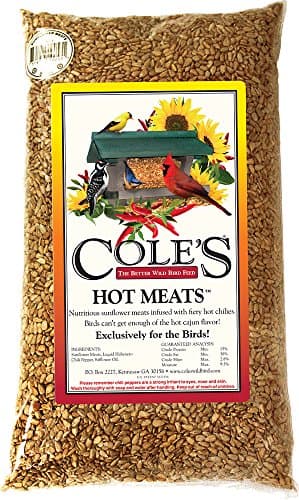
#1 · Best hot pepper seed
Cole's Hot Meats
Cole's · A yard where squirrels have beaten every piece of hardware
Hulled sunflower coated in liquid habanero, which birds cannot taste and most mammals eventually decline — sold by a manufacturer honest enough to print that chilies are not a repellent.
Published specifications
- Ingredients
- Sunflower meats, liquid habanero chili peppers, safflower oil
- Sizes
- 5, 10, 20 and 40 lb
- Hulls
- None — sunflower meats are already shelled
- Guaranteed analysis
- Not published by Cole's
What it does well
- Shelled, so there are no husks under the feeder and nothing can sprout
- Cole's names cardinals, finches, woodpeckers, titmice and chickadees among the birds that take it
- Works in any feeder, so it needs no new hardware
What it does not
- Cole's states plainly that chilies are not repellents — squirrels sample it first and only some move on
- Cole's advises rubber gloves when handling it, and advises against children or anyone with a chronic lung condition pouring it
- Hulled sunflower is among the most expensive ways to fill a feeder, and this costs more again
Specifications above come from the manufacturer's own published listing: Cole's Hot Meats — published ingredients and sizes, Cole's hot products safety information.
#ad How we are funded · Price as of October 22, 2026
#2 · Best hot pepper suet
Cole's Hot Meats Suet Cake
Cole's · Keeping a suet cage for the woodpeckers rather than the squirrels
The same habanero idea in a no-melt cake, which matters because a suet cage is the easiest thing in the yard for a squirrel to simply carry away.
Published specifications
- Ingredients
- Corn, roasted peanuts, rendered beef suet, oats, sunflower meats, red pepper, soy oil
- Size
- 11.75 oz cake
- Format
- No-melt, sold for year-round feeding
- Guaranteed analysis
- Not published by Cole's
What it does well
- No-melt, so it holds shape in warm weather when plain suet turns greasy
- Cole's names bluebirds, woodpeckers, nuthatches, finches and cardinals among the birds it attracts
What it does not
- Corn is the first ingredient, so a share of it still feeds starlings and grackles
- Same handling caveat as the seed — Cole's recommends gloves with chili-infused products
Specifications above come from the manufacturer's own published listing: Cole's Hot Meats Suet Cake — published ingredients and size.
#3 · What to buy first instead
Erva SB1D Cylindrical (Torpedo) Squirrel Baffle
Erva · Pole-mounted feeders
A long steel cylinder a squirrel cannot get around or hug past, and the single most effective thing you can buy after the feeder itself.
Published specifications
- Length
- 16.75"
- Diameter
- 6.25"
- Type
- Pole-mounted cylindrical baffle
What it does well
- Length is what defeats a squirrel here: it cannot reach past the top
- Steel, so it survives winters and chewing
What it does not
- Useless if the pole sits within jumping distance of a fence, wall or branch
- Must be mounted high enough that a squirrel cannot leap over it entirely
Specifications above come from the manufacturer's own published listing: Erva SB1D published dimensions.
Common questions
Does hot pepper bird seed keep squirrels away?
Not reliably. Cole's states that chilies are not repellents, and an experiment reported by Audubon found squirrels ate regular seed first but still went back for even the spiciest. It shifts preference; it is not a barrier.
Is hot pepper seed safe for birds?
At commercial heat levels, yes — the vanilloid receptor that connects spice with pain in mammals is far less sensitive in birds. Audubon reports that birds tolerated peppers up to around 500,000 Scoville units and refused seed at ghost-pepper heat, so hotter is not better.
Can I just add cayenne or hot sauce to my own seed?
We would not. Commercial products are coated so the capsaicin stays on the seed; loose powder blows off, coats unevenly, and the dust is the part that gets into eyes and lungs.
Do I need gloves to handle it?
Cole's suggests rubber gloves when directly handling chili-infused seed, and advises against children or anyone with a chronic lung condition pouring it. Worth knowing before the first windy refill.
What works better than hot pepper seed?
A baffled pole sited away from jumping-off points, bought once. See baffles and what squirrel-proof actually means.