Feeder Types
Hopper feeders: capacity, roof and a perch to stand on
The feeder for people who do not want to refill twice a week — and for the birds a tube shuts out.
By Scooter M. · Published · Last updated
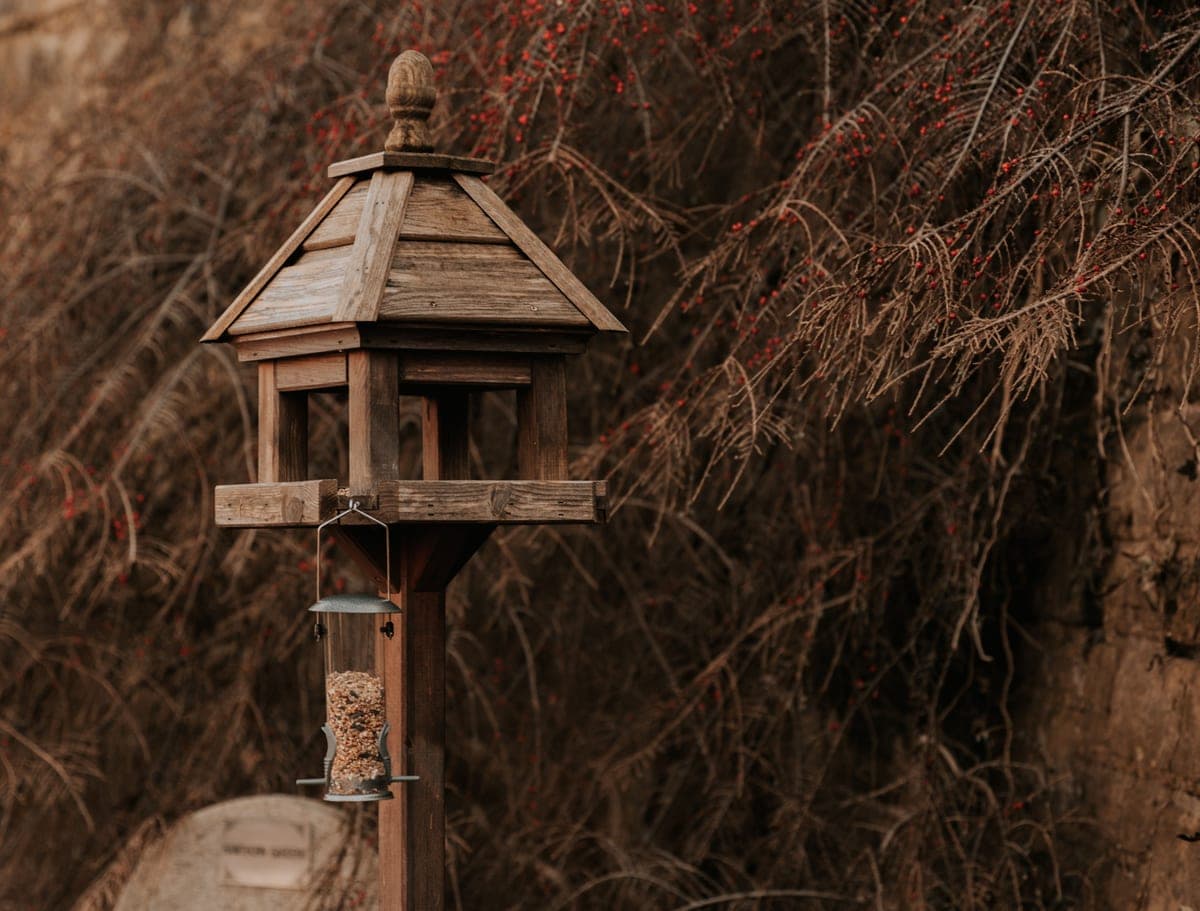
A hopper is a roofed platform holding seed behind walls, which Project FeederWatch describes as protecting seed against the weather. Large hoppers attract most feeder species including doves and grackles; smaller ones exclude the bigger birds. The Woodlink Absolute II adds counterweighted perches and holds 12 lb.
Seed & Sprig earns a commission when you buy through the links on this page, at no extra cost to you. It does not change which products we pick or the order we put them in — here is how we pick and here is how we are funded.
Quick picks
| # | Product | Best for | Price |
|---|---|---|---|
| 1 | 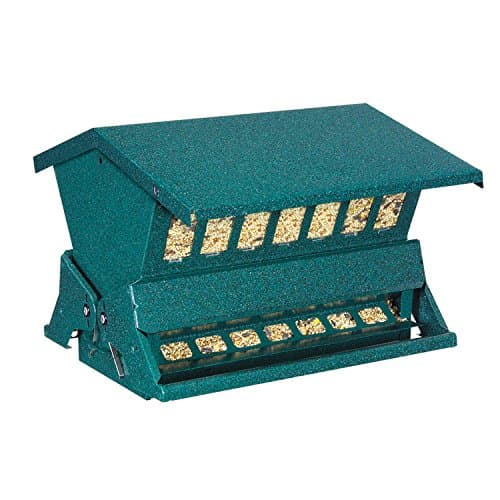 Woodlink Absolute II (model 7536) 12 lb, six ports, counterweighted perches adjustable to three weights. | Best overall hopper | $84.00 · View on Amazon #ad How we are funded · Price as of October 22, 2026 |
| 2 | NWno photo Nature's Way Cedar Hopper with Suet Cages (CWF19) 6 quarts of seed plus two suet cages, from one hook. | Best seed and suet combo | |
| 3 | 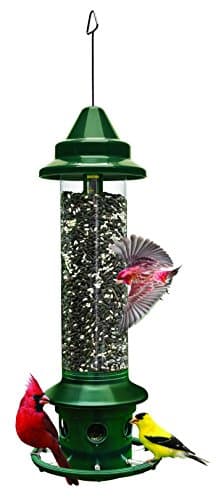 Brome Squirrel Buster Plus Less capacity than a hopper, but a tunable mechanism instead of a fixed one. | Best alternative if squirrels win | $125.90 · View on Amazon #ad How we are funded · Price as of October 22, 2026 |
Rows link to the full write-up further down this page. The price button goes to Amazon.
A hopper is the traditional bird-table shape: a roof, walls, and seed released gradually onto a tray. Project FeederWatch describes it as “a platform upon which walls and a roof are built, forming a hopper that protects seed against the weather.” It is the feeder to buy when refilling twice a week is not going to happen.
Size decides the guest list
Project FeederWatch is precise about this: large hoppers attract most feeder bird species and allow larger birds like doves and grackles, while small hoppers attract smaller birds while preventing larger species.
So the decision is not really about capacity. It is about whether you want doves, jays and grackles at the feeder. Some people do; some people spend a season trying to get rid of them.
The counterweighted perch
This is what turns a hopper into a squirrel-resistant feeder. The perch is a lever: enough weight on it pulls a metal shield across the seed tray. The Woodlink Absolute II publishes two counterbalanced perches adjustable to three positions for light, medium or heavy birds.
It has a second use nobody advertises — set it to exclude grackles and starlings and you have solved the other common feeder problem with the same dial. The trade-off is that setting it too heavy excludes cardinals, which are probably why you bought a hopper. Compared in weight-activated vs caged.
Capacity, honestly
Twelve pounds sounds like a luxury and it comes with a real cost: seed that sits for weeks in damp weather is how mold starts. Keeping seed dry goes through the fix, and the short version is to fill it a third full in a wet spell. A big hopper needs exactly the same cleaning discipline as a small tube — every week or two — and it is harder work.
If you are away often, a big hopper is genuinely the right answer. If you are home daily, a smaller feeder refilled more often keeps fresher seed in front of the birds.
Hopper vs tube
| Hopper | Tube | |
|---|---|---|
| Capacity | 3 to 12 lb | 1 to 5 lb |
| Weather protection | Roof — the best of the common types | Fairly good; ports are exposed |
| Cardinals and jays | Yes, on the perch rail | Only with a cardinal ring |
| Excludes big birds | Only if it is small, or the perch is counterweighted | Yes, by perch length |
| Cleaning | Harder — more corners, more seed | Easy, if the base comes off |
| Squirrel resistance | Possible, via counterweighted perches | None, unless it is a weight-closing model |
Where to put one
On a pole, not a branch. A full hopper is heavy — twelve pounds of seed plus the feeder itself — and that weight rules out most decorative hooks. Use heavy-gauge steel and a proper ground anchor. See feeder poles.
What to fill it with
Black oil sunflower, or safflower if squirrels are the problem — a hopper takes both without any change of hardware. Avoid filler-heavy mixes especially here: a big hopper full of milo is a big hopper of seed nobody eats, sitting there getting damp. Seed types here. Cedar hoppers are compared here. The Absolute II is reviewed in full here.
The picks in full
#1 · Best overall hopper
Woodlink Absolute II (model 7536)
Woodlink · Big capacity and cardinals — the hopper answer to squirrels
A double-sided steel hopper whose counterweighted perches drop a shield over the seed tray when something heavy lands, and it holds twelve pounds so it barely needs attention.
Published specifications
- Seed capacity
- 12 lb
- Dimensions
- 16" W x 11.25" H x 13.5" D
- Feeding ports
- 6 (both sides)
- Mechanism
- Two counterbalanced perches, adjustable to three weight settings
- Materials
- Steel and acrylic
What it does well
- 12 lb capacity means refills measured in weeks, not days
- Perch tension adjusts for light, medium or heavy birds
- The long perch rail suits cardinals, which will not use a small tube port
What it does not
- Twelve pounds of seed is heavy, so the hook or pole has to be rated for it
- Seed sitting for weeks in wet weather is how mold starts; a big hopper needs the same cleaning discipline as a small one
Specifications above come from the manufacturer's own published listing: Woodlink Absolute II published specifications.
#ad How we are funded · Price as of October 22, 2026
#2 · Best seed and suet combo
Nature's Way Cedar Hopper with Suet Cages (CWF19)
Nature's Way · Running seed and suet from one hook
A six-quart cedar hopper with a suet cage on each end, which covers seed-eaters and woodpeckers from a single hanging point.
Published specifications
- Dimensions
- 8" L x 12" W x 8" H
- Capacity
- 6 quarts of seed plus 2 suet cakes
- Materials
- Premium cedar with rust-free hardware
What it does well
- Two food types from one hook, which suits a small yard
- The roof keeps seed dry, which is the whole point of a hopper
What it does not
- No squirrel mechanism whatsoever
- Suet cages on the ends put suet within easy reach of squirrels and raccoons
Specifications above come from the manufacturer's own published listing: Nature's Way CWF19 published specifications.
#3 · Best alternative if squirrels win
Brome Squirrel Buster Plus
Brome · The one feeder to buy if you only buy one
A weight-closing tube feeder with a large capacity and a cardinal ring, and the closest thing to a genuinely squirrel-resistant feeder that a beginner can hang up and stop thinking about.
Published specifications
- Seed capacity
- 5.1 lb
- Height
- 28" base to hanger
- Feeding ports
- 6, plus a cardinal ring
- Mechanism
- Weight-adjustable spring shroud
- Materials
- Chew-proof, UV-resistant components
- Warranty
- Brome Lifetime Care
What it does well
- The spring tension is adjustable, so you can shut out heavy birds as well as squirrels
- Comes apart by hand for cleaning, which means it actually gets cleaned
- 5.1 lb is enough that a busy fall week does not mean daily refills
What it does not
- The most expensive feeder in this roundup by a wide margin
- The shroud collects seed dust and needs a full strip-down every couple of weeks
- A squirrel that can reach the top hanger still wins, so this is not a substitute for a baffle
Specifications above come from the manufacturer's own published listing: Brome — Squirrel Buster Plus (manufacturer store).
#ad How we are funded · Price as of October 22, 2026
Common questions
What is the best hopper bird feeder?
For most yards, one with counterweighted perches and enough capacity to skip a week — the Woodlink Absolute II publishes 12 lb, six ports and three perch settings.
Do hopper feeders keep seed dry?
Better than any other common type, because the roof covers the seed. The tray still needs drainage and the hopper still needs regular emptying.
Are hopper feeders squirrel proof?
Not inherently. Models with counterweighted perches are squirrel-resistant. A plain hopper is an open invitation and needs a baffled pole.
Should a hopper feeder have a tray?
A tray catches what gets flicked out and gives cardinals somewhere to stand. It also needs draining and cleaning, so buy one with a screen bottom.