Feeder Types
The best bird feeders for cardinals
A cardinal is a heavy, broad bird that forages on the ground. Almost every cardinal problem people have follows from that one sentence.
By Scooter M. · Published · Last updated
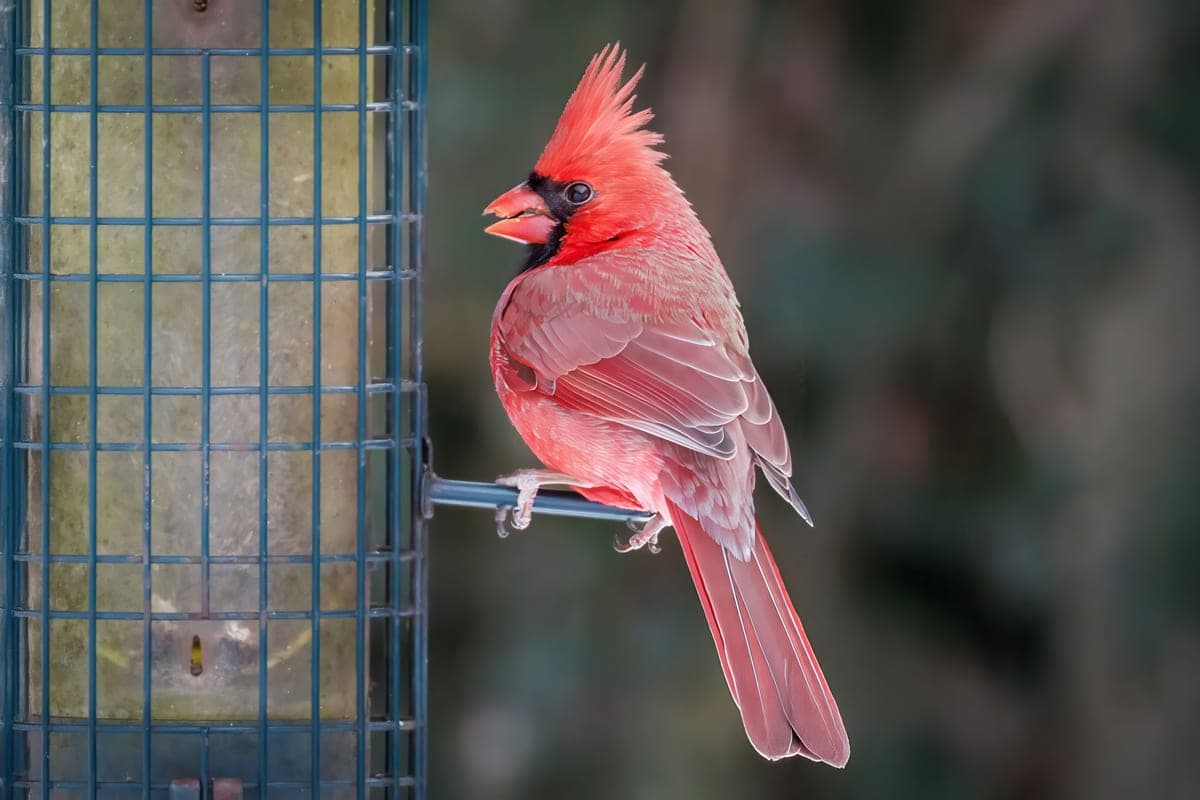
Cardinals want a flat surface they can stand on, and sunflower seed. An open cedar tray on a baffled pole is the most reliable answer; a large hopper with a long perch rail is the tidier one. Safflower is the fallback once squirrels have found either.
Seed & Sprig earns a commission when you buy through the links on this page, at no extra cost to you. It does not change which products we pick or the order we put them in — here is how we pick and here is how we are funded.
Quick picks
| # | Product | Best for | Price |
|---|---|---|---|
| 1 | NWno photo Nature's Way Cedar Platform Tray Feeder (CWF3) Twelve inches square of cedar with a screen bottom that drains. The surface cardinals will actually stand on. | Best feeder for cardinals | |
| 2 | 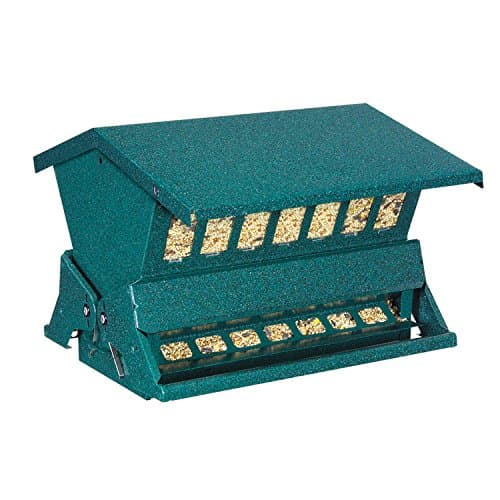 Woodlink Absolute II (model 7536) Twelve pounds under a roof, with a perch rail long enough for a bird this size. | Best hopper for cardinals | $84.00 · View on Amazon #ad How we are funded · Price as of October 22, 2026 |
| 3 | 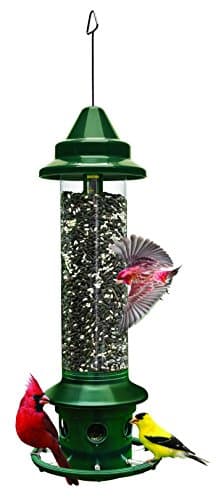 Brome Squirrel Buster Plus One of the very few closing feeders that ships with a cardinal ring. | Best when squirrels are already winning | $125.90 · View on Amazon #ad How we are funded · Price as of October 22, 2026 |
| 4 | 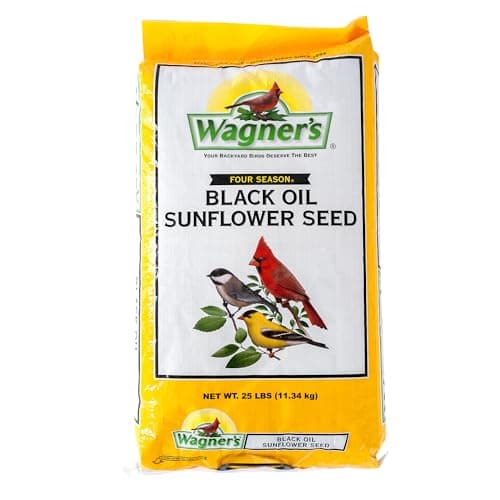 Wagner's Black Oil Sunflower Seed Project FeederWatch names black-oil sunflower among the favorite feeder foods of cardinals. | Best seed for cardinals | $41.98 · View on Amazon #ad How we are funded · Price as of October 22, 2026 |
| 5 | 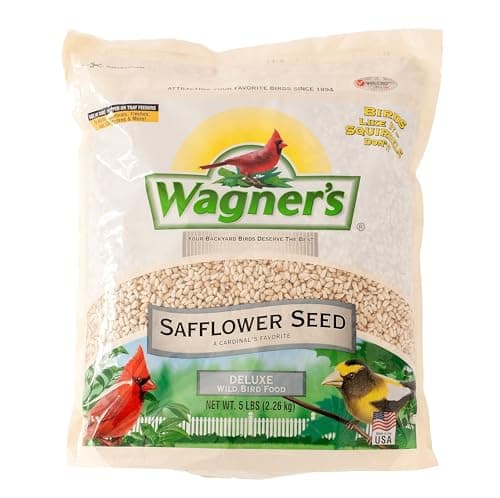 Wagner's Safflower Seed FeederWatch: safflower attracts cardinals and other big-billed birds. Most squirrels prefer sunflower. | Best seed once squirrels take over | $11.98 · View on Amazon #ad How we are funded · Price as of October 22, 2026 |
| 6 | Eno photo Erva SB1D Cylindrical (Torpedo) Squirrel Baffle Sixteen and three-quarter inches of steel — the part that makes an open tray survivable. | Best baffle for an open tray |
Rows link to the full write-up further down this page. The price button goes to Amazon.
There is a specific disappointment familiar to anyone who has just started feeding birds: cardinals in the hedge every morning, a new feeder in the yard, and not one cardinal on it. The feeder is not faulty. The seed is probably fine. The problem is posture.
Audubon describes the Northern Cardinal as a bird that forages mostly while hopping on the ground or in low bushes, and one that readily comes to feeders, where it favors sunflower seeds. Both halves of that sentence matter. A cardinal will absolutely use a feeder, but it arrives expecting a surface, and a standard tube feeder offers it a stub of plastic to balance a heavy, broad-chested bird on. It tries once, gives up, and goes back to eating what you spilled.
So this is not really a list of feeders. It is one criterion — somewhere to stand — applied to the shelf, plus the seed that makes the trip worth it and the one piece of hardware that stops the answer being eaten by squirrels.
What a cardinal needs from a feeder
Four requirements, in the order they decide whether a cardinal comes back. If a feeder fails the first one, nothing further down the list rescues it.
| Requirement | Why it matters | What fails it |
|---|---|---|
| A flat surface or a long rail | A cardinal wants to stand, not cling. It is a big bird with a heavy bill. | Short-perch tube feeders |
| Sunflower or safflower in the hopper | Both are big-billed seeds. Audubon and FeederWatch each name sunflower first. | Milo and cracked corn mixes |
| Cover within about ten feet | Cardinals shelter in dense bushes; an exposed feeder gets used nervously, if at all. | A pole in the middle of a bare lawn |
| Drainage, if the surface is open | An open tray with no drainage is a bowl, and wet seed molds quickly. | Solid-bottomed trays |
How we ranked these
Everything below is judged on published manufacturer specifications and on what institutional sources say about cardinal behavior. There is no claim of hands-on testing here, because we have not run a test program and will not pretend otherwise. Within that, we weighed four things: whether the design gives a cardinal somewhere to stand, whether it holds a seed cardinals actually eat, whether it can be stripped and cleaned in about two minutes, and what the manufacturer commits to in writing. The full criteria are on the methodology page.
Cleaning carries more weight on this page than on most. The feeders that suit cardinals are the open ones, and open feeders take the weather. Project FeederWatch asks for cleaning every week or two, and more often in heavy use or wet conditions. A tray that holds standing water is the fastest way to turn a good idea into a health problem for the birds you were trying to attract.
Which of these is you
| Your situation | Buy | Then read |
|---|---|---|
| You have a tube feeder and want to add cardinals | An open cedar tray, plus a baffle | Platform feeders in full |
| You want one feeder that does everything | A large hopper with a long perch rail | Hopper feeders in full |
| Squirrels have already taken the yard | A weight-closing feeder with a cardinal ring | Squirrel-resistant feeders |
| You would rather not buy hardware at all | A bag of safflower, and patience | What safflower really does |
| You are starting from nothing this fall | Pole, baffle, tray, sunflower — in that order | The first-setup walkthrough |
Why the tube feeder has no cardinals on it
Project FeederWatch puts the mechanism plainly: tube feeders with short perches accommodate small birds such as finches but exclude larger birds such as grackles and jays. That exclusion is the reason people buy tubes, and it is a good reason — it is how you stop a flock of grackles emptying five pounds of seed in an afternoon. But exclusion by perch length does not read a guest list. It excludes cardinals with exactly the same efficiency.
There are two ways out. The first is to stop asking a tube to do it and add a second, open feeder, which is why the cedar tray is our top pick and also the cheapest fix on this page. The second is to buy a tube-format feeder designed with the problem in mind: a cardinal ring is a wide circular perch fitted around the base of the tube, and the Squirrel Buster Plus is one of the few closing feeders that includes one as standard. If you were going to buy a squirrel feeder anyway, that detail is worth more than it looks.
What does not work is bolting a bigger perch onto a feeder that was not built for one, or waiting the birds out. Cardinals are permanent residents throughout their range, per Audubon. They are not passing through, and they are not going to learn a new skill for you. They will feed at the neighbor’s tray instead.
The seed: sunflower first, safflower as a tactic
Start with plain black-oil sunflower. FeederWatch calls it the most common seed offered at feeders in North America and names it among the favorite feeder foods of cardinals, chickadees, finches and sparrows. Audubon says the same thing from the bird’s side: at feeders, the cardinal favors sunflower seeds. There is no cleverer answer here, and a bag with one ingredient in it costs less per bird than any mix on the shelf.
Safflower is the second move, not the first. FeederWatch describes it as a seed that attracts cardinals and other big-billed birds, while noting that most birds prefer sunflower over safflower. Read that as a trade rather than an upgrade: you give up some variety at the feeder, and in exchange squirrels and grackles usually lose interest. It is a genuinely useful tactic in a yard that has been taken over, and it is oversold everywhere as a magic bullet. We wrote the honest version of the safflower claim rather than repeat it.
For the wider picture of which bag brings which bird, the seed-by-bird guide covers goldfinches, jays, woodpeckers and bluebirds alongside cardinals, and our seed roundup compares the bags themselves.
The problem an open tray creates
Everything that makes a tray right for cardinals makes it wrong for squirrel defense. It is a flat, open, unguarded surface at a convenient height with food on it. Hung from a branch or a shepherd’s hook with no protection, a cedar tray is a squirrel feeding station that occasionally serves birds.
The fix is not a better tray. It is a pole and a baffle, which is why a baffle appears in a list of cardinal picks at all. A long steel torpedo baffle on a pole is the single most effective purchase after the feeder itself, because a squirrel cannot get around it or hug past its length. It also never becomes obsolete: it protects whatever you hang above it for the next decade, which no feeder can claim.
The catch is placement, and it is not optional. A baffle is useless if the pole sits within jumping distance of a fence, a wall or a low branch, because the squirrel arrives from above and never touches the pole. Baffle sizing and the jump distances are here, and if you would rather solve it in one purchase, a pole system with an integrated moving baffle is covered in the pole roundup.
Where the tray goes
Cardinals are birds of woodland edges, thickets and suburban gardens — Audubon puts them almost wherever there are some dense bushes for nesting. That is a placement instruction as much as a habitat description. FeederWatch asks for feeders close to natural cover such as trees or shrubs, at roughly ten feet from dense branches: near enough that a nervous bird has an escape route, far enough that a cat has nowhere to launch from and a squirrel has nothing to jump off.
Ten feet is also the working radius the baffle above needs. The two requirements turn out to be the same requirement, which is convenient, and it is why we tell people to choose the spot before choosing the feeder. Full heights and distances are here.
What about just feeding them on the ground?
It is a fair question, given that Audubon has the cardinal foraging mostly while hopping on the ground in the first place. FeederWatch is clear that many species prefer to feed on large, flat surfaces and that a tray positioned low is the way to reach juncos, doves and sparrows. Scattered seed genuinely does work for cardinals, and it costs nothing.
We still would not make it the plan, for two reasons that have nothing to do with the birds. The first is that seed on the ground is wet seed: it sits in the soil, it cannot drain, and it goes moldy far faster than seed on a screened tray. The second is that ground seed is the single clearest invitation to rodents you can issue in a backyard, and it is the reason most feeder complaints from neighbors start. What actually attracts rats and mice to a feeder goes through the mechanism, and the short version is that spillage, not the feeder, is the problem.
A low tray on a baffled pole is the compromise worth making. It gives a cardinal the flat surface and the low approach it wants, keeps the seed off the soil and above standing water, and leaves you able to lift the whole thing away and rinse it. A screened tray at roughly knee to waist height reaches nearly every ground-forager a scattered handful would, and none of the rodents.
What each pick costs you
None of these is a reason not to buy the thing. They are the trades, and knowing them in advance is most of the difference between a feeder that works and one that gets moved three times and then put in the shed.
- The cedar tray is completely open — to squirrels, and to rain. It belongs on a baffled pole or nowhere, and you should put out small amounts rather than filling it.
- The large hopper holds twelve pounds, which is excellent for refill intervals and a real mold risk if seed sits for weeks in damp weather. That weight also means the pole or hook has to be rated for it.
- The weight-closing feeder is by some distance the most expensive item on this page, its shroud collects seed dust and needs a full strip-down every couple of weeks, and a squirrel that reaches its top hanger from above still wins.
- Black-oil sunflower leaves hulls under the feeder that will kill the grass beneath it, and squirrels like it every bit as much as cardinals do.
- Safflower costs more per pound than sunflower, attracts fewer species, and the squirrel claim is a tendency rather than a law — a hungry squirrel eats it.
- The torpedo baffle only works mounted high enough and far enough from anything jumpable, which rules out a lot of small yards and almost every fence line.
How long before a cardinal shows up
Longer than you would like, and the honest answer is that it depends on whether cardinals already live near you. If they are in the hedge now, an open tray with sunflower on it is usually found within days. If your yard has no cover at all, the feeder is not the thing to fix first — the bushes are.
If squirrels are the obstacle rather than cover, the feeders that stop squirrels without excluding cardinals are compared here.
Do not keep moving it. A new feeder commonly takes days to a few weeks to be found, and relocating it every four days resets that clock each time. Put out a small amount of sunflower, keep the tray drained and clean, and give it a fortnight before changing anything. If nothing at all is visiting after that, the cause is usually placement or cats rather than the seed, and the empty-feeder checklist works through the possibilities in order. On the hopper above, our full Absolute II review covers the capacity trade in detail.
The picks in full
#1 · Best feeder for cardinals
Nature's Way Cedar Platform Tray Feeder (CWF3)
Nature's Way · Cardinals, jays, doves and anything that will not use a tube
An open cedar tray with a removable screen bottom, which is the honest answer for the big ground-feeding birds a tube feeder quietly excludes.
Published specifications
- Dimensions
- 12" x 12" x 2.25"
- Capacity
- 3 quarts
- Materials
- Premium cedar, stainless steel screws, powder-coated galvanized steel seed tray
- Drainage
- Removable screen tray for drainage and airflow
What it does well
- Cardinals and jays use it immediately; they often will not use a small tube port
- The screen bottom drains, which is the difference between a tray and a puddle
- Nothing to break, and it cleans in a minute
What it does not
- Completely open to squirrels, so this one belongs on a baffled pole or nowhere
- Seed is exposed to rain even with drainage, so put out small amounts
Specifications above come from the manufacturer's own published listing: Nature's Way CWF3 published specifications.
#2 · Best hopper for cardinals
Woodlink Absolute II (model 7536)
Woodlink · Big capacity and cardinals — the hopper answer to squirrels
A double-sided steel hopper whose counterweighted perches drop a shield over the seed tray when something heavy lands, and it holds twelve pounds so it barely needs attention.
Published specifications
- Seed capacity
- 12 lb
- Dimensions
- 16" W x 11.25" H x 13.5" D
- Feeding ports
- 6 (both sides)
- Mechanism
- Two counterbalanced perches, adjustable to three weight settings
- Materials
- Steel and acrylic
What it does well
- 12 lb capacity means refills measured in weeks, not days
- Perch tension adjusts for light, medium or heavy birds
- The long perch rail suits cardinals, which will not use a small tube port
What it does not
- Twelve pounds of seed is heavy, so the hook or pole has to be rated for it
- Seed sitting for weeks in wet weather is how mold starts; a big hopper needs the same cleaning discipline as a small one
Specifications above come from the manufacturer's own published listing: Woodlink Absolute II published specifications.
#ad How we are funded · Price as of October 22, 2026
#3 · Best when squirrels are already winning
Brome Squirrel Buster Plus
Brome · The one feeder to buy if you only buy one
A weight-closing tube feeder with a large capacity and a cardinal ring, and the closest thing to a genuinely squirrel-resistant feeder that a beginner can hang up and stop thinking about.
Published specifications
- Seed capacity
- 5.1 lb
- Height
- 28" base to hanger
- Feeding ports
- 6, plus a cardinal ring
- Mechanism
- Weight-adjustable spring shroud
- Materials
- Chew-proof, UV-resistant components
- Warranty
- Brome Lifetime Care
What it does well
- The spring tension is adjustable, so you can shut out heavy birds as well as squirrels
- Comes apart by hand for cleaning, which means it actually gets cleaned
- 5.1 lb is enough that a busy fall week does not mean daily refills
What it does not
- The most expensive feeder in this roundup by a wide margin
- The shroud collects seed dust and needs a full strip-down every couple of weeks
- A squirrel that can reach the top hanger still wins, so this is not a substitute for a baffle
Specifications above come from the manufacturer's own published listing: Brome — Squirrel Buster Plus (manufacturer store).
#ad How we are funded · Price as of October 22, 2026
#4 · Best seed for cardinals
Wagner's Black Oil Sunflower Seed
Wagner's · The first bag of seed you should buy
One hundred percent black oil sunflower with nothing else in the bag, which is the seed the widest range of feeder birds actually eats, at the lowest cost per bird you will find.
Published specifications
- Ingredients
- 100% black oil sunflower
- Crude protein
- 14.0% min
- Crude fat
- 24.0% min
- Crude fiber
- 35.0% max
- Moisture
- 15.0% max
What it does well
- One ingredient, so there is nothing in the bag birds will throw on the ground
- Cardinals, chickadees, finches and sparrows all take it
- The cheapest way to fill a feeder that birds will actually empty
What it does not
- The hulls make a mess under the feeder and can kill the grass
- Squirrels like sunflower as much as birds do
Specifications above come from the manufacturer's own published listing: Wagner's Four Season black oil sunflower published analysis, Project FeederWatch — seed preferences.
#ad How we are funded · Price as of October 22, 2026
#5 · Best seed once squirrels take over
Wagner's Safflower Seed
Wagner's · Cardinals, when squirrels have taken over
A single-ingredient seed cardinals and finches take readily and squirrels usually leave alone, which is the closest thing to a no-hardware squirrel answer, with an honest caveat.
Published specifications
- Ingredients
- 100% safflower seed
- Crude protein
- 17.0%
- Crude fat
- 25.0%
- Crude fiber
- 32.0%
- Moisture
- 13.0%
What it does well
- Cardinals, house finches, chickadees and titmice all eat it
- Most squirrels prefer sunflower and will move on if safflower is all there is
What it does not
- 'Squirrels do not like safflower' is a tendency, not a law — hungry squirrels eat it
- Costs more per pound than black oil sunflower and attracts fewer species
Specifications above come from the manufacturer's own published listing: Wagner's safflower published analysis.
#ad How we are funded · Price as of October 22, 2026
#6 · Best baffle for an open tray
Erva SB1D Cylindrical (Torpedo) Squirrel Baffle
Erva · Pole-mounted feeders
A long steel cylinder a squirrel cannot get around or hug past, and the single most effective thing you can buy after the feeder itself.
Published specifications
- Length
- 16.75"
- Diameter
- 6.25"
- Type
- Pole-mounted cylindrical baffle
What it does well
- Length is what defeats a squirrel here: it cannot reach past the top
- Steel, so it survives winters and chewing
What it does not
- Useless if the pole sits within jumping distance of a fence, wall or branch
- Must be mounted high enough that a squirrel cannot leap over it entirely
Specifications above come from the manufacturer's own published listing: Erva SB1D published dimensions.
Common questions
What is the best bird feeder for cardinals?
An open platform tray with a drainage screen, mounted on a baffled pole. Cardinals forage on the ground and want a flat surface to stand on. A large hopper with a long perch rail is the neater alternative if you want a roof over the seed.
What seed do cardinals like best?
Black-oil sunflower. Project FeederWatch names it among the favorite feeder foods of cardinals, and Audubon notes that at feeders the cardinal favors sunflower seeds. Safflower is the second choice, and the better one if squirrels have taken over.
Why will cardinals not use my tube feeder?
Short perches. FeederWatch notes that tube feeders with short perches accommodate small birds such as finches but exclude larger birds, and a cardinal is a large bird. Add a tray, or buy a feeder that includes a cardinal ring.
Do cardinals eat safflower seed?
Yes. FeederWatch says safflower attracts cardinals and other big-billed birds, while adding that most birds prefer sunflower over safflower. It is a useful swap in a yard squirrels have taken, not a general upgrade.
Where should I put a feeder to attract cardinals?
Close to cover. FeederWatch suggests roughly ten feet from trees or shrubs, and cardinals shelter in dense bushes. Ten feet is also the clearance a pole baffle needs to work, so one spot solves both problems.
Do cardinals feed on the ground?
Mostly, yes. Audubon describes the Northern Cardinal as foraging mainly while hopping on the ground or in low bushes, which is exactly why a low, flat feeding surface works better for them than a hanging tube.