Setup & Placement
Where to hang a bird feeder
Placement decides whether your feeder works. These are the numbers, including where the sources disagree.
By Scooter M. · Published · Last updated
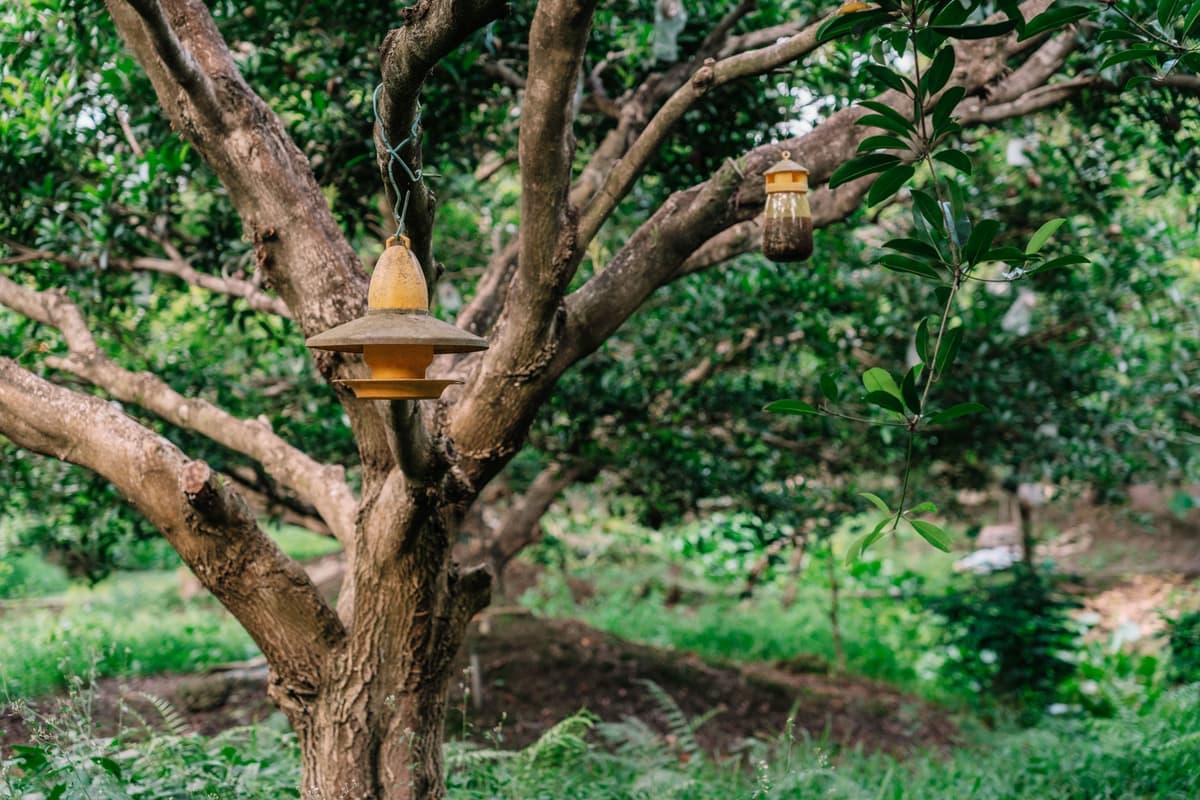
Hang the feeder five to six feet off the ground, about ten feet from trees and shrubs, and either within three feet of a window or more than thirty feet from one. Keep it at least seven feet — ten is safer — from any fence, wall, roof or branch a squirrel could jump from.
Seed & Sprig earns a commission when you buy through the links on this page, at no extra cost to you. It does not change which products we pick or the order we put them in — here is how we pick and here is how we are funded.
Placement is the highest-leverage free decision in backyard bird feeding. It decides whether birds feel safe enough to use the feeder, whether squirrels can reach it, and whether the birds you attract survive the visit. Four numbers cover it.
The 5-7-9 rule
The clearest published shorthand for squirrel placement is Duncraft's 5-7-9 rule, and it is worth learning because it maps onto the three ways a squirrel actually arrives:
- 5 feet from below. Squirrels ascend “to heights of 4 to 5 feet when lifting off from the ground,” so hang the feeder at least five feet up.
- 7 feet from nearby objects. “When leaping horizontally, squirrels can achieve a distance of about 7 feet,” so keep an obstacle-free perimeter of at least seven feet on every side.
- 9 feet from above. “A feeder is safe from aerial invasion as long as it is placed at least 9 feet below any tree branches.”
An honest caveat. Other retailers publish larger numbers: one recommends a pole system at least ten to twelve feet from any jumping-off point, with the top of the baffle four and a half feet up. Those figures do not agree with the seven in 5-7-9, and we are not going to pretend they do. Treat seven feet as the minimum anyone recommends and ten as the target if your yard can give it.
About ten feet from cover — the rule that sounds contradictory
Beginners get told two opposite things: put the feeder near cover so birds can escape hawks, and keep it away from cover so squirrels cannot jump across. Project FeederWatch resolves it in one line: place feeders close to natural cover, be careful not to place them too close to strong branches, and “a distance of about 10 feet seems to be a good compromise.”
Ten feet is close enough that a startled bird reaches a shrub in one flight, and far enough that a squirrel has to work for it.
Windows: under three feet, or over thirty
This is a safety rule and it is not optional. The American Bird Conservancy states that more than a billion birds die from collisions with glass every year in the United States.
The mechanism is speed. A feeder mounted right against the glass means a startled bird cannot build up enough speed for the impact to be fatal. A feeder more than thirty feet away means the reflected sky is not part of its escape route. In between is the dangerous zone — enough runway to hit hard. More on this, including what to do about the window itself, in keeping birds safe.
Where you can actually watch it from
The last distance nobody mentions. A feeder placed perfectly at the bottom of the garden where you never see it will not get refilled, cleaned or enjoyed. Put it where you already look — the kitchen window, the desk, the spot you drink coffee — and every other habit follows.
Hanging without a tree, on a fence, or up high
Most yards do not offer a perfect spot. Poles, brackets, deck rails and window mounts all have their own rules, and they are covered separately in hanging a feeder without a tree and balcony and small-space feeding.
The quick site survey
- Stand at the window you will watch from and pick a candidate spot.
- Look up. Any branch within about nine feet above it? Move.
- Look around. Fence, shed roof, wall, garden chair, washing line within seven to ten feet? Move, or accept that squirrels will reach it.
- Check the window distance — under three feet or over thirty.
- Check you can reach it to refill without a ladder.
If a spot fails one test, the window rule is the one to keep. If it fails the squirrel tests, read how to stop squirrels before you decide the yard is hopeless.
What we would buy for this
#1 · For getting the distances right
Squirrel Stopper Sequoia Pole System
Squirrel Stopper · Building the whole feeding station in one purchase
A steel pole with an integrated moving baffle and four hanging arms, and the closest thing to a complete answer, because it fixes the placement problem and the climbing problem at once.
Published specifications
- Pole
- 1.25" diameter, 16-gauge tubular steel
- Hanging stations
- 4 arms, 19" of clearance from the pole
- Height above ground
- Listed as 8 ft 2 in by some sellers and 7 ft 6 in by others — see note
- Baffle
- Integrated baffle that moves up, down and side to side
What it does well
- Four arms means seed, suet, nyjer and peanuts all run from one baffled pole
- The moving baffle defeats squirrels that would grip a fixed one
- Solves the real problem, which is placement, rather than only the feeder
What it does not
- Published height figures disagree between sellers (8 ft 2 in vs 7 ft 6 in), so measure before assuming it clears the 9-foot drop rule
- Needs 10 feet of clear space around it to work as advertised, which many small yards do not have
- The most expensive single item in a beginner setup
Specifications above come from the manufacturer's own published listing: Squirrel Stopper Sequoia published specifications (seller listing), Squirrel Stopper Sequoia specifications (second seller, conflicting height).
#2 · For the height rule
Erva SB1D Cylindrical (Torpedo) Squirrel Baffle
Erva · Pole-mounted feeders
A long steel cylinder a squirrel cannot get around or hug past, and the single most effective thing you can buy after the feeder itself.
Published specifications
- Length
- 16.75"
- Diameter
- 6.25"
- Type
- Pole-mounted cylindrical baffle
What it does well
- Length is what defeats a squirrel here: it cannot reach past the top
- Steel, so it survives winters and chewing
What it does not
- Useless if the pole sits within jumping distance of a fence, wall or branch
- Must be mounted high enough that a squirrel cannot leap over it entirely
Specifications above come from the manufacturer's own published listing: Erva SB1D published dimensions.
Common questions
How high should a bird feeder be?
About five to six feet from the ground. That clears the four-to-five foot standing jump Duncraft publishes for squirrels and keeps the feeder refillable without a ladder.
How far should a bird feeder be from a tree?
About ten feet, which Project FeederWatch calls a good compromise between escape cover for birds and jumping distance for squirrels. Also keep it nine feet below any overhanging branch.
How do I hang a bird feeder without a tree?
A pole, a deck bracket, a wall-mounted arm or a window feeder. Each has its own constraints — see the full guide.
How do I hang a heavy bird feeder?
Use heavy-gauge steel, not a decorative hook: a twelve-pound hopper plus feeder weighs more than most garden hangers are rated for. Check the rating and anchor the pole properly.