Feeder Types
Bird Buddy vs Birdfy
One is the polished product with a subscription attached. The other is cheaper and says its AI is free for life. That is most of the decision.
By Scooter M. · Published · Last updated
Birdfy costs substantially less and advertises lifetime free AI identification. Bird Buddy has the better camera and app, and its listings state that premium features need a subscription. Buy Birdfy to avoid recurring costs; buy Bird Buddy if image quality and the app experience matter most.
Seed & Sprig earns a commission when you buy through the links on this page, at no extra cost to you. It does not change which products we pick or the order we put them in — here is how we pick and here is how we are funded.
Quick picks
| # | Product | Best for | Price |
|---|---|---|---|
| 1 | 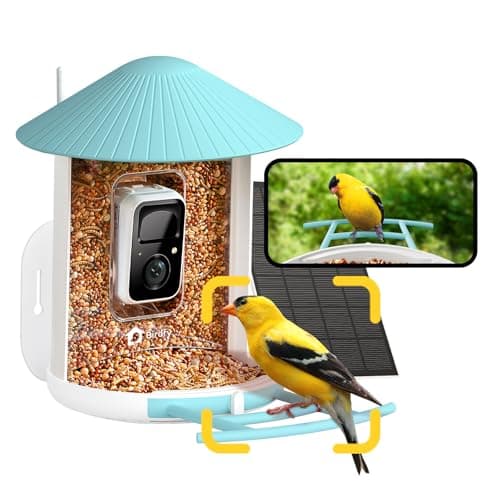 NETVUE Birdfy AI Smart Bird Feeder Camera, Solar Roughly half the price, solar, and the listing states lifetime free AI identification. | Better value | $149.99 · View on Amazon #ad How we are funded · Price as of September 21, 2026 |
| 2 | 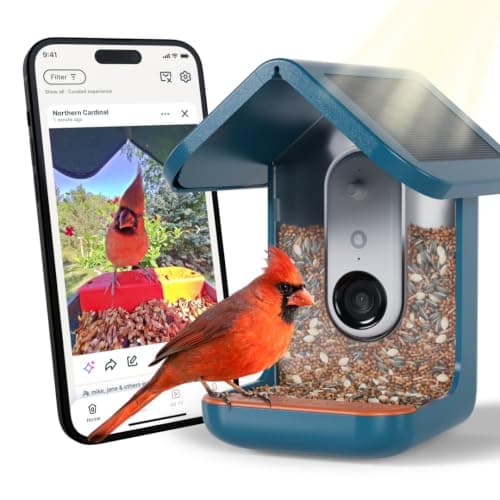 Bird Buddy Pro Solar Smart Bird Feeder 2K video and 5MP stills from a larger sensor, with premium app features on subscription. | Better camera | $239.99 · View on Amazon #ad How we are funded · Price as of September 21, 2026 |
| 3 | 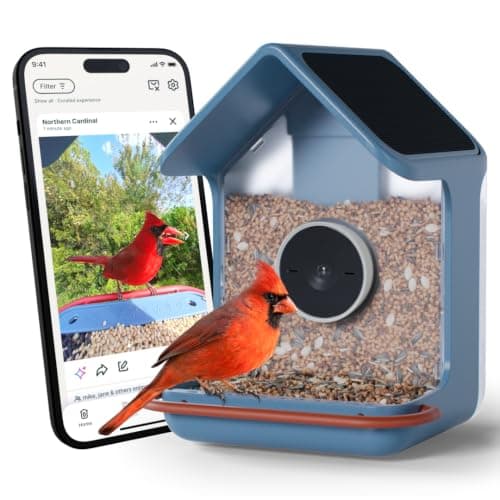 Bird Buddy Home Smart Bird Feeder Dual solar, 5 GHz Wi-Fi support and a simpler setup, at the highest price here. | Newest Bird Buddy | $299.00 · View on Amazon #ad How we are funded · Price as of September 21, 2026 |
| 4 | 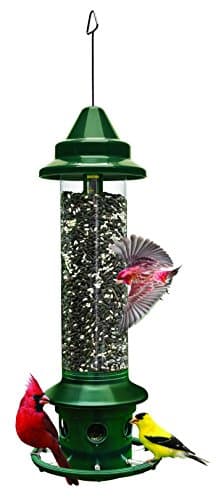 Brome Squirrel Buster Plus If the goal is more birds rather than photographs of them, this plus a baffle does more. | What to buy instead, for most people | $128.79 · View on Amazon #ad How we are funded · Price as of September 21, 2026 |
Rows link to the full write-up further down this page. The price button goes to Amazon.
These are the two names that come up in every smart feeder conversation, and the choice between them is unusually clean: Bird Buddy is the premium product with a subscription attached, and Birdfy is the cheaper one that makes a point of not requiring one.
Everything below comes from what the makers publish on their current listings. We have not tested either feeder, we do not have sample images to compare, and we are not going to invent a verdict on which app is nicer to use. Our wider camera feeder roundup covers the category, and our Bird Buddy review goes deeper on that product alone.
The short version
| Birdfy (NETVUE) | Bird Buddy Pro | Birdbuddy Home | |
|---|---|---|---|
| Price tier | Lowest | High | Highest |
| Camera | 1080p | 2K video, 5MP stills, larger sensor with HDR | Enhanced camera, landscape or portrait |
| Solar | Solar powered | Solar roof | Dual solar panel |
| Wi-Fi | 2.4 GHz, 5dBi antenna | 2.4 GHz | 2.4 and 5 GHz |
| AI identification | Listed as lifetime free | Premium subscription required, per the listing | Premium membership for the full experience |
| Cloud storage | 3 months free, per the listing | Tiered | Tiered |
If you read one row, read the AI identification row. It is the difference that compounds every month you own the thing.
How we compared them
On published listing specifications only, checked against live listings in September 2026 so that every model here is currently purchasable. No hands-on testing, no photo samples, no claims about which app feels better — this site does not run a product lab and will not pretend otherwise. Where the makers describe the same feature in different language, we quote each one rather than flattening them into a false equivalence. Our full criteria are here.
One warning that applies to this whole category: subscription terms move. The paragraph below is what the listings say today, and it is the thing most likely to be out of date when you read this.
The subscription question, stated carefully
Bird Buddy's current Pro listing states plainly that the AI-powered app features — species identification, recognizing individual birds, detecting signs of illness, alerts — require a premium subscription. The Home listing frames the AI experience around premium membership in the same way. The hardware works; the intelligence is the paid layer.
Birdfy's listing takes the opposite position as its headline: lifetime free AI identification, no subscription for species ID, with three months of cloud storage included. Cloud storage beyond that is a paid tier, which is the part people miss — free AI is not the same as free everything.
That is a genuine and substantial difference, and it is also exactly the kind of term that changes with a firmware update or a new pricing page. Our standing advice in this category has not changed: check the maker's own current terms on the day you buy, and do not rely on any review's description of a free tier, including this one.
Camera quality, as published
Bird Buddy Pro publishes 2K video and 5MP stills from a sensor it describes as twice the size of the previous generation, with HDR. Birdfy's classic model publishes 1080p. On paper that is a clear win for Bird Buddy, and it is the main thing the extra money buys.
How much it matters depends on what you do with the images. For identifying what landed on the perch, 1080p is plenty. For photographs you want to crop, print or post, the higher resolution and the bigger sensor are real advantages, particularly in poor light — which, since birds feed at dawn and dusk under a roof that shades the perch, is most of the time.
The Birdbuddy Home adds a choice of landscape or portrait framing and a claim of improved low-light performance, alongside support for 5 GHz Wi-Fi. That last one is more practical than it sounds: if your router is dual-band and your yard is at the edge of coverage, a feeder that can only see 2.4 GHz is occasionally a genuine problem.
The things neither maker leads with
Three points apply to both, and they are the reasons people end up disappointed rather than the specifications.
Capacity is small. These are small feeders with a camera in them. Neither holds the seed a plain hopper does, so in a busy yard you are refilling often, and the feeder is mounted wherever the Wi-Fi and the light are good rather than wherever the birds prefer.
Squirrels are unaffected. Neither has a weight mechanism or a cage. A camera feeder on a hook is a squirrel feeder with a camera, and an expensive one. A baffled pole is not optional if squirrels are active where you live.
Cleaning matters more, not less. Electronics do not exempt a feeder from hygiene, and a camera feeder is fiddlier to strip than a tube. Plan for the same weekly or fortnightly routine — our cleaning guide covers it — and check how the camera module detaches before you buy.
Power, and what solar actually means
All three models here are solar, and the word is doing more work in the marketing than in the yard.
Solar on a bird feeder means a small panel trickle-charging an internal battery, not a feeder that runs independently of you. In long summer days, in a spot that gets real sun, it can genuinely keep up. In a shaded corner under a tree — which is where birds prefer to feed, and where you are most likely to hang a feeder — it will not, and you will be bringing the camera indoors to charge.
Birdbuddy Home publishes a dual solar panel, which is the clearest hardware response to that problem; the Pro has a solar roof; Birdfy's classic model is sold as solar powered with the panel on top. None of them escapes the basic trade: the sunniest spot and the best bird-watching spot are rarely the same place. Plan on charging the camera periodically through winter whichever you buy, and check how the module detaches before you commit, because you will be doing it in the cold.
Mounting, and the thing both makers skip
Bird Buddy's listing walks through pole, wall and strap mounting; Birdfy's feeder hangs or straps to a trunk in the same way. What neither addresses is that a camera feeder is an expensive object hanging in a place squirrels can reach.
A strap around a tree trunk is the worst option available on that score: it puts the feeder on a squirrel highway, in the shade, against bark that holds damp. A pole in the open with a baffle is the best, and it also gives you a clean background for the photographs — which is the entire point of buying one of these.
Do the Wi-Fi check before you dig a hole, though. Stand where the feeder will go with a phone and see what the signal does. A camera feeder at the far corner of a yard with two bars is a stream that buffers and a device that drains its battery retrying. That is the practical case for the Home's 5 GHz support if your router is dual-band and your house sits between the two.
What the identification actually does
Both makers lead with AI species identification, and it is the feature people enjoy most and understand least.
In practice it is image recognition on the clips the camera captures: the app names the bird, logs the visit and builds a list over time. Birdfy's listing claims identification across thousands of species; Bird Buddy's describes recognizing species and individual birds, spotting other animal visitors, and flagging signs of illness. Neither is a scientific instrument — common birds are identified reliably, and unusual angles, fast-moving birds and poor light produce misses and wrong answers.
That matters for two reasons. If you are a beginner, the identification is genuinely educational and will teach you your local birds within a season. If you are recording observations seriously, treat the app as a prompt rather than a record, and confirm anything unusual yourself. And remember which side of the paywall it sits on for each brand, because identification is the feature you would miss most if it stopped.
Which one suits which buyer
- You want to know what visits, and you hate subscriptions: Birdfy. The lifetime-free AI claim is the whole argument, and at roughly half the price the calculation is not close.
- You want photographs worth keeping: Bird Buddy Pro. The larger sensor and 2K video are the published difference, and image quality is the one thing you cannot fix later with a subscription.
- Marginal Wi-Fi, or you want the newest hardware: Birdbuddy Home, for the dual-band support and the revised setup.
- You mainly want more birds: neither. A good feeder, a baffled pole and better seed will do more for what lands in your yard than any camera, for less money. That is not a rhetorical flourish; it is what we recommend to beginners.
Capacity, and living with one
Both of these are small feeders. That is a design constraint rather than an oversight — the camera needs the bird at a fixed distance and angle, which means a perch and a shallow tray rather than a deep hopper.
In a quiet yard that is fine. In a busy one, expect to refill every couple of days, and expect the refill to be more awkward than on a normal feeder because you are working around a camera module you would rather not knock about. Neither maker publishes a seed capacity in pounds on the listings we checked, which is itself telling: capacity is not what they are selling.
Two habits make ownership easier. Keep a small container of seed near the door rather than hauling a sack out, since you will be doing this often — a pour container is ideal. And settle on one seed rather than a mix: a camera feeder full of a filler-heavy mix produces endless clips of birds flicking rejected millet onto the ground, which is neither good viewing nor good value.
The gift question
A large share of smart feeders are bought as presents, and that changes the advice slightly. A subscription-dependent product is an awkward gift: the recipient discovers the recurring cost after unwrapping it, and the feature they were shown in the advertisement is the one behind the paywall. If you are buying for someone else, the model with fewer strings attached is usually the kinder choice, whatever the camera specification says.
Either way, buy the baffle and pole with it. A camera feeder hung from a shepherd's hook in squirrel country will be on the ground within a month, and the gift becomes a chore.
Where we land
For most people asking this question, Birdfy is the better purchase: it costs substantially less, it is solar, and identification — the feature that makes these feeders fun — is advertised as free for life. Bird Buddy earns its premium only if you care about image quality specifically, in which case the Pro's published sensor and 2K video are a real, checkable advantage rather than a marketing claim.
And the honest caveat we apply to the whole category: these are entertainment products. They photograph birds beautifully and they feed them adequately. If your yard is quiet, a camera will document the silence in high definition — fix the placement, seed and squirrel situation first, and the camera becomes worth having.
The picks in full
#1 · Better value
NETVUE Birdfy AI Smart Bird Feeder Camera, Solar
NETVUE · The main Bird Buddy alternative, usually for less money
The other serious name in the category: solar, automatic capture, and a species library the listing puts at 6000+ — generally cheaper than the equivalent Bird Buddy.
Published specifications
- Camera
- AI camera with auto capture, per the listing
- Power
- Solar powered
- Identification
- Listing claims 6000+ bird species
- Storage
- Cloud storage offered; terms change, check current
- Seed capacity
- Not published on the listing
What it does well
- Usually undercuts Bird Buddy for a comparable feature set
- Auto-capture means you are not relying on catching birds live
- Solar, so no battery routine
What it does not
- Cloud storage and AI features sit behind plans that change — read the current terms, not a review's
- Listing does not publish seed capacity
- Squirrels treat it like any other unbaffled hanging feeder
Specifications above come from the manufacturer's own published listing: NETVUE Birdfy — published listing (solar, AI capture, species count).
#ad How we are funded · Price as of September 21, 2026
#2 · Better camera
Bird Buddy Pro Solar Smart Bird Feeder
Bird Buddy · The camera feeder to buy if the photos are the point
The reference smart feeder: a 2K camera in a proper feeder body with a solar roof, and the one whose bird identification most people are actually buying.
Published specifications
- Camera
- 2K video, per the listing
- Power
- Solar roof included on this configuration
- Identification
- AI bird ID
- Seed capacity
- Not published on the listing
- Subscription
- Free tier exists; extended features are paid — check current terms
What it does well
- The best-known name in the category, which matters for app support and species data
- Solar roof removes the recharging chore that kills most camera feeders
- It is a real feeder, not a camera bolted to a box
What it does not
- The most expensive way to feed birds by a wide margin — a tube feeder and a baffle costs a fraction
- Amazon's listing does not publish seed capacity, and it is small compared with an ordinary hopper
- Feature tiers change; confirm what the free tier includes before you buy on that basis
Specifications above come from the manufacturer's own published listing: Bird Buddy Pro — published listing (camera, solar, AI ID).
#ad How we are funded · Price as of September 21, 2026
#3 · Newest Bird Buddy
Bird Buddy Home Smart Bird Feeder
Bird Buddy · The bigger-capacity Bird Buddy, if the Pro runs dry too fast
The same platform with a dual solar panel, sold at the top of the range — worth it only if you have already decided the Bird Buddy app is what you want.
Published specifications
- Camera
- Smart camera with AI bird ID, per the listing
- Power
- Dual solar panel
- Seed capacity
- Not published on the listing
What it does well
- Dual solar is the fix for shaded yards where a single panel struggles
- Same app and species data as the rest of the range
What it does not
- The most expensive feeder on this site by some distance
- Listing does not publish capacity or dimensions, so you are buying on brand
Specifications above come from the manufacturer's own published listing: Bird Buddy Home — published listing (dual solar, AI ID).
#ad How we are funded · Price as of September 21, 2026
#4 · What to buy instead, for most people
Brome Squirrel Buster Plus
Brome · The one feeder to buy if you only buy one
A weight-closing tube feeder with a large capacity and a cardinal ring, and the closest thing to a genuinely squirrel-resistant feeder that a beginner can hang up and stop thinking about.
Published specifications
- Seed capacity
- 5.1 lb
- Height
- 28" base to hanger
- Feeding ports
- 6, plus a cardinal ring
- Mechanism
- Weight-adjustable spring shroud
- Materials
- Chew-proof, UV-resistant components
- Warranty
- Brome Lifetime Care
What it does well
- The spring tension is adjustable, so you can shut out heavy birds as well as squirrels
- Comes apart by hand for cleaning, which means it actually gets cleaned
- 5.1 lb is enough that a busy fall week does not mean daily refills
What it does not
- The most expensive feeder in this roundup by a wide margin
- The shroud collects seed dust and needs a full strip-down every couple of weeks
- A squirrel that can reach the top hanger still wins, so this is not a substitute for a baffle
Specifications above come from the manufacturer's own published listing: Brome — Squirrel Buster Plus (manufacturer store).
#ad How we are funded · Price as of September 21, 2026
Common questions
Is Birdfy or Bird Buddy cheaper?
Birdfy, by a wide margin at current listing prices, and its listing advertises lifetime free AI identification. Bird Buddy's listings state that premium app features require a subscription.
Which has the better camera?
Bird Buddy Pro, on published specifications: 2K video and 5MP stills from a larger sensor with HDR, against 1080p for the classic Birdfy.
Does Bird Buddy require a subscription?
The hardware works without one, but the current Pro listing states that the AI-powered app features need a premium subscription. Terms change, so check the maker's site on the day you buy.
Are smart bird feeders squirrel proof?
No. Neither of these has a weight mechanism or a cage. Mount one on a baffled pole or expect squirrels to use it.
Do these feeders need Wi-Fi in the yard?
Yes, and it is the most common setup complaint. Birdfy and Bird Buddy Pro use 2.4 GHz; the newer Birdbuddy Home also supports 5 GHz, which helps on dual-band networks.