Care & Season
Grackles, starlings and the birds you did not want
A flock arrives, the feeder is empty by noon, and the chickadees have gone. There are four fixes and they all work by exclusion.
By Scooter M. · Published · Last updated
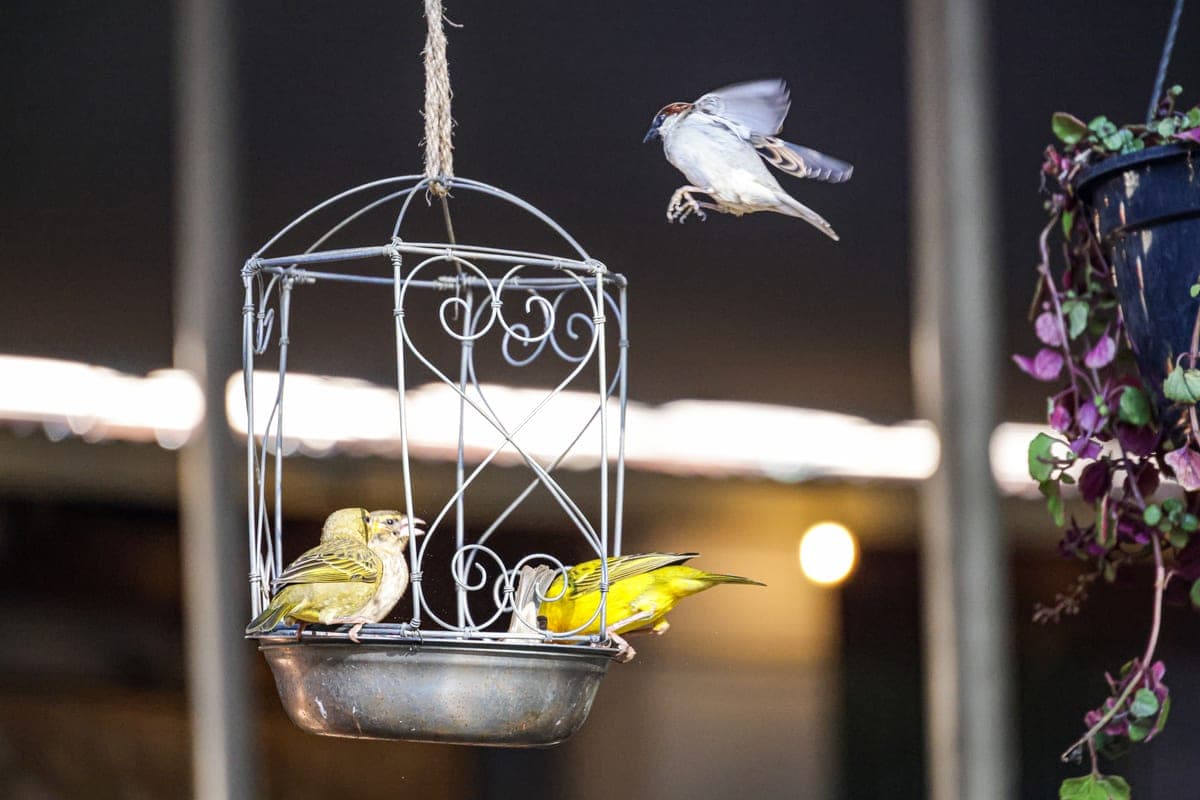
Exclusion, not deterrence. Project FeederWatch recommends tube feeders with short perches and no catch basins, weight-closing feeders, cage-surrounded feeders, and suet cages that open only from the bottom — plus avoiding platform trays and not spreading food on the ground.
Seed & Sprig earns a commission when you buy through the links on this page, at no extra cost to you. It does not change which products we pick or the order we put them in — here is how we pick and here is how we are funded.
The pattern is always the same. The feeder runs quietly for a few weeks, then a flock finds it — grackles in spring, starlings in autumn, house sparrows any time, pigeons if you are in a town — and within days the feeder is emptied by lunchtime and the small birds you actually wanted have stopped coming.
The important thing to understand is that nothing has gone wrong. A feeder is a reliable concentrated food source, and these are the species best at exploiting exactly that. You are not going to persuade them to be reasonable. You are going to make the food physically unreachable, which is the only approach that holds.
The four methods that work
Project FeederWatch's guidance for anyone whose feeders are overrun by grackles, starlings, pigeons or crows is specific, and every method is exclusion by size, weight or geometry.
| Method | Excludes | You also lose |
|---|---|---|
| Tube feeder, short perches, no catch basin | Grackles, jays, doves, starlings | Cardinals and jays — the same trade |
| Weight-closing feeder | Anything heavy, tunable | Set it too light and cardinals go too |
| Cage-surrounded feeder | Everything bigger than the mesh | Cardinals permanently — a cage cannot be tuned |
| Suet cage open only from below | Starlings, mostly | Very little — the best-value fix here |
| Removing trays and ground seed | Flocks that feed shoulder to shoulder | Juncos, doves and sparrows you may want |
Read the right-hand column before buying anything, because it is where the regret lives. There is no method that removes grackles and keeps cardinals, since a grackle and a cardinal are close enough in size and weight that no mechanism separates them cleanly. The weight-versus-cage comparison covers that trade in detail.
Start by taking the tray away
The cheapest fix costs nothing and most people resist it. FeederWatch's advice for an overrun feeder is to avoid platform trays and not to spread food on the ground, and the reason is mechanical: a flock feeds shoulder to shoulder, and only an open surface lets it do that. A tube with four ports admits four birds; a tray admits fifteen.
So before spending anything: take down the tray, stop scattering, and clear what is already on the ground. In a lot of yards that alone breaks the pattern, because the flock moves to whichever neighbor still has an open surface.
The cost is real, though — you lose juncos, doves and towhees at the same time, since those are the birds that need a flat surface. Ground feeding has its own page, including when not to do it, and the honest sequence is: remove the tray while the flock is around, put it back when they have moved on.
Then change what is in the feeder
Food selection does a surprising amount of work here, and it is cheaper than hardware.
Safflower is the classic swap. FeederWatch notes that safflower attracts cardinals and other big-billed birds, and it is much less popular with grackles and starlings — so it keeps the bird most people want while thinning the flock. It also costs more per pound and attracts fewer species overall, which is the trade. The full safflower picture is here.
Nyjer is the answer to a house sparrow problem specifically. FeederWatch's guidance on house sparrows is that small finches will come to nyjer feeders with perches and ports too small for house sparrows, whose larger bodies and bills make it awkward — and that switching to foods less desirable to them, such as nyjer, suet and fruit, is one way to discourage them.
Cheap mixes are the thing to stop buying. Cracked corn attracts doves, quail and sparrows, per FeederWatch, and milo is a major component of inexpensive mixes that most birds will not eat. A bargain bag is close to a purpose-built flock attractant. How to read the panel is here.
The suet fix, which is the best value on this page
If starlings are the problem, there is one change that reliably works and costs the price of a cheap feeder. FeederWatch's guidance is to provide suet in starling-proof feeders — feeders that allow access to the suet only from the bottom.
Woodpeckers, nuthatches and chickadees hang underneath without difficulty, because hanging upside down is ordinary behavior for all three. Starlings largely cannot manage it. Unlike every other method here, this one costs you almost nothing in wanted birds — the only real drawback is that some woodpeckers take a week to work it out. Suet feeder picks are here.
The trick with the washers
One genuinely odd method is worth mentioning because it comes from FeederWatch rather than from folklore. Its house sparrow material reports that hanging washers from feeder ports deterred sparrows, while blue jays, cardinals, chickadees, woodpeckers and nuthatches appeared unaffected.
We have not tried it and we are not going to claim it works in your yard. But it is free, it is reversible, and it comes from a real observation rather than a product page, which puts it well ahead of anything with a plastic owl in it. The FeederWatch write-up is here.
What about just taking the feeders down?
It is the nuclear option and it does work. A fortnight with no food breaks the habit for the flock, which moves on to a more reliable source, and you can restart with the tray removed and a different seed.
It also breaks the habit for your chickadees, and you will spend a few weeks earning them back. Worth it when a flock has genuinely taken over, and disproportionate when you have seen three grackles twice. Consider it the last item on the list rather than the first.
The hygiene reason this matters
Crowded feeders are not only annoying, they are the condition under which disease spreads between birds. That is the real argument for dealing with a flock rather than waiting it out, and it is the argument for cleaning more often while one is around: FeederWatch asks for cleaning every week or two, and more often in heavy use — which is exactly what a flock is. The cleaning routine is here.
The ground matters as much as the feeder while a flock is present. A dozen large birds feeding at once put down a great deal more than a few chickadees do, and the accumulation underneath is the part people forget. Rake and clear it more often than usual for as long as the flock is around, and be aware that the spillage brings its own second problem after dark.
It is usually seasonal
Knowing this changes how much you should spend on it, because a lot of these invasions resolve without any intervention at all.
Grackles are the spring and early-summer problem across much of the country — they arrive in numbers, they are noisy and conspicuous, and they thin out again. Starlings are more of an autumn and winter flocking issue, when they band together and move around. House sparrows are the year-round one, and pigeons are a function of where you live rather than the season.
So the question worth asking before buying anything is: has this been going on for weeks, or days? A flock that has been present for three days in April may simply be passing through, and the cheap interventions — take the tray down, stop the cheap mix, clear the ground — are enough to make your yard less attractive than the next one while they move on. Buying a cage feeder in week one is how people end up excluding cardinals for years to solve a fortnight.
Do not try to solve this with poison or trapping
It comes up, and it is worth being direct. Trapping or killing birds is not a feeder problem and it is not something we will give instructions for; wildlife law in the United States protects native species and the rules differ by state and by species. If you have reached the point of considering it, the proportionate answer is to take the feeders down for a fortnight — which is free, immediate, entirely legal, and works.
The same goes for anything sold as a chemical bird deterrent for feeders. There is no product that repels a grackle and not a chickadee, for the same reason there is no feeder mechanism that does: they are birds, and they are not different enough.
The order we would actually do it in
- Take the tray off and clear the ground. Free, immediate, and it is the single biggest change to how many birds can feed at once.
- Stop buying the cheap mix. Corn and milo are close to a flock attractant. Read the panel.
- Switch the seed to safflower if cardinals are what you are protecting, or nyjer if it is a house sparrow problem.
- Fix the suet with an underneath-access cage, if starlings are the species involved. Cheapest real win on this page.
- Only then buy hardware — a short-perch tube, a weight-closing feeder or a cage — and buy it knowing exactly which birds you are giving up.
Most yards stop at step three, which is the point of doing them in this order.
What we would buy for this
#1 · Best first move
Droll Yankees Onyx Clever Clean 18" Sunflower Tube Feeder
Droll Yankees · A plain, well-made first tube feeder
A straightforward polycarbonate tube whose base twists off in seconds, which is the single feature that decides whether a feeder gets cleaned or quietly turns into a health problem.
Published specifications
- Seed capacity
- 2 lb
- Height
- 18"
- Feeding ports
- 4
- Materials
- UV-stabilized polycarbonate tube; powder-coated metal cap, base and ports
- Cleaning
- Twist-and-release removable base; one-touch top opening
What it does well
- The removable base turns cleaning from a chore into a two-minute job
- Metal ports resist squirrel chewing better than all-plastic tubes
- Short perches keep grackles and jays off without excluding finches
What it does not
- No squirrel mechanism at all, so this feeder needs a baffle or a pole
- Four ports fill up quickly at a busy station
Specifications above come from the manufacturer's own published listing: Droll Yankees Onyx Clever Clean published specifications.
#2 · Best cage-style feeder
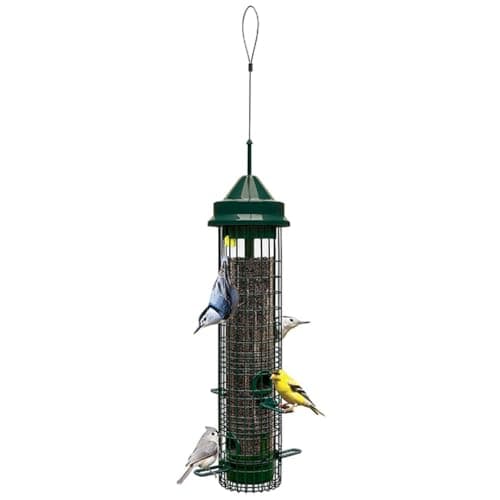
Brome Squirrel Buster Classic
Brome · Clinging birds and mixed flocks in a smaller yard
The same weight-closing mechanism as the Plus wrapped in a wire mesh shroud, which lets clinging birds feed anywhere on the cage instead of queueing for a port.
Published specifications
- Seed capacity
- 2.4 lb
- Feeding ports
- 4, plus a wire mesh shroud
- Mechanism
- Weight-closing shroud
- Dimensions
- Not published by Brome
What it does well
- The mesh shroud suits chickadees, nuthatches and woodpeckers that prefer to cling
- Half the capacity of the Plus but noticeably cheaper
What it does not
- 2.4 lb empties fast once a flock finds it
- Mesh is fiddlier to clean than a smooth shroud
Specifications above come from the manufacturer's own published listing: Brome — Squirrel Buster Classic (manufacturer store).
#ad How we are funded · Price as of October 22, 2026
#3 · Best starling-proof suet
Nature's Way Upside-Down Suet Feeder (CWF2)
Nature's Way · Keeping starlings off the suet
Suet reachable only from underneath, which woodpeckers, nuthatches and chickadees manage easily and starlings mostly do not.
Published specifications
- Dimensions
- 8.5" L x 8.5" W x 4.13" H
- Capacity
- 1 suet cake (8 oz)
- Materials
- Premium cedar with rust-free hardware
What it does well
- Genuinely reduces starling monopolies without excluding the birds you want
- The roof shades the cake, which slows melting
What it does not
- Some woodpeckers take a week to work it out
- Not squirrel-resistant in any way
Specifications above come from the manufacturer's own published listing: Nature's Way CWF2 published specifications.
#4 · Best seed switch
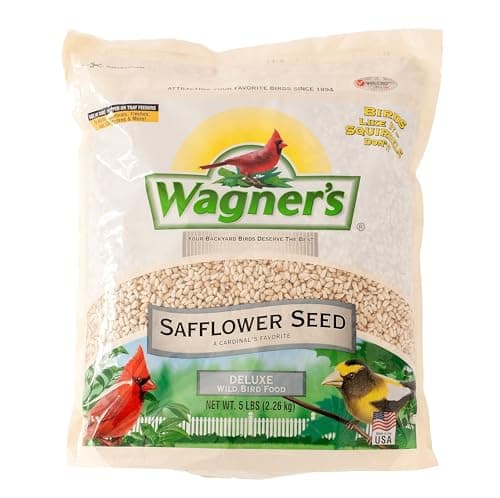
Wagner's Safflower Seed
Wagner's · Cardinals, when squirrels have taken over
A single-ingredient seed cardinals and finches take readily and squirrels usually leave alone, which is the closest thing to a no-hardware squirrel answer, with an honest caveat.
Published specifications
- Ingredients
- 100% safflower seed
- Crude protein
- 17.0%
- Crude fat
- 25.0%
- Crude fiber
- 32.0%
- Moisture
- 13.0%
What it does well
- Cardinals, house finches, chickadees and titmice all eat it
- Most squirrels prefer sunflower and will move on if safflower is all there is
What it does not
- 'Squirrels do not like safflower' is a tendency, not a law — hungry squirrels eat it
- Costs more per pound than black oil sunflower and attracts fewer species
Specifications above come from the manufacturer's own published listing: Wagner's safflower published analysis.
#ad How we are funded · Price as of October 22, 2026
#5 · Best for a sparrow problem
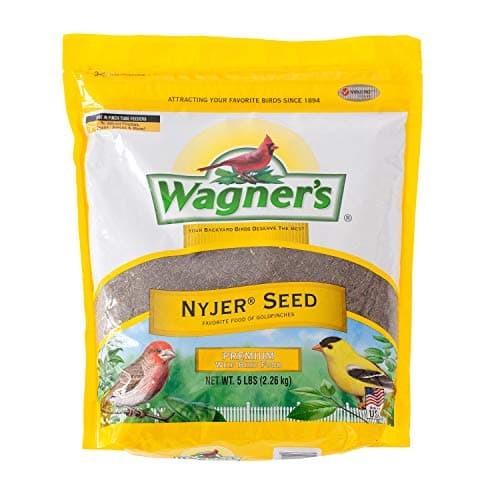
Wagner's Nyjer Seed
Wagner's · Goldfinches and nothing else
Straight nyjer, which is the only thing a finch feeder should ever be filled with. Buy the smallest bag that suits your traffic, because it goes stale.
Published specifications
- Ingredients
- 100% nyjer seed
- Crude protein
- 13.5% min
- Crude fat
- 8.0% min
- Crude fiber
- 7.0% max
- Moisture
- 15.0% max
- Ash
- 4.25% max
What it does well
- The seed that reliably brings in American Goldfinch, Pine Siskin and Common Redpoll
- Too small for most other birds, so a nyjer feeder stays a finch feeder
What it does not
- Expensive per pound and it dries out; old nyjer is the most common reason a finch feeder sits ignored
- Needs its own narrow-port feeder or most of it lands on the ground
Specifications above come from the manufacturer's own published listing: Wagner's nyjer published analysis, Project FeederWatch — nyjer and finches.
#ad How we are funded · Price as of October 22, 2026
Common questions
How do I keep grackles off my bird feeder?
Exclusion. FeederWatch recommends tube feeders with short perches and no catch basins, weight-closing feeders, or feeders surrounded by mesh — and removing platform trays and ground seed. Expect to lose cardinals from that feeder too.
How do I keep starlings off my suet feeder?
Use a suet feeder that allows access only from the bottom. It is FeederWatch's specific recommendation, and it costs you almost nothing in the birds you want.
How do I discourage house sparrows?
Switch to foods they find less desirable — FeederWatch names nyjer, suet and fruit — and use finch feeders whose perches and ports are too small for them.
Do fake owls or shiny tape keep birds off feeders?
Not for long. Birds habituate within days, and while it works it frightens the birds you wanted as well. Every method that lasts works by physical exclusion.
Will safflower keep grackles away?
It thins them out. FeederWatch notes safflower attracts cardinals and other big-billed birds; grackles and starlings are much less keen. It is a preference shift rather than a barrier.