Bird Seed
What it actually costs to feed birds
Nobody can tell you the number. Everybody can teach you to calculate it, and almost nobody does.
By Scooter M. · Published · Last updated

Your running cost is refills per month multiplied by feeder capacity multiplied by the price per pound of seed. A 2 lb tube refilled twice a week uses about 17 lb a month; a 12 lb hopper refilled fortnightly uses about 24 lb. Capacity does not change consumption — the birds do.
Seed & Sprig earns a commission when you buy through the links on this page, at no extra cost to you. It does not change which products we pick or the order we put them in — here is how we pick and here is how we are funded.
“How much does it cost to feed birds” is a real search, and every answer to it you will find is a made-up number. It has to be: the answer depends on how many birds visit you, which feeder you own, what seed you buy and where you buy it. So instead of inventing a figure, here is the arithmetic, which will still be right in five years.
The formula
Monthly seed use = refills per month × feeder capacity in pounds.
Monthly cost = monthly seed use × price per pound.
That is it. The only number you have to observe is how often you actually refill, which takes about three weeks of paying attention.
Worked examples, using published capacities
| Setup | Capacity | Typical refill | Seed per month |
|---|---|---|---|
| Small tube (Droll Yankees 12 in) | 1 lb | Every 3 days | About 10 lb |
| Standard tube (Droll Yankees 18 in) | 2 lb | Twice a week | About 17 lb |
| Weight-closing feeder (Squirrel Buster Plus) | 5.1 lb | Weekly | About 22 lb |
| Large hopper (Woodlink Absolute II) | 12 lb | Fortnightly | About 24 lb |
| Window feeder (Aspects Window Cafe) | 3/4 qt | Weekly | About 3 qt |
The refill intervals in that table are illustrative — they are the pattern of a moderately busy station, not a measurement of your yard. Substitute your own and the arithmetic holds.
The thing the table shows that surprises people
A twelve-pound hopper does not cost six times what a two-pound tube costs. Birds eat what they eat; capacity changes how often you walk outside, not how much they consume. What capacity actually buys you is your own time — and it costs you seed freshness, because twelve pounds sitting in damp weather for a fortnight is a mold risk that a two-pound tube never has.
Cost per edible pound
This is the number to compare bags on, and it is not the shelf price:
- Black oil sunflower in shell — roughly a third of the weight is shell, so you are buying about two-thirds food. It is still usually the cheapest per pound eaten, because it is so cheap per pound bought.
- Hulled no-mess mixes — close to all of the bag is edible, which closes much of the price gap.
- Filler-heavy bargain mixes — the worst value on this list. You pay for the milo, then you rake it up. See what is in the bag.
The costs that are not seed
- Hardware, once. Feeder, pole, baffle, brush. It is the largest single outlay and it is not recurring — a steel baffle outlives every feeder you hang on it.
- Replacement, if you buy badly. Plastic feeders get chewed. This is the hidden cost of a cheap first purchase.
- Squirrels. Genuinely a line item. An unbaffled feeder in a squirrel yard can double your seed use, which is the strongest financial argument for a baffle.
- Waste. Seed thrown out because it spoiled in storage — avoidable.
Three ways to spend less without feeding less
- Buy single-ingredient seed. Nothing you pay for gets discarded.
- Baffle the feeder. The cheapest way to stop losing seed to squirrels is to stop the squirrels.
- Buy the right bag size and store it properly. Bulk is only cheaper if you get through it before it turns.
What we would buy for this
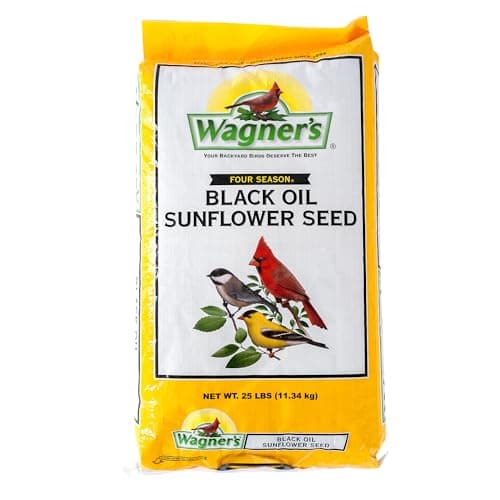
#1 · Lowest cost per bird fed
Wagner's Black Oil Sunflower Seed
Wagner's · The first bag of seed you should buy
One hundred percent black oil sunflower with nothing else in the bag, which is the seed the widest range of feeder birds actually eats, at the lowest cost per bird you will find.
Published specifications
- Ingredients
- 100% black oil sunflower
- Crude protein
- 14.0% min
- Crude fat
- 24.0% min
- Crude fiber
- 35.0% max
- Moisture
- 15.0% max
What it does well
- One ingredient, so there is nothing in the bag birds will throw on the ground
- Cardinals, chickadees, finches and sparrows all take it
- The cheapest way to fill a feeder that birds will actually empty
What it does not
- The hulls make a mess under the feeder and can kill the grass
- Squirrels like sunflower as much as birds do
Specifications above come from the manufacturer's own published listing: Wagner's Four Season black oil sunflower published analysis, Project FeederWatch — seed preferences.
#ad How we are funded · Price as of October 22, 2026
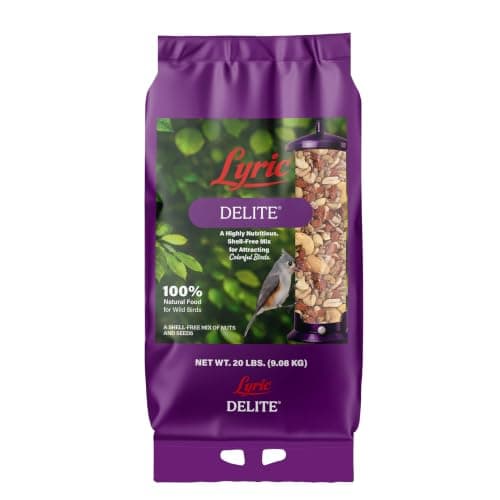
#2 · Lowest waste per pound
Lyric Delite No Waste Mix
Lyric · The genuinely filler-free no-mess bag
Shelled peanuts, sunflower kernels, pecans, pistachios and pumpkin seed: an expensive bag with no corn, no millet and nothing that ends up on the ground.
Published specifications
- Ingredients
- Shelled peanuts, sunflower kernels, pecans, pistachios, shelled pumpkin seed
- Crude protein
- 20% min
- Crude fat
- 35% min
- Crude fiber
- 10% max
- Moisture
- 12% max
What it does well
- No corn, no millet, no milo — nothing in the bag is filler
- Shell-free seed will not sprout under the feeder
- The highest fat content of any mix here, which matters in cold weather
What it does not
- Expensive per pound, though far less of it is wasted
- Nut-heavy mixes are exactly what squirrels want most
Specifications above come from the manufacturer's own published listing: Lyric Delite published ingredients and analysis.
#ad How we are funded · Price as of October 22, 2026
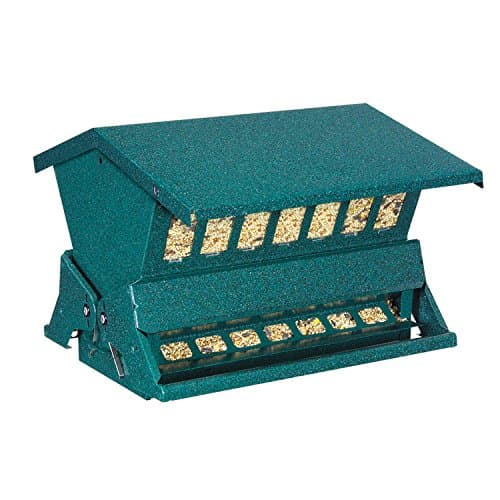
#3 · Fewest refill trips
Woodlink Absolute II (model 7536)
Woodlink · Big capacity and cardinals — the hopper answer to squirrels
A double-sided steel hopper whose counterweighted perches drop a shield over the seed tray when something heavy lands, and it holds twelve pounds so it barely needs attention.
Published specifications
- Seed capacity
- 12 lb
- Dimensions
- 16" W x 11.25" H x 13.5" D
- Feeding ports
- 6 (both sides)
- Mechanism
- Two counterbalanced perches, adjustable to three weight settings
- Materials
- Steel and acrylic
What it does well
- 12 lb capacity means refills measured in weeks, not days
- Perch tension adjusts for light, medium or heavy birds
- The long perch rail suits cardinals, which will not use a small tube port
What it does not
- Twelve pounds of seed is heavy, so the hook or pole has to be rated for it
- Seed sitting for weeks in wet weather is how mold starts; a big hopper needs the same cleaning discipline as a small one
Specifications above come from the manufacturer's own published listing: Woodlink Absolute II published specifications.
#ad How we are funded · Price as of October 22, 2026
Common questions
How much does it cost to feed birds each month?
It depends entirely on your traffic and your seed. Use the formula: refills per month × feeder capacity × price per pound. Three weeks of watching gives you the refill number.
Does a bigger feeder cost more to run?
No. Birds eat what they eat. A bigger feeder means fewer trips outside, not more seed consumed — though it does raise the risk of seed spoiling before it is eaten.
Is cheap bird seed a false economy?
Usually. A mix padded with milo, red millet or cracked corn is partly weight you rake up. Compare cost per edible pound, not per pound.
How much seed do squirrels cost me?
Enough to be a real line item — an unbaffled feeder in a squirrel-heavy yard can go through markedly more seed. A baffle usually pays for itself in a season.