Squirrels
Chipmunks, and why your squirrel setup does not stop them
Three ounces, ground-dwelling, and small enough to walk through a cage built for small birds. A different animal needs a different answer.
By Scooter M. · Published · Last updated
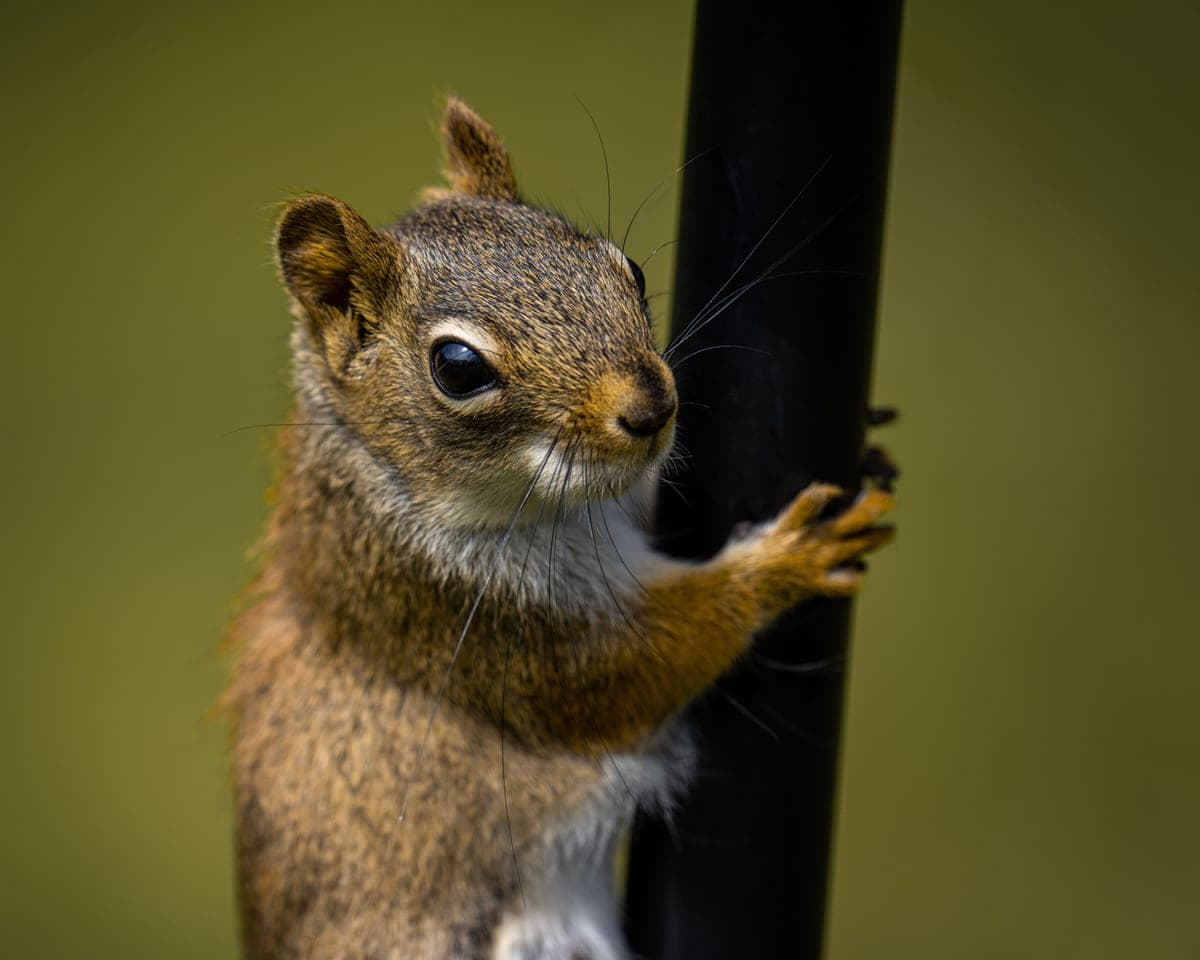
Chipmunks defeat most anti-squirrel hardware because they are too light to trigger weight-closing feeders and small enough to pass through cage mesh. The fix is a tall baffled pole set well away from cover, a catch tray under the feeder, and keeping the ground clear.
Seed & Sprig earns a commission when you buy through the links on this page, at no extra cost to you. It does not change which products we pick or the order we put them in — here is how we pick and here is how we are funded.
Quick picks
| # | Product | Best for | Price |
|---|---|---|---|
| 1 | SSno photo Squirrel Stopper Sequoia Pole System A pole with an integrated moving baffle. Placement is the part that works on both animals. | Best complete answer | |
| 2 | Eno photo Erva SB1D Cylindrical (Torpedo) Squirrel Baffle Sixteen and three-quarter inches of steel, mounted high. Length is what a climber cannot pass. | Best baffle for a pole you own | |
| 3 | NWno photo Nature's Way Cedar Platform Tray Feeder (CWF3) Mounted under the feeder, not on the ground. ICWDM's guidance is to capture fallen seed. | Best catch tray | |
| 4 | 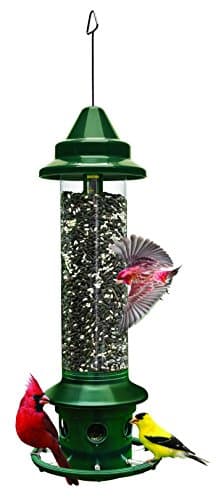 Brome Squirrel Buster Plus Excellent against squirrels. Do not expect the weight mechanism to notice a chipmunk. | Best feeder, with one caveat | $125.79 · View on Amazon #ad How we are funded · Price as of October 24, 2026 |
| 5 | 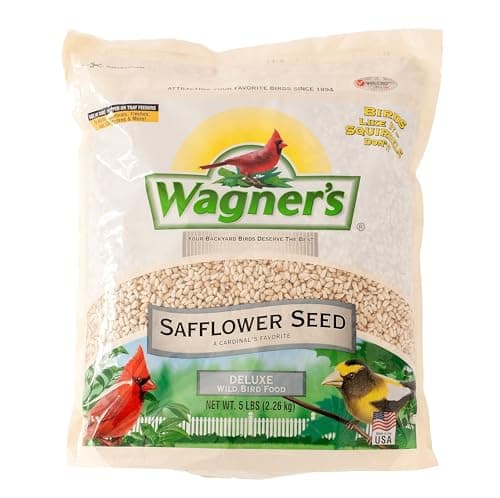 Wagner's Safflower Seed Worth trying. The published evidence behind it is about squirrels, not chipmunks. | Cheapest experiment | $11.98 · View on Amazon #ad How we are funded · Price as of October 24, 2026 |
Rows link to the full write-up further down this page. The price button goes to Amazon.
There is a specific and slightly demoralizing moment in backyard bird feeding: you have finally beaten the squirrels — pole, baffle, the right distance from the fence, the whole apparatus — and then you look down and there are four chipmunks working the ground under the feeder like a cleanup crew, and one of them is sitting in the tray.
The setup has not failed. It was built for a different animal. Almost everything this site recommends for squirrels is about defeating a heavy climber that jumps a long way, and a chipmunk is none of those things.
What you are actually dealing with
Penn State Extension is the clearest source on the basics, and three of its figures change what you should buy.
| Fact | What Extension says | Why it matters at a feeder |
|---|---|---|
| Size and weight | "5 to 6 inches long and weighs about 3 ounces" | Too light for a weight mechanism tuned to admit jays and cardinals |
| Where it lives | "although they can climb trees, spend most of their time on the ground" | The ground under the feeder is the real battleground, not the feeder |
| Diet | "grains, nuts, berries, seeds, mushrooms, insects, and carrion" | Spilled seed is exactly what they are built to exploit |
| Burrows | "the burrow’s main tunnel is 20 to 30 feet long" | They are not passing through. They live there, close by |
| Winter | "enter a period of inactivity that continues through the winter months" | The problem has a season, and an end date |
That second row is the one to hold on to. A squirrel is a climbing problem you solve in the air. A chipmunk is mostly a ground problem, and treating it as an air problem is why people buy three feeders and stay annoyed.
How we ranked these
On published manufacturer specifications and on what extension services and wildlife damage management sources say about the animal — no testing claim, because we have not run one. For this page we weighed four things: whether the approach works by geometry rather than by weight or by taste, whether it addresses the ground rather than only the feeder, whether it survives being outdoors for years, and whether it is honest about what it cannot do. Full criteria here.
That third criterion quietly rules out most of the seed-based answers, and the fourth rules out the entire chipmunk-proof product category.
Why the anti-squirrel playbook only half-works
Three of the standard defenses fail against a chipmunk, and it is worth knowing which before you spend anything.
Weight-closing feeders mostly do not close. The mechanism works by detecting something heavy on the perch, and you set the tension yourself. Extension puts a chipmunk at about three ounces — which sits inside the range of the larger songbirds those mechanisms are deliberately tuned to admit. If you have set the shroud loose enough for cardinals and jays to feed, you have set it loose enough for a chipmunk. Tighten it far enough to exclude one and you have excluded the birds you bought the feeder for. The weight-versus-cage trade is covered in full here.
Cages let them straight through. A cage feeder excludes by gap size, and the gap on a small-bird cage is sized for chickadees and finches. The wildlife damage management guidance for excluding chipmunks calls for hardware cloth at quarter-inch mesh — far smaller than any bird feeder cage, because a bird feeder cage has to let birds through. A chipmunk simply walks in.
Trays are an invitation. An open platform at low height is the single best thing you can install for a ground-dwelling animal. If chipmunks are the complaint, the low tray comes down first — which is a real cost, because it is also what juncos and doves use.
The ground is the actual problem
This is the part that changes outcomes, and it is mostly free.
The Internet Center for Wildlife Damage Management is direct about the feeder side of chipmunk control: bird feeders should be modified to prevent rodents from accessing them, and you should use feeders that capture fallen seed to reduce the amount that reaches the ground. That is a catch tray under the feeder — not a tray they can stand on, but a shelf that intercepts what gets flicked out before it lands.
Penn State adds the placement half: to prevent spilled birdseed from attracting and supporting chipmunks near homes, place bird feeders at least 15 to 30 feet from buildings. Note the verb. Spilled seed does not just attract chipmunks, it supports them — it raises how many the area can carry, which is the same mechanism that makes a decoy feeder a bad idea for squirrels. The identical logic drives mice and rats, and clearing the ground is the fix for all three.
So the order of operations is: catch tray on, ground raked clear, feeder moved away from the house and away from the stone wall or wood pile. ICWDM's habitat guidance is specifically to avoid landscape features that connect wooded areas to foundations, and to remove or mortar stone walls, because those are the travel corridors and the nest sites.
Baffles and poles: what the published guidance covers
A tall smooth pole with a long baffle mounted high is still the best hardware answer, for the same reason it is for squirrels: it works by geometry, and geometry does not care how heavy the animal is.
One honest caveat, and it matters. The baffle numbers this site quotes — the 5-7-9 rule, a baffle top about four and a half feet up, a pole seven to ten feet from anything jumpable — are published for gray squirrels. We have not found equivalent published geometry for chipmunks, so treat those figures as a floor rather than a guarantee. A chipmunk cannot jump anywhere near as far as a squirrel, which works in your favor; it is also a smaller, lighter climber that needs less purchase, which does not. Baffle sizing and the numbers are here.
The practical version: buy the longest torpedo baffle you can, mount it as high as the pole allows, and keep the pole genuinely isolated. If your pole is next to a wall, a planter or a wood pile, you have given a ground animal a staircase, and no baffle fixes a staircase. Pole systems are compared here.
Seed: what we know and what we do not
Two of the commonest questions about chipmunks are seed questions, and we can give an honest answer to both without pretending to more than we have.
Safflower. Project FeederWatch says safflower attracts cardinals and other big-billed birds, and the widely-repeated claim is that squirrels dislike it. Our own page on it already treats that as a tendency rather than a law. For chipmunks specifically we have not found a published source either way, so what we will say is this: it is the cheapest experiment available, it costs a bag of seed, and if it works in your yard it works. Do not buy it expecting a documented result. The honest version of the safflower claim.
Hot pepper. Capsaicin products are marketed for exactly this, and the wildlife damage management position on repellents generally is unenthusiastic: they are expensive, they usually do not provide 100% reduction in damage, and effectiveness of active ingredients varies. That matches what we found when we looked at the bird-feeder version of the same idea — the manufacturer itself states that chilies are not repellents. It is a nudge, not a barrier, and it costs a premium on every refill.
There is one seed choice that genuinely helps, and it is not about taste. Hulled, shell-free seed produces almost no waste under the feeder, which starves the ground of the spilled material that supports the population in the first place. No-mess seed costs more per pound and less per edible pound, and against a ground-feeding animal that trade is better than it looks.
What we will not tell you to do
Trapping and killing come up constantly in chipmunk searches, and some extension material does discuss lethal control. We are not going to publish instructions for it. This is a bird feeding site, the same position we take on the birds people want rid of applies here, and the honest reality is that removing individual animals from a yard with a reliable food source in it does not change the outcome — the vacancy fills.
It is worth knowing that UNH Extension explicitly cautions against live trapping and relocation because relocated animals often do not survive, so the humane-sounding option is not necessarily the humane one. Remove the food source instead. That is the lever that actually moves the population, and it is the one you control.
The escape hatch nobody mentions: it is seasonal
Chipmunks are not a year-round problem, and this genuinely changes the calculation on how much to spend.
Penn State notes that with the onset of cold weather in late fall, chipmunks enter a period of inactivity that continues through the winter months, and that in Pennsylvania they emerge from their burrows from late April to early May. So the problem broadly runs spring through fall and then stops — which is the inverse of the season most people care most about their feeders.
That produces two reasonable strategies, and both are defensible. UNH Extension takes the blunt one: take feeders down and do not replace them until the chipmunks and bears have gone to sleep for the winter. That certainly works, and it costs you a summer of feeding.
The alternative, and the one we would actually run, is to feed lighter through the warm months — one feeder, small amounts, a catch tray, ground kept clear — and then scale the station back up in October when the chipmunks turn in and the birds need it most. That happens to be the calendar we recommend anyway, for entirely different reasons.
What each pick costs you
- The pole system is the most expensive item here, its published height figures disagree between sellers, and it needs about ten feet of clear space that many small yards do not have.
- The torpedo baffle is useless if the pole sits within reach of a fence, a wall or a wood pile — and for a ground animal, a planter counts.
- The catch tray has to be emptied. A tray left full of wet seed is worse than no tray, and it becomes exactly the ground-level food source you were trying to eliminate.
- The weight-closing feeder is the best feeder on this list and its headline mechanism will probably not register a three-ounce animal at all. Buy it for the squirrels; do not credit it for the chipmunks.
- Safflower costs more per pound than sunflower, attracts fewer species, and its reputation rests on squirrel behavior rather than on anything published about chipmunks.
The pattern is the same one this site keeps arriving at from different directions: geometry and discipline beat mechanisms and chemistry. A baffled pole in open ground, a tray that catches what falls, and five minutes with a rake will do more than any product with an animal's name on the box.
The picks in full
#1 · Best complete answer
Squirrel Stopper Sequoia Pole System
Squirrel Stopper · Building the whole feeding station in one purchase
A steel pole with an integrated moving baffle and four hanging arms, and the closest thing to a complete answer, because it fixes the placement problem and the climbing problem at once.
Published specifications
- Pole
- 1.25" diameter, 16-gauge tubular steel
- Hanging stations
- 4 arms, 19" of clearance from the pole
- Height above ground
- Listed as 8 ft 2 in by some sellers and 7 ft 6 in by others — see note
- Baffle
- Integrated baffle that moves up, down and side to side
What it does well
- Four arms means seed, suet, nyjer and peanuts all run from one baffled pole
- The moving baffle defeats squirrels that would grip a fixed one
- Solves the real problem, which is placement, rather than only the feeder
What it does not
- Published height figures disagree between sellers (8 ft 2 in vs 7 ft 6 in), so measure before assuming it clears the 9-foot drop rule
- Needs 10 feet of clear space around it to work as advertised, which many small yards do not have
- The most expensive single item in a beginner setup
Specifications above come from the manufacturer's own published listing: Squirrel Stopper Sequoia published specifications (seller listing), Squirrel Stopper Sequoia specifications (second seller, conflicting height).
#2 · Best baffle for a pole you own
Erva SB1D Cylindrical (Torpedo) Squirrel Baffle
Erva · Pole-mounted feeders
A long steel cylinder a squirrel cannot get around or hug past, and the single most effective thing you can buy after the feeder itself.
Published specifications
- Length
- 16.75"
- Diameter
- 6.25"
- Type
- Pole-mounted cylindrical baffle
What it does well
- Length is what defeats a squirrel here: it cannot reach past the top
- Steel, so it survives winters and chewing
What it does not
- Useless if the pole sits within jumping distance of a fence, wall or branch
- Must be mounted high enough that a squirrel cannot leap over it entirely
Specifications above come from the manufacturer's own published listing: Erva SB1D published dimensions.
#3 · Best catch tray
Nature's Way Cedar Platform Tray Feeder (CWF3)
Nature's Way · Cardinals, jays, doves and anything that will not use a tube
An open cedar tray with a removable screen bottom, which is the honest answer for the big ground-feeding birds a tube feeder quietly excludes.
Published specifications
- Dimensions
- 12" x 12" x 2.25"
- Capacity
- 3 quarts
- Materials
- Premium cedar, stainless steel screws, powder-coated galvanized steel seed tray
- Drainage
- Removable screen tray for drainage and airflow
What it does well
- Cardinals and jays use it immediately; they often will not use a small tube port
- The screen bottom drains, which is the difference between a tray and a puddle
- Nothing to break, and it cleans in a minute
What it does not
- Completely open to squirrels, so this one belongs on a baffled pole or nowhere
- Seed is exposed to rain even with drainage, so put out small amounts
Specifications above come from the manufacturer's own published listing: Nature's Way CWF3 published specifications.
#4 · Best feeder, with one caveat
Brome Squirrel Buster Plus
Brome · The one feeder to buy if you only buy one
A weight-closing tube feeder with a large capacity and a cardinal ring, and the closest thing to a genuinely squirrel-resistant feeder that a beginner can hang up and stop thinking about.
Published specifications
- Seed capacity
- 5.1 lb
- Height
- 28" base to hanger
- Feeding ports
- 6, plus a cardinal ring
- Mechanism
- Weight-adjustable spring shroud
- Materials
- Chew-proof, UV-resistant components
- Warranty
- Brome Lifetime Care
What it does well
- The spring tension is adjustable, so you can shut out heavy birds as well as squirrels
- Comes apart by hand for cleaning, which means it actually gets cleaned
- 5.1 lb is enough that a busy fall week does not mean daily refills
What it does not
- The most expensive feeder in this roundup by a wide margin
- The shroud collects seed dust and needs a full strip-down every couple of weeks
- A squirrel that can reach the top hanger still wins, so this is not a substitute for a baffle
Specifications above come from the manufacturer's own published listing: Brome — Squirrel Buster Plus (manufacturer store).
#ad How we are funded · Price as of October 24, 2026
#5 · Cheapest experiment
Wagner's Safflower Seed
Wagner's · Cardinals, when squirrels have taken over
A single-ingredient seed cardinals and finches take readily and squirrels usually leave alone, which is the closest thing to a no-hardware squirrel answer, with an honest caveat.
Published specifications
- Ingredients
- 100% safflower seed
- Crude protein
- 17.0%
- Crude fat
- 25.0%
- Crude fiber
- 32.0%
- Moisture
- 13.0%
What it does well
- Cardinals, house finches, chickadees and titmice all eat it
- Most squirrels prefer sunflower and will move on if safflower is all there is
What it does not
- 'Squirrels do not like safflower' is a tendency, not a law — hungry squirrels eat it
- Costs more per pound than black oil sunflower and attracts fewer species
Specifications above come from the manufacturer's own published listing: Wagner's safflower published analysis.
#ad How we are funded · Price as of October 24, 2026
Common questions
Is there such a thing as a chipmunk-proof bird feeder?
No, in the same way nothing is squirrel-proof — and less so, because a chipmunk is small enough to pass through cage mesh sized for birds and light enough that weight-closing mechanisms do not register it. A baffled pole in open ground is the closest thing.
Do chipmunks eat safflower seeds?
We have not found a published source either way. The squirrel-dislikes-safflower claim is well known and is a tendency rather than a rule; for chipmunks specifically, treat it as a cheap experiment rather than a documented result.
Will a squirrel baffle stop chipmunks?
It helps, because a baffle works by geometry rather than weight. But published baffle dimensions are written for gray squirrels, so treat them as a minimum, mount the baffle high, and keep the pole away from anything a small animal can climb from.
Do bird feeders attract chipmunks?
Spilled seed does. Penn State Extension recommends placing feeders at least 15 to 30 feet from buildings to stop spilled birdseed attracting and supporting chipmunks near homes, and ICWDM recommends feeders that capture fallen seed.
Does hot pepper bird seed keep chipmunks away?
Not reliably. Wildlife damage management guidance is that repellents are expensive and usually do not give 100% reduction, and effectiveness varies — the same conclusion we reached about hot pepper seed generally.
Do chipmunks go away in winter?
Yes. Penn State notes they enter a period of inactivity from late fall through the winter months, emerging from late April to early May. The problem is seasonal, which is worth knowing before you spend heavily on it.