Feeder Types
Hummingbird feeders, and the saucer-or-bottle decision
Two designs, and the one you pick decides how much of your summer you spend cleaning sugar off a hook.
By Scooter M. · Published · Last updated
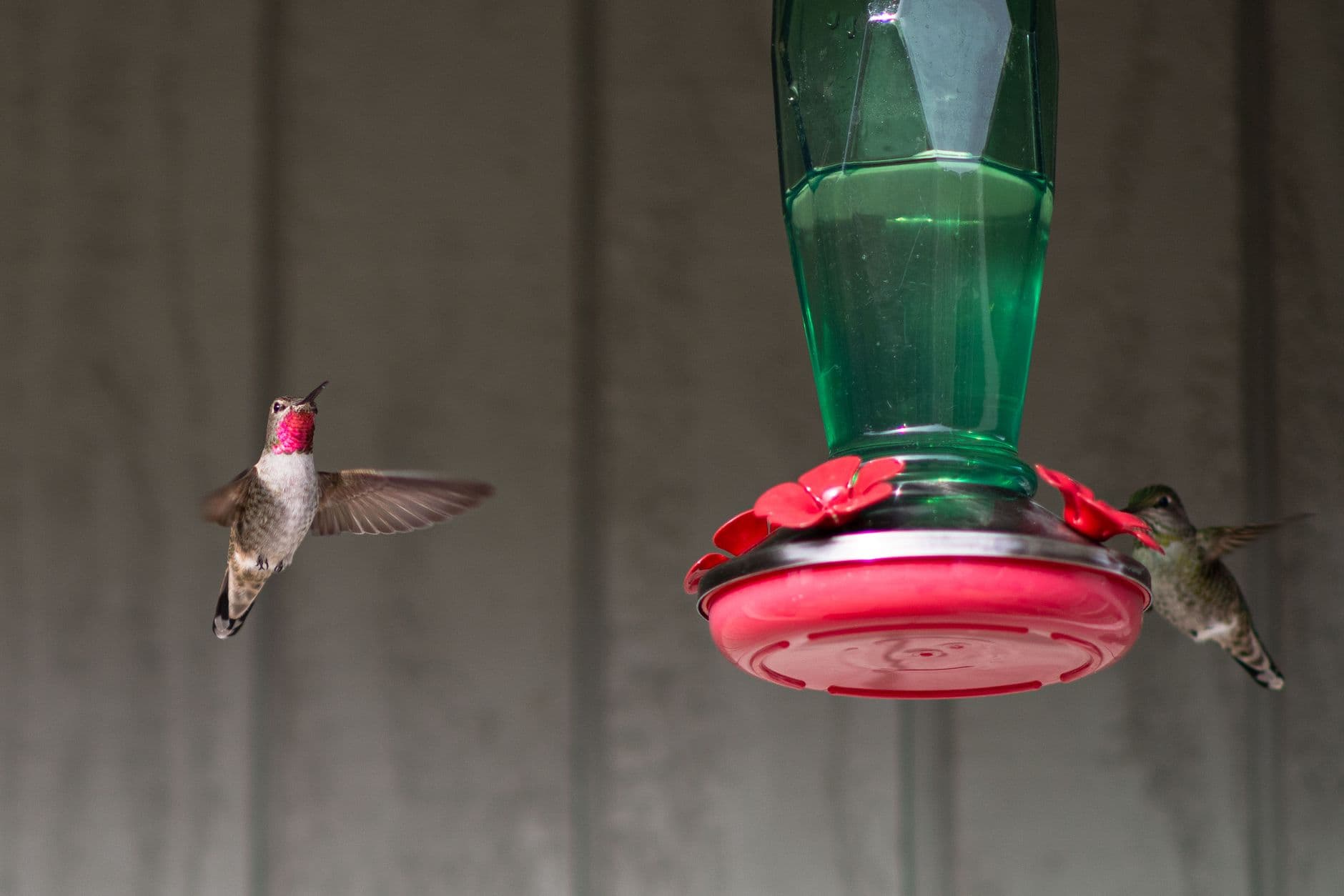
Buy a saucer feeder: the Aspects HummZinger Excel holds its nectar below the ports so it cannot drip, has a built-in ant moat, and its bowl lifts out for the cleaning that nectar needs every two or three days. Fill it with one part sugar to four parts water and no red dye.
Seed & Sprig earns a commission when you buy through the links on this page, at no extra cost to you. It does not change which products we pick or the order we put them in — here is how we pick and here is how we are funded.
Quick picks
| # | Product | Best for | Price |
|---|---|---|---|
| 1 | 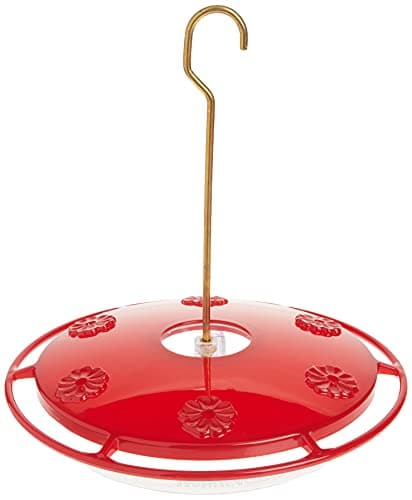 Aspects HummZinger Excel Hummingbird Feeder (item 143) Saucer design, built-in ant moat, removable bowl, and a lifetime guarantee behind it. | Best overall | $34.96 · View on Amazon #ad How we are funded · Price as of October 22, 2026 |
| 2 | 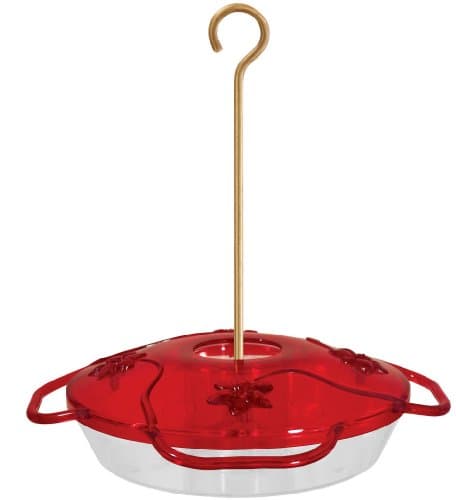 Aspects HummZinger Ultra Hummingbird Feeder (model 367) Twelve ounces and four ports. Two small feeders out of sight of each other beat one big one. | Best second feeder | $30.96 · View on Amazon #ad How we are funded · Price as of October 22, 2026 |
| 3 | 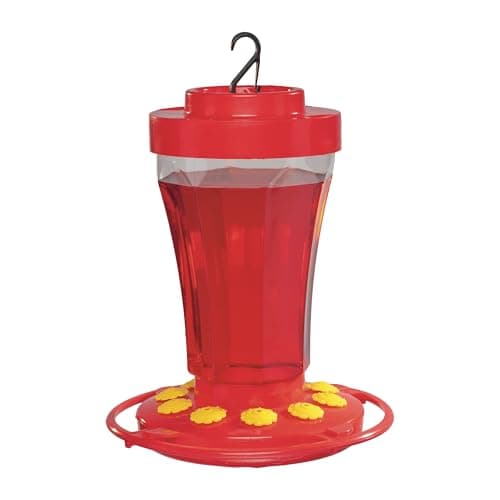 First Nature 32-Ounce Hummingbird Flower Feeder Thirty-two ounces, wide mouth, a quarter of the price. A bottle, with a bottle's drip. | Best value | $16.49 · View on Amazon #ad How we are funded · Price as of October 22, 2026 |
| 4 | 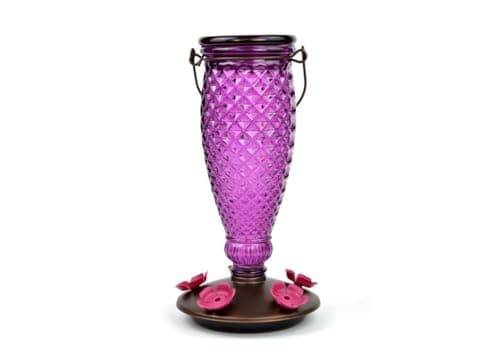 Perky-Pet Diamond Wine Top Fill Glass Hummingbird Feeder, 24 oz Glass, and it fills from the top, so you are not inverting a full reservoir over the sink. | Best bottle to live with | $23.97 · View on Amazon #ad How we are funded · Price as of October 22, 2026 |
Rows link to the full write-up further down this page. The price button goes to Amazon.
Hummingbird feeders look like an easy purchase and are not. The design choice in front of you — saucer or bottle — decides whether the feeder drips in the sun, whether ants reach the nectar, and above all whether the every-few-days cleaning that sugar water demands takes one minute or ten. That is the decision this page is about.
Audubon's account of the Ruby-throated Hummingbird is of a bird that takes nectar from flowers, feeds on tiny insects, and will also feed on sugar-water mixtures in hummingbird feeders — with the instruction attached: avoid red food coloring and clean often. The feeder you buy is mostly a decision about the second half of that sentence.
Saucer versus bottle
| Saucer (nectar below the ports) | Bottle (inverted reservoir) | |
|---|---|---|
| Dripping | Cannot drip; there is no pressure pushing nectar out | Drips as the day warms and air inside expands |
| Ants | Usually a built-in moat in the center | Needs a separate ant moat above it |
| Cleaning | Bowl lifts out; a cloth reaches every surface | Narrow neck; needs a brush, or a wide mouth |
| Capacity for the money | Lower | Much higher |
| Bees and wasps | Nectar sits deeper, often out of reach | Depends entirely on port design and bee guards |
| Price | Premium | Cheap |
Read the first row twice, because it is the one people discover the hard way. An inverted bottle works on air pressure: as the sun warms the air trapped above the nectar, that air expands and pushes sugar water out of the ports. The puddle underneath is what the ants and yellowjackets are following, and no amount of ant moat fixes a feeder that is dripping onto the deck.
The counter-argument for bottles is real and it is money. A thirty-two ounce wide-mouth bottle feeder costs a fraction of a premium saucer. If your yard holds a lot of birds in late summer, or you want two feeders for the price of a third of one, a bottle is a defensible choice — hung over grass rather than a deck, with a moat above it.
How we chose these
On published manufacturer specifications, checked against live listings in October 2026 so every pick is currently purchasable. No testing claim: we have not run nectar feeders side by side, and nobody should trust a site that says it has without showing the method.
Ranking went: can you get it fully apart and clean it in a minute, because that is the difference between a feeder that helps birds and one that harms them; does it have an ant moat; does it leak; and then capacity against price. Our full criteria are here.
The nectar recipe, and the three ways people get it wrong
Project FeederWatch gives it in one line: one part sugar to four parts boiling water, stirred, and cooled before it goes in the feeder. Maryland's DNR gives the same ratio and adds the reason for the boiling water: it kills potential fungi and bacteria.
The three mistakes, in order of how often we see them:
- Red dye. FeederWatch says plainly not to add red food coloring because it is harmful to birds. The feeder's own red parts — or a red ribbon on the hook — do the attracting.
- Honey, brown sugar or sweetener. Plain white table sugar and water. Honey ferments and grows mold readily; the substitutes are not what the bird is adapted to.
- Topping up instead of replacing. Adding fresh nectar to old nectar in an unwashed feeder is how a feeder becomes a problem. Empty, wash, refill.
Make it in batches and keep the spare in the fridge. That way the two-or-three-day change is a thirty-second job rather than a reason to skip it.
Cleaning is the whole hobby
This is the part that separates hummingbird feeding from seed feeding, and it is not negotiable. FeederWatch's instruction is to clean hummingbird feeders more frequently than seed feeders — every couple of days, ideally every time you refill. Maryland's DNR says to change the solution and thoroughly clean the feeder every two to three days, because the fungus and bacteria that accumulate in nectar feeders can kill hummingbirds.
In practice: hot water and a brush, every surface including the ports, and a full dry before refilling. Dish soap is fine if it is rinsed thoroughly. Black specks inside the reservoir are mold, and a feeder that has reached that state needs scrubbing rather than rinsing. Our cleaning guide covers the method for seed feeders, and the principle is the same with a shorter interval.
Which is the practical argument for a saucer, and the practical argument for a smaller feeder: a twelve-ounce bowl you will actually empty and wash twice a week beats a thirty-two ounce bottle you will not.
Two small feeders beat one large one
Hummingbirds are territorial out of all proportion to their size. A single dominant bird will sit on a perch near a feeder and chase every other bird off it, which means a big feeder in an open spot can end up feeding exactly one hummingbird.
The fix is geometric rather than mechanical: hang two feeders where a bird at one cannot see the other — opposite corners of the house, or either side of a shrub. The dominant bird can only defend one. This is why our second pick is a smaller, cheaper saucer rather than a bigger version of the first one.
It is also the argument against overfilling. A feeder should hold a few days' worth of nectar, not a fortnight's, because the surplus is going down the sink either way.
Where to hang it
Hummingbird feeders break most of the placement rules on this site, and for once squirrels are not the reason. What matters:
- Shade in the afternoon. Nectar in direct sun ferments faster and a bottle feeder drips more. Shade buys you a day.
- A perch within a few feet. Hummingbirds spend most of the day perched, watching the feeder they have claimed. A thin twig nearby gets used constantly.
- Visible from a window, close or far. The window-strike distances apply here as much as anywhere: within three feet of the glass, or beyond thirty.
- Away from the seed feeders. Not for the birds' sake — for yours. Sugar water near a seed station collects everything that drops.
When to put it up and when to take it down
Audubon notes that nearly all Ruby-throated Hummingbirds leave North America in the fall, wintering from Mexico to Costa Rica or Panama, and that males move north earlier than females in spring. Maryland's DNR observes that its one native species is present only during the warmer months.
So: up in spring, around the time the first birds are reported in your area, and kept up into the autumn. Leaving a feeder out does not keep a hummingbird from migrating — that decision is made by day length, not by your feeder — and a late feeder helps stragglers.
In October, in most of the country, the hummingbirds have gone. That is the honest reason this page is about next spring, and the reason to buy the feeder you will still be happy to clean in July. The fall calendar covers what should be out right now.
What we would buy
- One feeder, bought once: the HummZinger Excel. A saucer that cannot drip, with the ant moat built in and a bowl that lifts out.
- Two feeders, which is the better plan: the Excel and the Ultra, hung out of sight of each other.
- Watching the budget: the First Nature 32 oz, filled part way, over grass, with an ant moat above it.
- You want glass: the top-fill Perky-Pet, because filling a glass bottle feeder from the bottom is the worst five minutes of the week.
The thing to take away: the sugar water is trivial and the hygiene is not. Buy the feeder you will clean every third day in August, and the rest of this takes care of itself.
The picks in full
#1 · Best overall
Aspects HummZinger Excel Hummingbird Feeder (item 143)
Aspects · The one hummingbird feeder to buy if you only buy one
A saucer feeder with the nectar below the ports rather than above them, a built-in ant moat in the centre and a bowl that lifts out for washing. Nothing about it leaks, and nothing about it is hard to clean, which is the entire argument for saucers.
Published specifications
- Capacity
- 16 oz
- Ports
- 6
- Ant moat
- Built in
- Perch
- Wrap-around, so several birds can feed at once
- Design
- Drip and leak proof, per the published specification
- Cleaning
- Removable bowl
- Guarantee
- Lifetime, per the published specification
- Model
- 143
What it does well
- A saucer cannot leak: the nectar sits below the ports instead of being pushed out by air pressure, which is why bottle feeders drip in the sun
- The ant moat is part of the feeder rather than an extra you hang above it
- The bowl lifts out, so the every-few-days cleaning that nectar demands takes a minute rather than a bottle brush
- A lifetime guarantee on a nectar feeder is unusual and tells you what the plastic is
What it does not
- It costs two or three times what a glass bottle feeder costs
- Sixteen ounces in a shallow bowl has a wide footprint, so it needs a hook with room around it
- Saucers hold less than their bottle equivalents for the same money, and in hot weather you should not be filling a feeder to the brim anyway
- No built-in bee guards; the port design is the only defence against wasps
Specifications above come from the manufacturer's own published listing: Greenhouse Megastore — Aspects HummZinger Excel (capacity, ports, ant moat, leak-proof design, removable bowl, lifetime guarantee, wrap-around perch), Aspects HummZinger Excel with built-in ant moat, item 143 — published listing.
#ad How we are funded · Price as of October 22, 2026
#2 · Best second feeder
Aspects HummZinger Ultra Hummingbird Feeder (model 367)
Aspects · A smaller saucer, or a second feeder out of sight of the first
The same saucer idea as the Excel in a smaller bowl with four ports. Twelve ounces is the right size for most yards, because nectar should be changed every few days whether the birds have drunk it or not.
Published specifications
- Capacity
- 12 oz
- Ports
- 4
- Color
- Red
- Model
- 367
What it does well
- Twelve ounces suits the real refill cycle: in hot weather nectar needs changing every two or three days, so a smaller bowl wastes less sugar
- Saucer design, so it does not drip in sun the way an inverted bottle does
- Cheaper than the Excel, which makes a second feeder affordable — and hummingbirds are territorial enough that two feeders out of sight of each other feed more birds than one big one
What it does not
- Four ports and no wrap-around perch means less space than the Excel when several birds arrive
- Still a premium price next to a glass bottle feeder
- The listing publishes capacity, ports and color and little else, so there is no dimension or material figure to check
Specifications above come from the manufacturer's own published listing: Aspects 367 HummZinger Ultra, 12-Ounce, 4 feeding ports, Red — published listing.
#ad How we are funded · Price as of October 22, 2026
#3 · Best value
First Nature 32-Ounce Hummingbird Flower Feeder
First Nature · Most nectar per dollar, and the easiest bottle to fill
The high-capacity bottle feeder that bird stores sell by the pallet: thirty-two ounces, a wide-mouth reservoir you can get a hand into, and flower-shaped ports. It is a quarter of the price of a premium saucer and it works.
Published specifications
- Capacity
- 32 oz
- Reservoir
- Wide-mouth, per the listing
- Ports
- Flower-shaped
- Type
- Inverted bottle
What it does well
- Thirty-two ounces is the most nectar on this page, which matters in late summer when a yard can hold a dozen birds
- The wide mouth is the real feature: narrow-necked bottle feeders are miserable to clean and this one takes a brush or a hand
- Cheap enough to buy two and hang them where neither bird can see the other
What it does not
- An inverted bottle drips when the sun warms the air inside it, and nectar on the ground brings ants and wasps
- No built-in ant moat, so you need to hang one above it
- Thirty-two ounces is too much nectar for most yards: fill it part way, because unused nectar has to be thrown out every few days anyway
- Plastic, and it will cloud with age
Specifications above come from the manufacturer's own published listing: First Nature Hummingbird Flower Feeder, 32-Ounce, wide-mouth — published listing.
#ad How we are funded · Price as of October 22, 2026
#4 · Best bottle to live with
Perky-Pet Diamond Wine Top Fill Glass Hummingbird Feeder, 24 oz
Perky-Pet · Filling a bottle feeder without turning it upside down over the sink
A glass bottle feeder that fills from the top, so you are not inverting a full reservoir and losing half of it. Built-in bee guards, and glass rather than plastic, which stays clear.
Published specifications
- Capacity
- 24 oz
- Filling
- Top fill, per the listing
- Bee guards
- Built in, per the listing
- Material
- Glass reservoir
What it does well
- Top filling removes the one genuinely annoying step of owning a bottle feeder
- Glass does not cloud, scratch or hold sugar residue the way aging plastic does
- Built-in bee guards, which a surprising number of bottle feeders still omit
What it does not
- It is still an inverted-reservoir feeder, so it can still drip as the day warms
- Glass is heavier and breakable, and a 24 oz glass bottle on a thin hook swings
- No ant moat is published for it, so ants are your problem to solve separately
- The listing publishes capacity, filling, bee guards and material, and no dimensions
Specifications above come from the manufacturer's own published listing: Perky-Pet Diamond Wine Top Fill Glass Hummingbird Feeder, 24 oz — published listing.
#ad How we are funded · Price as of October 22, 2026
Common questions
What is the right sugar-to-water ratio for hummingbirds?
One part white sugar to four parts water. Project FeederWatch says to use boiling water and stir, then cool before filling. Never add red food coloring, which FeederWatch says is harmful to birds.
How often do I need to clean a hummingbird feeder?
Every two to three days in warm weather, and ideally every time you refill. Maryland's DNR warns that the fungus and bacteria that accumulate in nectar feeders can kill hummingbirds, which is why this is the one feeder you cannot neglect.
Are saucer feeders better than bottle feeders?
For most people, yes. A saucer holds nectar below the ports so it cannot be pushed out by warming air, usually has a built-in ant moat, and comes apart for cleaning. Bottles win only on capacity per dollar.
Should I use red nectar?
No. Plain sugar water. FeederWatch notes that red portals on the feeder, or even a red ribbon tied on top, attract the birds just as well as dye — which it says is harmful.
Will leaving a feeder out stop hummingbirds migrating?
No. Migration is triggered by day length, not food supply, and Audubon notes that nearly all Ruby-throated Hummingbirds leave North America in the fall regardless. A feeder left up late helps the ones still moving through.
Why is only one hummingbird using my feeder?
Because it has claimed it. Hummingbirds are strongly territorial, and one dominant bird will chase others off. Hang a second feeder where a bird at one cannot see the other.
Sources
- Audubon — Ruby-throated Hummingbird field guide (diet, sugar water, avoid red dye and clean often, fall migration)
- Cornell Lab of Ornithology, Project FeederWatch — one-to-four nectar ratio, no red food coloring, cleaning frequency
- Maryland Department of Natural Resources — Supplemental Feeding Wild Birds (nectar recipe, boiling, two-to-three-day cleaning, fungus and bacteria risk)