Squirrels
Are any bird feeders really squirrel-proof?
The whole category answers this question dishonestly. Here is the version with the numbers attached.
By Scooter M. · Published · Last updated
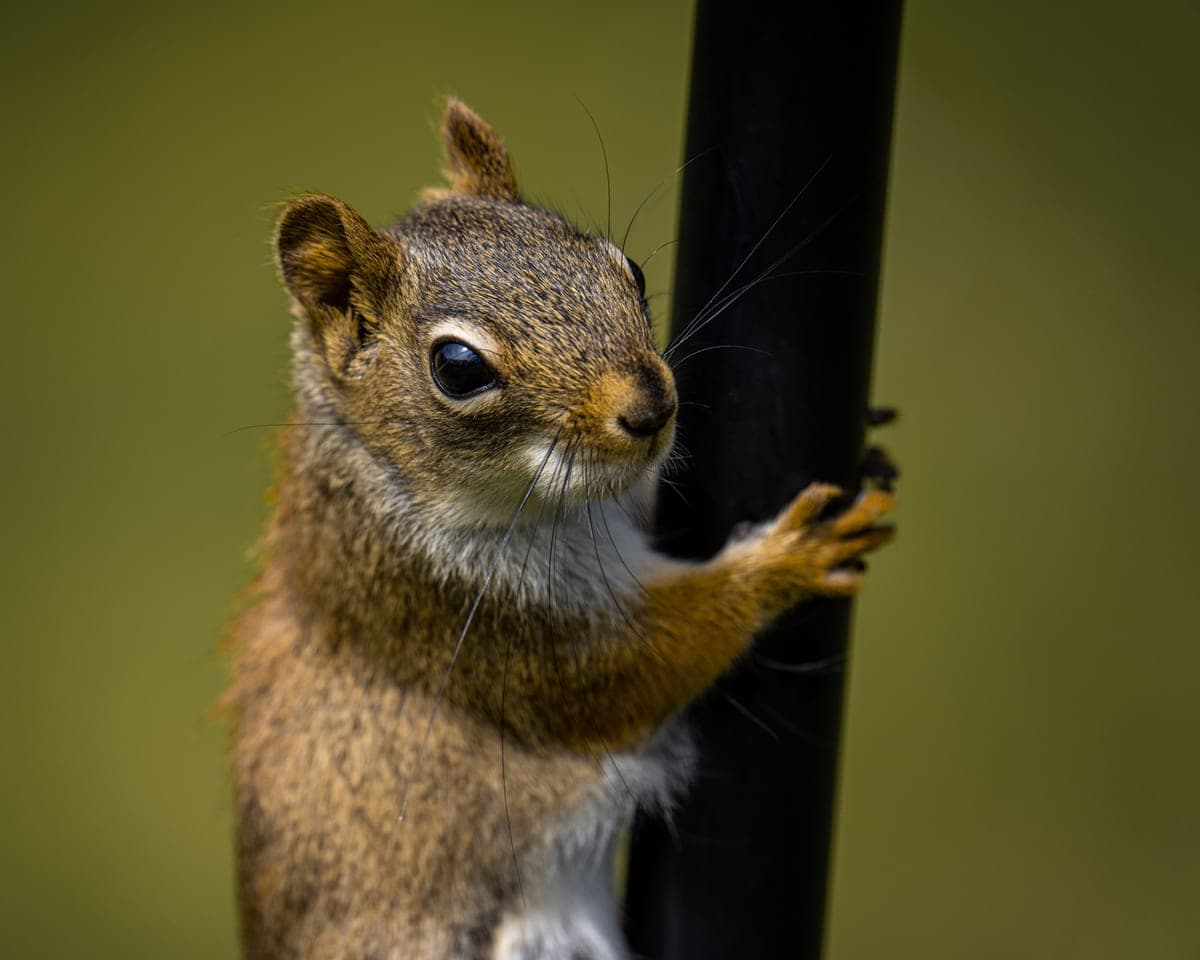
No. Weight-triggered and caged feeders are squirrel-resistant and they work well, but every one of them has a documented failure mode. Placement does more of the work than the mechanism does: a baffled pole sited beyond a squirrel's jumping range defeats squirrels regardless of which feeder hangs on it.
Search the phrase and you will find a national home-improvement title promising feeders squirrels “can't beat,” a manufacturer publishing thirty-day test results for its own products, and a dozen affiliate pages using the word proof as though it were a specification. It is not a specification. There is no standard, no test protocol, and nobody certifying anything.
So the question is worth answering properly, because the answer changes what you should buy.
Start with the animal
The eastern gray squirrel is the animal most of this is about — if yours are actually chipmunks, the numbers below do not apply to them. What matters for feeder design is what it can do, and the published figures vary more than you would expect for something so easy to measure:
| Source | Vertical jump | Horizontal jump | Recommended clearance |
|---|---|---|---|
| Duncraft (5-7-9 rule) | 4 to 5 ft from the ground | About 7 ft | 7 ft around, 9 ft below a branch |
| All Seasons Wild Bird Store | Not stated | Not stated | Pole 10 to 12 ft from any jumping-off point; baffle top 4.5 ft up |
Those numbers do not agree, and we are not going to average them into a single confident figure we cannot support. What they agree on is the shape of the problem: a squirrel gets to your feeder by climbing up, jumping across, or dropping down, and the distances involved are measured in feet, not inches. If your yard can give ten feet of clearance, give it ten. If it can only give seven, you are at the edge of what the most optimistic source recommends.
What the mechanisms actually do
Weight-closing shrouds. A sleeve drops over the feeding ports when something heavy enough lands on it. On Brome's Squirrel Buster line the trigger weight is adjustable, which is genuinely clever — you can also use it to exclude grackles. The failure mode is that it only works on a squirrel that stands on the shroud. One that arrives from above and works at the cap, the hanger or the seal is not applying weight to anything.
Counterweighted perches. The Woodlink Absolute II uses the perch as a lever: weight pulls a shield over the seed tray. Also effective, also tunable, and it has a second use as a grackle filter. The failure mode is the tuning: too heavy and you have not excluded much, too light and you have excluded cardinals.
Cages. A physical gap small birds fit through and squirrels do not. This is the most absolute of the three, and it is also the one that shuts out cardinals, jays and doves. Young squirrels are small enough to defeat wider cages.
Baffles. Not a mechanism at all — geometry. A 17-inch cone or a long steel torpedo, mounted so its top sits about four and a half feet up the pole, presents a squirrel with a shape it cannot get around. This is the only one of the four with no interesting failure mode, provided the pole is sited far enough from anything to jump off.
So what is the honest recommendation?
Buy the placement first and the mechanism second. A fifteen-dollar baffle on a properly sited pole outperforms a hundred-dollar feeder hanging from a branch, every time, and it keeps working when you replace the feeder.
If a pole is impossible — a deck, a balcony, a paved courtyard — then the mechanism is the only lever you have and it is worth paying for. That is the situation the weight-closing feeders were designed for.
Why does the category talk this way?
Because “squirrel-proof” is what people search for, and because “squirrel-resistant, and mostly a placement problem” is a harder sentence to sell a feeder with. We are not accusing anyone of lying. We are saying the word does not mean what a first-time buyer thinks it means, and that the buyer usually finds out three weeks later with an empty feeder and a fat squirrel.
What we did instead of testing
We have not put these feeders in a yard for a season. What we did: read each manufacturer's published mechanism description and specifications, recorded them with sources, compared the recommended baffle geometry against the jump distances the retail sources publish, and reported where those sources contradict each other rather than picking the convenient one. That is a smaller claim than a test lab. It is also checkable, which most claims in this category are not.
Common questions
Are squirrels bad for bird feeders?
They empty them, they can chew plastic ports and hangers, and their weight can bend a light hook. They are not dangerous to birds. The cost is seed and hardware, not harm.
How far can a squirrel jump?
Duncraft publishes about seven feet horizontally and four to five feet vertically from the ground. Other retailers recommend eight to twelve feet of clearance, which implies a longer jump. Plan for the larger figure.
Will a baffle alone stop squirrels?
On a correctly sited pole, usually yes. A baffle on a pole two feet from a fence stops nothing, because the squirrel never has to climb the pole.
Should I just feed the squirrels separately?
It rarely works as a diversion — a separate squirrel feeder tends to increase how many squirrels live in your yard, and they will still visit the bird feeder. Exclusion works; distraction mostly does not.