Setup & Placement
Shepherd's hooks for bird feeders
The cheapest way to get a feeder off the ground, and the piece of hardware this site most often tells people to stop relying on.
By Scooter M. · Published · Last updated
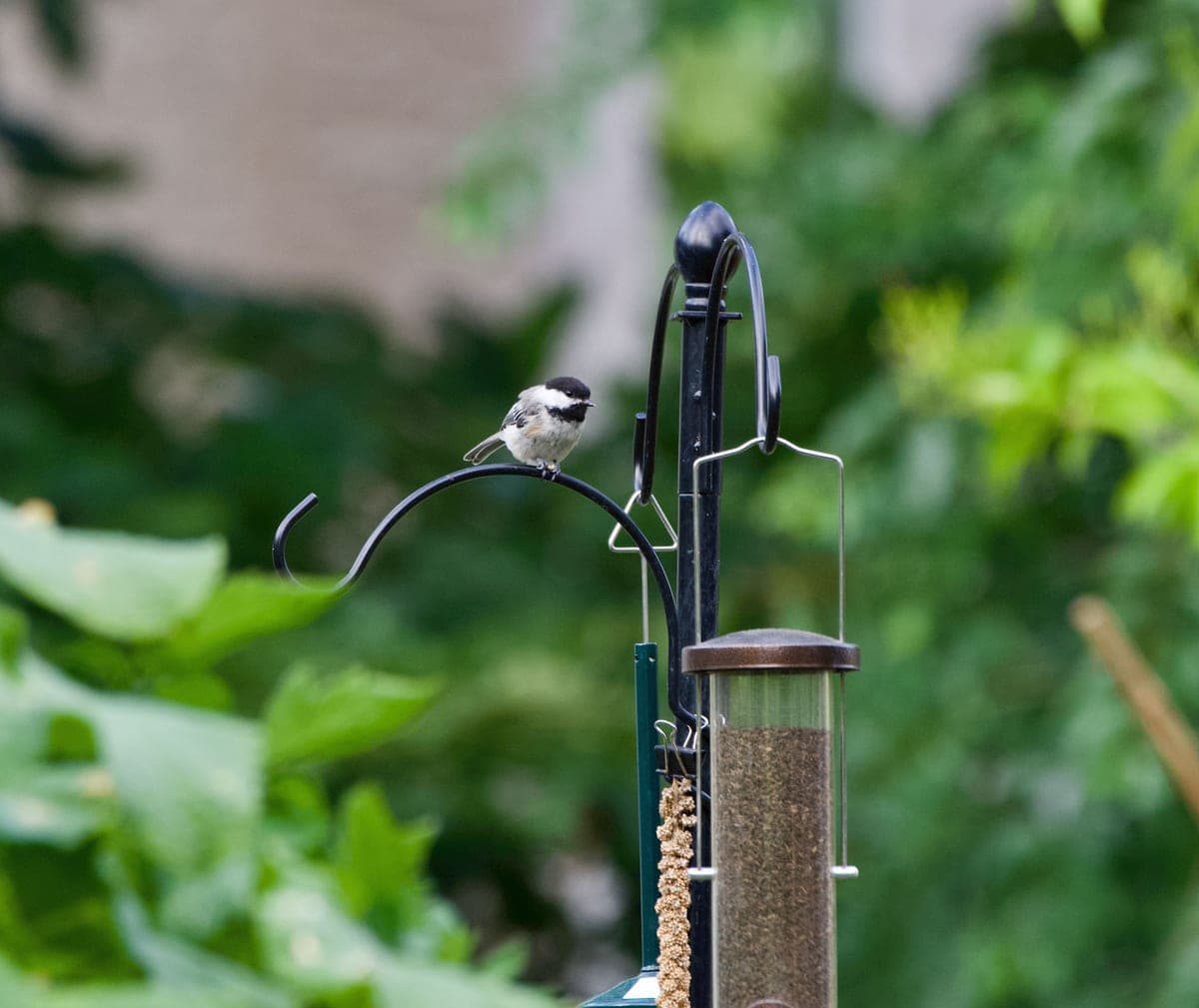
A shepherd's hook is a place to hang a feeder, not squirrel defense. Buy on two specifications: base prongs, which decide whether it stays upright, and height, which decides whether a baffle can be mounted high enough to work. Under about seven feet, it cannot.
Seed & Sprig earns a commission when you buy through the links on this page, at no extra cost to you. It does not change which products we pick or the order we put them in — here is how we pick and here is how we are funded.
Quick picks
| # | Product | Best for | Price |
|---|---|---|---|
| 1 | 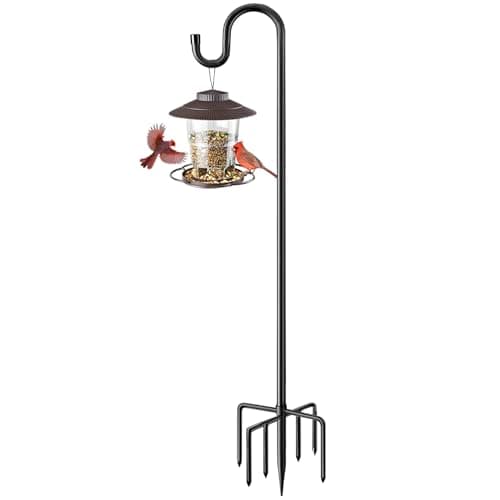 ANIDEER 84" Shepherds Hook, 7-Prong Base 84" with a 7-prong base — the only combination here that lets a baffle sit high enough. | Best shepherd's hook | $21.99 · View on Amazon #ad How we are funded · Price as of September 16, 2026 |
| 2 | 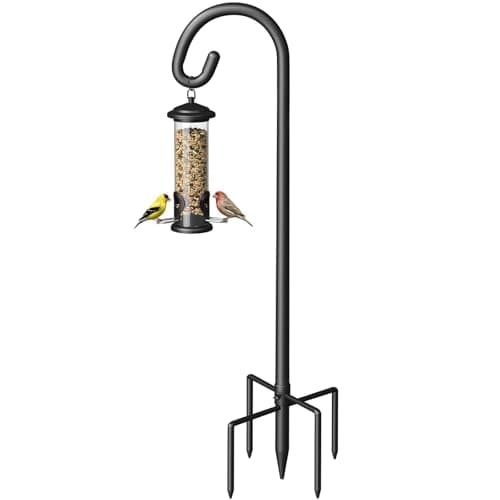 Heavy-Duty 76" Shepherd Hook with 5-Prong Base 76", 5-prong, adjustable height. Fine for a light feeder away from cover. | Best budget hook | $18.99 · View on Amazon #ad How we are funded · Price as of September 16, 2026 |
| 3 | SSno photo Squirrel Stopper Sequoia Pole System A pole system with an integrated baffle. A hook is not this and cannot become it. | What to buy if squirrels are the problem | |
| 4 | 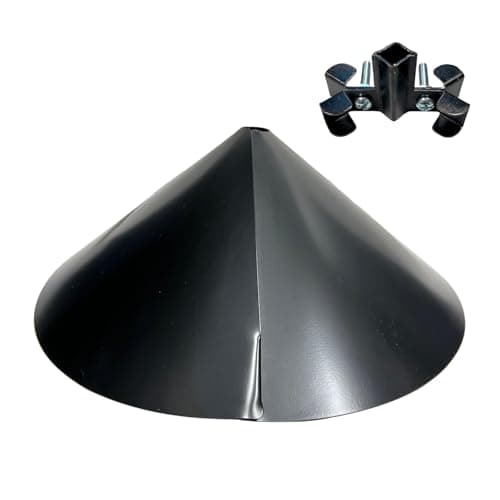 Erva 17" Wrap-Around Cone Squirrel Baffle Wraps around an existing pole and locks shut, so nothing has to come out of the ground. | If you are retrofitting a hook you own |
Rows link to the full write-up further down this page. The price button goes to Amazon.
Almost every first feeder in the country goes onto a shepherd's hook, and almost every squirrel page on this site ends up explaining why that did not work. Both things are true at once, and this page is the attempt to be useful about it rather than sniffy.
A hook is a good product with a narrow job: getting a feeder off the ground, at a sensible height, cheaply, without digging. It is not squirrel defense, it never was, and most of the disappointment comes from expecting it to be.
The two specifications that decide everything
Height and base prongs. Almost nothing else on a hook listing matters, and these two are the ones buyers skip.
| Spec | Why | What to look for |
|---|---|---|
| Base prongs | Decides whether it stays vertical under a loaded feeder in wet ground. | Five at minimum; seven is better |
| Height | Decides whether a baffle can sit high enough to matter. | Over 80" if a baffle is the plan |
| Adjustability | Lets you set a workable refill height. | Useful, not decisive |
| Load rating | A full hopper is heavy and hooks flex. | Rarely published — assume light duty |
That last row is an honest gap. None of the hook listings we checked publishes a load rating, so there is no figure to compare and we will not invent one. Treat every hook as light-duty unless the seller says otherwise, and put the twelve-pound hopper on a pole.
How we ranked these
On published listing specifications — height, base prongs, adjustability — and on whether the hook can support the one thing that makes a feeder station work, which is a baffle at the correct height. No testing claim; we have not run one. Full criteria here.
We deliberately did not rank on finish, color or decorative scrollwork, which is what most of this category competes on and none of which keeps a feeder upright.
The height problem, which is the real point of this page
Here is the arithmetic that makes most shepherd's hooks unsuitable for a squirrel yard.
Published baffle guidance asks for the top of the baffle to sit about four and a half feet from the ground, with the feeder above that, and the whole thing seven to ten feet from anything a squirrel can launch from. A hook is not all usable height — a good part of it is in the ground, and the feeder hangs down from the crook.
On a 76-inch hook, once you have put a foot of it in the soil and hung a two-foot feeder from the top, there is not enough clear pole left to mount a baffle at four and a half feet and still have the feeder above it. On an 84-inch hook there just about is. That single difference is why our top pick is the taller one, and it is not a detail any listing explains. The baffle numbers are here.
When a hook is the right buy
- A light feeder, in open ground, with no squirrel pressure. This is a real situation and a hook is the correct, cheap answer to it.
- A second or third station away from the main pole, to spread birds out — which is exactly what the how-many-feeders page recommends when jays or grackles dominate.
- Renting, or anywhere you cannot dig. A hook goes in and comes out without trace.
- Hanging something that is not a feeder — a bath, a plant, a suet cage near the house.
When to stop and buy a pole instead
If squirrels are established, buy the pole. This is not an upsell; it is the conclusion every page on this site arrives at from a different direction. A pole system with an integrated baffle solves the placement problem and the climbing problem in one purchase, and it does not flex under a loaded hopper. Pole systems are compared here.
If you already own a hook and would rather not replace it, a wrap-around cone baffle retrofits without taking anything out of the ground — provided the hook is tall enough for the baffle to sit at a useful height, which brings us back to the arithmetic above.
Installation, briefly
Two things people get wrong. Push the prongs in with a foot, evenly, rather than hammering the top — hammering bends the crook and a bent hook never sits straight again. And site it before you sink it: FeederWatch asks for feeders close to natural cover at roughly ten feet from dense branches, and a hook moved three times leaves three holes and an unhappy lawn.
Expect to push it back in after heavy rain. A hook in saturated ground with a full feeder on it works loose, which is the single most common way one ends up leaning. Placement rules in full.
What each pick costs you
- The 84-inch hook is still a hook: it flexes under a heavy hopper in a way a one-inch steel pole does not, publishes no load rating, and is tall enough that refilling wants a step.
- The 76-inch hook is too short to take a baffle at a useful height once a feeder is hanging from it. Buy it for a light feeder in open ground, not for a squirrel problem.
- The pole system is the most expensive item here, its published height figures disagree between sellers, and it wants about ten feet of clear space.
- The wrap-around cone is easier for a determined squirrel to knock askew than a torpedo baffle, and it looks bulky on a slim hook.
Hook or pole: the honest comparison
These are different products that look like the same product, and the confusion costs people money in a specific order: they buy the hook, then the baffle that will not sit high enough, then the pole they should have bought first.
| Shepherd's hook | Pole system | |
|---|---|---|
| Cost | Low | Several times higher |
| Install | Push in by foot, no digging | Ground socket, more effort |
| Load | Light feeders; flexes under a hopper | Takes a loaded hopper without flexing |
| Baffle at a useful height | Only on the tallest hooks | Designed for it |
| Multiple feeders | One, maybe two on a double | Three or four arms |
| Moves easily | Yes — its real advantage | Not really |
Note the bottom row, because it is the reason to own a hook even if you also own a pole. Placement is the part of bird feeding that takes experimentation, and a hook lets you try a spot for a fortnight and change your mind without leaving a socket in the lawn. That is a genuine use, and it is the one we would buy a cheap hook for.
Two hooks beat one tall one, sometimes
If jays or grackles are dominating a single station, the standard fix is separation rather than exclusion: a second feeding point far enough away that the big birds are not sitting on top of the small ones. A pair of inexpensive hooks does that better than one expensive pole, because the whole point is distance between them.
The same logic applies to hygiene. Concentrating every feeder on one pole concentrates droppings and hulls in one patch of ground, and FeederWatch's cleaning guidance scales with use. Spreading two hooks across the yard spreads that load and makes the raking easier. The cleaning routine is here.
What about a double hook?
Double-armed hooks are common and cheap, and they are a reasonable buy with one caveat worth stating: two feeders on one hook doubles the load on a base that was marginal to begin with. If you are going to run two, the prong count matters more, not less, and soft ground is where this fails.
They also put two feeders close enough together that the separation benefit above mostly disappears. If the reason for the second feeder is to keep jays away from the chickadees, a double hook does not achieve it — two single hooks at opposite ends of the yard do. How many feeders a yard actually needs is here.
The picks in full
#1 · Best shepherd's hook
ANIDEER 84" Shepherds Hook, 7-Prong Base
ANIDEER · The tallest honest option, and the one that can take a baffle
Eighty-four inches with a seven-prong base, which is the combination that actually lets you mount a baffle high enough to matter.
Published specifications
- Height
- 84"
- Base
- 7-prong
- Load rating
- Not published on the listing
What it does well
- The extra height is what makes a baffle viable rather than decorative
- Seven prongs spread the load better than five in soft ground
What it does not
- Still a hook, so it flexes under a heavy hopper in a way a 1-inch pole does not
- No published load rating
- Taller means harder to refill without a step
Specifications above come from the manufacturer's own published listing: ANIDEER 84 inch shepherds hook — published listing (height, 7-prong base).
#ad How we are funded · Price as of September 16, 2026
#2 · Best budget hook
Heavy-Duty 76" Shepherd Hook with 5-Prong Base
Shepherd Hook · A single feeder, in soft ground, away from anything jumpable
An adjustable-height hook with a five-prong base, which is the specification that decides whether a hook stays upright when a squirrel lands on it.
Published specifications
- Height
- 76"
- Base
- 5-prong
- Height adjustment
- Adjustable, per the listing
- Load rating
- Not published on the listing
What it does well
- The five-prong base is the difference between a hook that holds and one that leans
- Adjustable height lets you get the feeder to a sensible working level
- Cheap enough to buy two
What it does not
- At 76" the hook top is well under the clearance a baffle needs to work properly
- No load rating is published, and a full hopper is heavy
- A hook is not squirrel defense — it is a place to hang something
Specifications above come from the manufacturer's own published listing: 76 inch shepherd hook — published listing (height, 5-prong base, adjustable).
#ad How we are funded · Price as of September 16, 2026
#3 · What to buy if squirrels are the problem
Squirrel Stopper Sequoia Pole System
Squirrel Stopper · Building the whole feeding station in one purchase
A steel pole with an integrated moving baffle and four hanging arms, and the closest thing to a complete answer, because it fixes the placement problem and the climbing problem at once.
Published specifications
- Pole
- 1.25" diameter, 16-gauge tubular steel
- Hanging stations
- 4 arms, 19" of clearance from the pole
- Height above ground
- Listed as 8 ft 2 in by some sellers and 7 ft 6 in by others — see note
- Baffle
- Integrated baffle that moves up, down and side to side
What it does well
- Four arms means seed, suet, nyjer and peanuts all run from one baffled pole
- The moving baffle defeats squirrels that would grip a fixed one
- Solves the real problem, which is placement, rather than only the feeder
What it does not
- Published height figures disagree between sellers (8 ft 2 in vs 7 ft 6 in), so measure before assuming it clears the 9-foot drop rule
- Needs 10 feet of clear space around it to work as advertised, which many small yards do not have
- The most expensive single item in a beginner setup
Specifications above come from the manufacturer's own published listing: Squirrel Stopper Sequoia published specifications (seller listing), Squirrel Stopper Sequoia specifications (second seller, conflicting height).
#4 · If you are retrofitting a hook you own
Erva 17" Wrap-Around Cone Squirrel Baffle
Erva · Retrofitting a pole or shepherd's hook you already own
A steel cone that wraps around an existing pole and locks shut, so you do not have to dismantle a working feeder station to add a baffle.
Published specifications
- Diameter
- 17"
- Materials
- Steel with locking tab closure and steel collar
- Fitting
- Wraps around 1/2" to 1" round or square poles
What it does well
- Installs without taking the pole out of the ground
- 17 inches is wide enough to defeat a reach-around from below
What it does not
- Cones are easier for a determined squirrel to knock askew than a torpedo
- The wide diameter looks bulky on a slim decorative hook
Specifications above come from the manufacturer's own published listing: Erva wrap-around cone baffle published specifications.
Common questions
Are shepherd's hooks squirrel proof?
No. A hook is a place to hang a feeder. Squirrels climb it freely. Squirrel resistance comes from a baffle mounted high enough, sited away from anything jumpable.
How tall should a shepherd's hook be?
Over 80 inches if you intend to fit a baffle, because part of the hook is in the ground and the feeder hangs down from the crook. Shorter hooks are fine for light feeders where squirrels are not a problem.
How many prongs should the base have?
Five at minimum, seven if the ground is soft. The base is what keeps it vertical under a loaded feeder, and it is the specification buyers most often ignore.
Why does my shepherd's hook keep leaning?
Too few prongs, ground softened by rain, or a feeder heavier than the hook was built for. Push it back in by foot rather than hammering the crook, and move heavy hoppers to a pole.
Can I put a baffle on a shepherd's hook?
Yes, with a wrap-around cone that does not require dismantling anything — but only if the hook is tall enough for the baffle top to sit around four and a half feet up with the feeder still above it.