Squirrels
Roamwild PestOff review
A weight mechanism that closes one port at a time instead of the whole feeder. Genuinely different, and cheaper than the obvious alternative.
By Scooter M. · Published · Last updated

The PestOff uses spring-loaded ports that close individually under weight, so a squirrel on one port does not shut the others. There is nothing to adjust, it includes a rain guard, and it costs less than comparable Brome models — at the price of no published weight threshold and a smaller seed capacity.
Seed & Sprig earns a commission when you buy through the links on this page, at no extra cost to you. It does not change which products we pick or the order we put them in — here is how we pick and here is how we are funded.
Quick picks
| # | Product | Best for | Price |
|---|---|---|---|
| 1 | 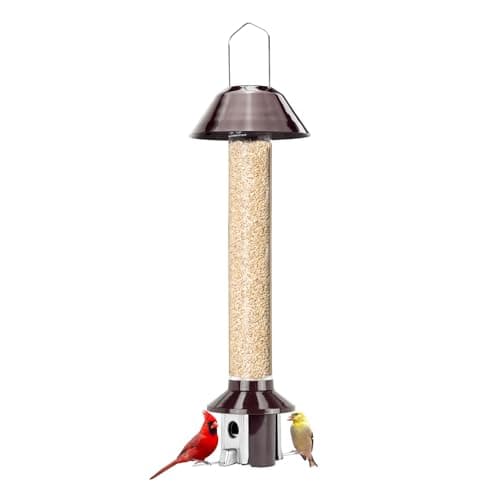 Roamwild PestOff 2.0 Squirrel Proof Feeder Four pounds, per-port closing, chew-proof polycarbonate tube and a rain guard. | The one to buy | $59.99 · View on Amazon #ad How we are funded · Price as of October 3, 2026 |
| 2 | 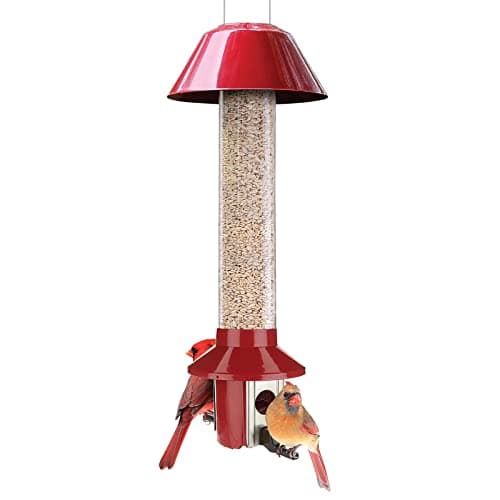 Roamwild PestOff Cardinal Feeder (Sunflower Heart Version) The cheaper sunflower-heart version, built around cardinals, with dual baffles. | Best for cardinals and hearts | $44.99 · View on Amazon #ad How we are funded · Price as of October 3, 2026 |
| 3 | 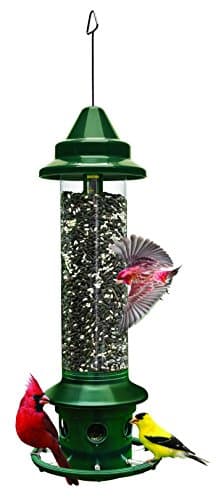 Brome Squirrel Buster Plus More capacity, a tunable spring and tool-free cleaning, for noticeably more money. | The main alternative | $124.00 · View on Amazon #ad How we are funded · Price as of October 3, 2026 |
| 4 | Eno photo Erva SB1D Cylindrical (Torpedo) Squirrel Baffle A baffle on a pole. Every weight mechanism fails to a squirrel arriving from above. | What any of them needs |
Rows link to the full write-up further down this page. The price button goes to Amazon.
Roamwild is a name most American feeder buyers have not heard, which is the main reason to write about it: the PestOff does something none of the feeders we usually recommend does, and it does it for less money than the Brome models it competes with.
The difference is per-port closing. On a Squirrel Buster, weight pulls a single shroud down over every port at once. On the PestOff, each port has its own spring, so a squirrel landing on one closes that one and leaves the rest open for the birds already feeding.
As always here, this is a specification-based review. We have not tested the feeder against squirrels and are not going to invent a result. Our squirrel-resistant roundup covers the field, and the Brome range comparison covers the main alternative.
Two models, and which is which
Roamwild's American listings are not a model of clarity — both share a part number — so it is worth separating them.
| PestOff Cardinal (sunflower heart version) | PestOff 2.0 | |
|---|---|---|
| Capacity | Listed as 3 lb in the title, up to 4 lb in the features | 4 lb |
| Ports | Spring-loaded, close under weight, reopen for songbirds | Individually spring-loaded; one closing leaves the others open |
| Baffles | Dual baffles against squirrels and large birds | Not stated; relies on the port mechanism and tube |
| Tube | Described as "riot grade" | Polycarbonate, described as chew-proof because the surface gives no grip |
| Weather | Integrated rain guard | Built-in rain guard, fully enclosed tube |
| Dimensions | 20.5" x 7.5" x 7.5" with hanger | 17.5" x 8" x 8" |
| Price tier | Lower | Higher |
The capacity contradiction on the Cardinal listing is Roamwild's, not ours: the title says three pounds and the bullet points say up to four. We have quoted both rather than picking the flattering one. It is a small thing that tells you something about the brand's American listings.
How we assessed it
On published specifications from both listings, checked live in October 2026 so that both models are currently purchasable. No hands-on testing, no squirrel trial, no photographs of our own. We weighed the mechanism against the ones we already understand, then materials at the points squirrels attack, then weather protection, then cleaning access, then what the maker fails to publish — which on this brand is the weight threshold, the single number a buyer would most like to know. Our full criteria are here.
Why per-port closing is interesting
It sounds like marketing and it has a real consequence.
On a whole-shroud feeder, a squirrel sitting on the ring closes the feeder for everything. The squirrel gets nothing, which is the point — but so do the chickadees queueing in the shrub, for as long as the squirrel chooses to sit there. Anyone who has watched a squirrel camp on a Squirrel Buster for twenty minutes knows the behavior.
With individually sprung ports, the squirrel's weight closes the port it is on. The birds on the far side keep feeding. The feeder stays in service while the standoff happens, which is a genuinely better outcome rather than a different one.
The related claim — that it stops large birds while admitting cardinals and finches — is the same mechanism with a lighter threshold, and it is where the missing number matters. Roamwild publishes no weight at which a port closes, so there is no way to predict whether a particular jay or grackle trips it. Brome at least gives you a spring you can tune and watch.
The chew-proof claim, examined
Roamwild's durability pitch for the 2.0 is specific and, unusually, mechanical rather than vague: a hard polycarbonate tube that squirrels cannot get a purchase on with their teeth, with metal elsewhere.
That is a reasonable argument. Chewing damage on tube feeders concentrates at the ports and any soft plastic lip a squirrel can hook an incisor into; a smooth, hard, enclosed tube genuinely gives less to work with. It is the same logic behind the metal-port feeders in our materials comparison.
What nobody should read into it is permanence. Polycarbonate scratches and yellows with UV, and a feeder in full sun for five seasons will show it. Chew-resistant is the honest word.
Against the Squirrel Buster Plus
This is the comparison that decides most purchases, and it is closer than the price gap suggests.
The PestOff wins on price — meaningfully, with the Cardinal version at roughly a third of what the Plus costs — and on the per-port behavior described above. It also includes a rain guard as standard, where a weather dome for the Brome is a separate purchase.
The Brome wins on capacity (5.1 lb against four), on the adjustable spring, on the cardinal ring as a designed perch, on published detail generally, and on support: Brome's Lifetime Care supplies warranty parts free, which is a real thing to have when a mechanism ages.
Both come apart without tools for cleaning, both rely entirely on weight, and both are defeated by the same thing: placement. Neither is an argument against the other on effectiveness, because neither publishes a figure that would let you compare them on it.
Our read: if you want the cheapest credible weight-activated feeder, or specifically want cardinals on sunflower hearts, the PestOff Cardinal is the better value. If you want the most tunable mechanism, the largest capacity and the best after-sales position, the Brome still justifies its premium. Neither choice is wrong.
Sunflower hearts, and the trap in the Cardinal version
The Cardinal model is sold as a sunflower-heart and mixed-seed feeder, and hearts change how you should run it.
Hulled seed has no shell protecting it, so it absorbs damp and clumps far faster than sunflower in the shell. In a feeder with a rain guard that is manageable; in a feeder filled to its stated capacity and left for a fortnight, it is how you end up with a solid plug above the ports. The rain guard helps with rain and does nothing about humidity.
So: fill it part-way, especially in damp weather, and empty rather than top up. The wet-seed rules are here, and the hulled-seed trade-off is here. Used that way the mess benefit is real: no shells under the feeder at all, which matters on a deck or patio.
What Roamwild does not publish
A review should be as clear about the gaps as the features, and this brand leaves three.
No weight threshold. The central claim is that ports close under a squirrel or large bird and stay open for songbirds. Without a figure — or an adjustment — there is no way to predict which birds you will lose. A grackle and a cardinal are not far apart in mass, and that boundary is exactly where the interesting question sits.
No clear model numbering. Both American listings we checked share the part number RF001 despite being different products with different capacities. That makes it awkward to be certain which version you are ordering, and it is why we have described each by its listing title rather than its model code.
No published warranty terms on the listings. Brome prints a Lifetime Care policy and supplies warranty parts free, which is a tangible benefit when a sprung mechanism ages. Roamwild's listings make durability claims without a stated support position. That is not evidence of a bad policy — only that we cannot cite one.
None of this makes the feeder a poor buy. It does mean the Brome premium buys documentation as well as hardware, and documentation is worth something on a product whose whole value is a mechanism.
Capacity, in practice
Three to four pounds sounds modest next to a twelve-pound hopper, and for this kind of feeder it is close to right.
A tube feeder's seed sits in a narrow column where the bottom portion is the oldest and the dampest, and the fix is turnover rather than volume. Four pounds of sunflower hearts in a busy yard is a few days; in a quiet one it is a fortnight, and a fortnight is long enough for hulled seed to clump in humid weather. Fill to the traffic you actually have, which is the same advice we give for larger hoppers and for bulk seed buying generally.
The upside of a smaller tube: refilling is a one-handed job from a pour container, and the whole feeder lifts off the hook without a second thought. Capacity is a convenience specification, not a quality one, and the trade runs in both directions.
Placement, which decides the outcome
Every weight-activated feeder on this site shares one failure mode, and it is worth repeating in a review rather than burying in a roundup.
The mechanism only works if the animal has to commit weight to a port. The 5-7-9 rule — five feet up, seven feet of clearance from anything jumpable, nine feet below an overhanging branch — is what forces that. Meet it on a baffled pole and the PestOff's springs are the thing a squirrel is fighting. Hang it from a fence bracket and the springs never enter the argument. Placement distances are here, and the pole hardware is here.
Cleaning and upkeep
Both models click apart without tools, which is the specification that decides whether a feeder stays hygienic. FeederWatch asks for cleaning every week or two and more often in wet weather or heavy use, and a sprung-port feeder adds one job to the routine: check that each port still moves freely.
Seed dust and damp residue around a spring is what makes a mechanism sluggish, and a port that sticks open is a port a squirrel can use. Rinse, dry fully, and work each port by hand before refilling. The routine is here.
Where it sits in our picks
To be explicit about hierarchy, because a review in isolation is easy to over-read.
Our default recommendation across the site remains the Squirrel Buster Plus, for capacity, adjustability, the cardinal ring and the warranty position. The PestOff does not displace it. What the PestOff does is occupy a slot that was previously empty: a genuine weight-activated mechanism at roughly a third of the price, from a maker that put thought into how the mechanism behaves socially rather than only whether it works.
That matters for the reader who was about to buy a cage because the Brome felt too expensive. A cage excludes cardinals by design; this does not. Of the cheap routes into squirrel resistance, this is the one we would take, ahead of the budget options in our cheap setups page — with the same caveat that page makes, which is that a baffle beats all of them.
Who should buy it
- You want a weight mechanism on a budget: the Cardinal version. It is the cheapest credible one we have found.
- You feed sunflower hearts and hate the mess: the Cardinal version, filled part-way.
- You want the best version of the per-port idea: the 2.0, for the chew-proof tube and the extra pound.
- You want capacity, tuning and a warranty desk: the Brome, and spend the difference knowingly.
- Your feeder hangs within a squirrel's jump of something: neither. Buy the baffle first.
The verdict: the PestOff is a well-thought-out feeder from a brand with scruffy American listings, and the per-port mechanism is the first genuinely new idea in weight-activated feeders we have had cause to write about. It does not displace the Brome at the top of our picks — capacity, adjustability and published detail still matter — but it is the better-value way into a real mechanism, and that is worth knowing before you spend three times as much.
The picks in full
#1 · The one to buy
Roamwild PestOff 2.0 Squirrel Proof Feeder
Roamwild · Per-port closing, so one heavy bird does not shut the whole feeder
The current version: a chew-proof polycarbonate tube where each port closes independently. When a squirrel lands on one port, the others stay open for the birds already feeding — which is genuinely different from a shroud that closes everything at once.
Published specifications
- Capacity
- 4 lb
- Mechanism
- Individually spring-loaded weight-activated ports; one closing does not close the others
- Tube
- Polycarbonate, described as chew-proof because squirrels cannot grip the smooth surface
- Weather
- Built-in rain guard and fully enclosed tube
- Cleaning
- Clicks apart without tools; wide lid for filling
- Dimensions
- 17.5" x 8" x 8"
What it does well
- Per-port closing is the most elegant version of this mechanism we have seen published
- Chew-proof claim rests on a smooth hard tube rather than on a coating that wears
- Tool-free disassembly, which decides whether a feeder gets cleaned
What it does not
- Roamwild publishes no weight threshold for the ports, so there is no number to check
- Costs more than the Cardinal version for one extra pound of seed
- Like every weight mechanism, it does nothing about a squirrel that reaches the tube from above
Specifications above come from the manufacturer's own published listing: Roamwild PestOff 2.0 — published listing (capacity, per-port mechanism, tube, cleaning, dimensions).
#ad How we are funded · Price as of October 3, 2026
#2 · Best for cardinals and hearts
Roamwild PestOff Cardinal Feeder (Sunflower Heart Version)
Roamwild · Cardinals, on a feeder squirrels and large birds cannot work
A tough tube with dual baffles and spring-loaded ports that close under weight, sold specifically for cardinals and mixed seed. The one squirrel-resistant feeder built around the bird most people want.
Published specifications
- Capacity
- Listed as 3 lb in the title and up to 4 lb in the features
- Mechanism
- Patented spring-loaded ports close when a larger animal lands, reopening for songbirds; no settings to adjust
- Baffles
- Dual baffles against squirrels and large birds
- Weather
- Integrated rain guard
- Dimensions
- 20.5" x 7.5" x 7.5" with hanger, per the title
- Seed
- Sunflower heart and mixed seed version
- Model
- RF001
What it does well
- Nothing to adjust: the ports are individually sprung, so there is no weight setting to get wrong
- A rain guard as standard, which matters more with sunflower hearts than with seed in the shell
- Cheaper than the comparable Brome models while using a mechanism of the same kind
What it does not
- The listing gives two different capacities, which is sloppy and makes the real figure unclear
- Sunflower hearts spoil faster than seed in the shell, so the capacity is best used part-full
- A fixed spring has no adjustment, which cuts both ways: nothing to misconfigure, nothing to tune
Specifications above come from the manufacturer's own published listing: Roamwild PestOff Cardinal Feeder (RF001) — published listing (mechanism, baffles, rain guard, dimensions).
#ad How we are funded · Price as of October 3, 2026
#3 · The main alternative
Brome Squirrel Buster Plus
Brome · The one feeder to buy if you only buy one
A weight-closing tube feeder with a large capacity and a cardinal ring, and the closest thing to a genuinely squirrel-resistant feeder that a beginner can hang up and stop thinking about.
Published specifications
- Seed capacity
- 5.1 lb
- Height
- 28" base to hanger
- Feeding ports
- 6, plus a cardinal ring
- Mechanism
- Weight-adjustable spring shroud
- Materials
- Chew-proof, UV-resistant components
- Warranty
- Brome Lifetime Care
What it does well
- The spring tension is adjustable, so you can shut out heavy birds as well as squirrels
- Comes apart by hand for cleaning, which means it actually gets cleaned
- 5.1 lb is enough that a busy fall week does not mean daily refills
What it does not
- The most expensive feeder in this roundup by a wide margin
- The shroud collects seed dust and needs a full strip-down every couple of weeks
- A squirrel that can reach the top hanger still wins, so this is not a substitute for a baffle
Specifications above come from the manufacturer's own published listing: Brome — Squirrel Buster Plus (manufacturer store).
#ad How we are funded · Price as of October 3, 2026
#4 · What any of them needs
Erva SB1D Cylindrical (Torpedo) Squirrel Baffle
Erva · Pole-mounted feeders
A long steel cylinder a squirrel cannot get around or hug past, and the single most effective thing you can buy after the feeder itself.
Published specifications
- Length
- 16.75"
- Diameter
- 6.25"
- Type
- Pole-mounted cylindrical baffle
What it does well
- Length is what defeats a squirrel here: it cannot reach past the top
- Steel, so it survives winters and chewing
What it does not
- Useless if the pole sits within jumping distance of a fence, wall or branch
- Must be mounted high enough that a squirrel cannot leap over it entirely
Specifications above come from the manufacturer's own published listing: Erva SB1D published dimensions.
Common questions
How does the Roamwild PestOff work?
Each feeding port has its own spring. When a squirrel or large bird puts weight on a port, that port closes and reopens when the weight leaves — so the other ports stay open for small birds.
Is the PestOff better than a Squirrel Buster?
Cheaper, and better at staying in service while a squirrel is on it. The Brome holds more seed, has an adjustable spring, a cardinal ring and free warranty parts. Neither publishes a weight threshold.
Is there anything to adjust on a PestOff?
No. The springs are fixed, which means nothing to misconfigure and nothing to tune. If large birds you want are being shut out, you cannot change it.
Can squirrels chew through it?
Roamwild's argument is that a smooth hard polycarbonate tube gives teeth nothing to grip, with metal used elsewhere. Chew-resistant is the fair description; polycarbonate still scratches and yellows with age.
Which PestOff model should I buy?
The Cardinal version for the lowest price and sunflower hearts; the 2.0 for the chew-proof tube, an extra pound of seed and the cleanest version of the per-port mechanism.
Sources
- Roamwild PestOff Cardinal Feeder — published listing (mechanism, baffles, rain guard, dimensions)
- Roamwild PestOff 2.0 — published listing (per-port mechanism, tube, cleaning, capacity)
- Duncraft — the 5-7-9 rule for keeping squirrels off feeders
- Cornell Lab of Ornithology — Project FeederWatch, feeding birds