Feeder Types
Woodlink Absolute II review
The feeder we recommend more often than any other hopper, and the one whose main drawback is the thing people buy it for.
By Scooter M. · Published · Last updated
The Absolute II is a twelve-pound steel hopper with six ports and a weight-adjustable closing mechanism, feeding from both sides. It is the best answer on this site for cardinals plus squirrel resistance in one feeder — provided you accept that twelve pounds of seed is a spoilage risk, not just a convenience.
Seed & Sprig earns a commission when you buy through the links on this page, at no extra cost to you. It does not change which products we pick or the order we put them in — here is how we pick and here is how we are funded.
Quick picks
| # | Product | Best for | Price |
|---|---|---|---|
| 1 | 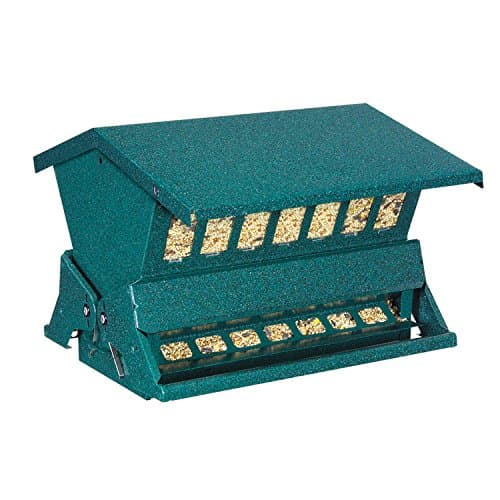 Woodlink Absolute II (model 7536) Twelve pounds, both sides, steel, weight-adjustable. The hopper we recommend most often. | The feeder reviewed | $84.00 · View on Amazon #ad How we are funded · Price as of October 3, 2026 |
| 2 | 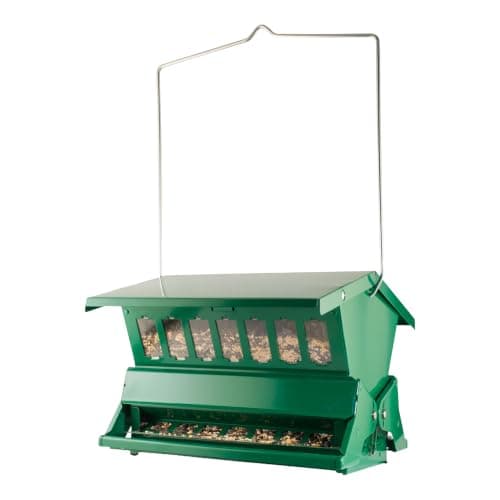 Panacea Absolute III Squirrel-Resistant Feeder (24640) Same closing principle, eight quarts, lower price. Better for a quiet yard. | The smaller version | $66.99 · View on Amazon #ad How we are funded · Price as of October 3, 2026 |
| 3 | 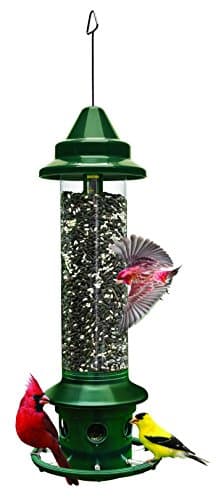 Brome Squirrel Buster Plus Tube rather than hopper, 5.1 lb, cardinal ring, tool-free cleaning. Costs more. | The main alternative | $124.00 · View on Amazon #ad How we are funded · Price as of October 3, 2026 |
| 4 | Eno photo Erva SB1D Cylindrical (Torpedo) Squirrel Baffle A weight mechanism is the second line of defense. The baffle is the first. | What it needs under it |
Rows link to the full write-up further down this page. The price button goes to Amazon.
The Woodlink Absolute II is the feeder this site has recommended more than any other hopper: it turns up as a pick on the cardinal roundup, the hopper comparison, the materials guide, the winter page and the squirrel-resistant roundup. It has never had a review of its own, which is an odd gap to leave, so this is that review.
Everything below comes from Woodlink's published specifications and the mechanism itself. We have not run a squirrel trial, have not weighed anything, and are not going to pretend otherwise. Our squirrel-resistant roundup compares it against other makers, and our hopper comparison covers the format.
What Woodlink publishes
| Specification | Published value |
|---|---|
| Seed capacity | 12 lb — described as a large 2 gallon capacity |
| Feeding ports | Six, on both sides of the feeder |
| Mechanism | Closing mechanism adjustable by weight |
| Perching | Full-length perch rails rather than short perches |
| Materials | Steel construction with polycarbonate windows above the feeding area |
| Dimensions | 16" W x 11.25" H x 13.5" D |
| Extras | Baffles inside to reduce wasted seed; heavy-duty hanger included |
Two things in that table do most of the work. The ports run along both sides under a continuous rail, which is why cardinals use this feeder when they will not use a tube: a cardinal wants to stand, not cling. And the closing mechanism is adjustable by weight, which puts it in the same mechanical family as the Brome feeders rather than among the cages.
How we assessed it
On published manufacturer specifications, checked against a live listing in October 2026 so the product is genuinely purchasable. No testing claim: this site does not run a product lab, and a review that invents a squirrel-defeat rate is worth nothing. We weighed the mechanism, the perching geometry against the species people actually want, the material choices where squirrels chew, the cleaning access, and the spoilage risk that comes with capacity. Our full criteria are here.
The mechanism, and what adjustable means here
The principle is the one Brome popularized: weight on the perch pulls a shield down over the seed ports, and the seed becomes inaccessible until the weight leaves. Woodlink states the closure is adjustable by weight, which matters because the threshold decides which birds you keep.
Set it light and you exclude the heavier birds many people want at a hopper — a jay, a grackle, a red-bellied woodpecker, sometimes a cardinal in a group. Set it heavy and a large squirrel feeds without triggering anything. There is no sensing of what the animal is, only how much it weighs, and a feeder swinging in wind can trip the mechanism on its own.
Expect to spend a few days moving the setting after you hang it, and to revisit it if you change seed. That is the same advice we give for the Brome range in the Squirrel Buster comparison, and it applies to every weight feeder ever made.
Where it beats a tube feeder
Three genuine advantages, all of them consequences of the shape.
Cardinals and jays can perch properly. This is the one that matters most and it is the reason the feeder keeps appearing in our picks. A rail along a hopper side gives a big bird somewhere to stand; a short tube perch does not. Our cardinal roundup explains the perching problem in full.
Mixed seed works. A hopper tolerates seed shapes that bridge and jam in a tube — safflower, mixes with larger pieces, sunflower in the shell — because gravity feeds a wide tray rather than a narrow port.
Steel where it counts. The body is steel with polycarbonate windows, so the surfaces a squirrel chews are metal. Plenty of hoppers at this price are plastic with a steel-colored finish, and they do not survive a determined gray squirrel.
Where it loses to a tube feeder
Cleaning. This is the honest weak point. A Squirrel Buster comes apart by hand into separate components; a large steel hopper does not. You can get at the tray and the reservoir, but a full strip-down is not a two-minute job, and that matters because FeederWatch asks for cleaning every week or two and more often in wet weather or heavy use. A feeder that is awkward to clean is a feeder that gets cleaned late.
Volume versus freshness. Twelve pounds is marvelous in a cold snap and a liability in a damp spring. Seed at the bottom of a hopper sits in the dampest part of the feeder, and the longer it sits the worse it gets. The wet-seed problem and its fixes are covered here.
Weight when full. Twelve pounds of seed plus a steel body is a serious load for a thin shepherd's hook or a branch. It wants a proper pole, which is an extra purchase if you do not have one — mounting hardware is covered here.
Absolute II or Absolute III?
The naming suggests a generational upgrade. It is not: they are different sizes, and the III is sold under the Panacea name rather than Woodlink, which makes the range needlessly confusing.
| Absolute II | Absolute III | |
|---|---|---|
| Capacity | 12 lb (2 gallons) | 8 quarts |
| Mechanism | Weight-adjustable closure | Weight-sensitive closure; no adjustment detail published |
| Materials | Steel with polycarbonate windows | Steel |
| Dimensions | 16" x 11.25" x 13.5" | 14" x 11.25" x 9.5" |
| Price tier | Higher | Lower |
| Best for | Busy yards, cardinals, cold snaps | Quieter yards, faster seed turnover |
Our read: the III is the better buy for most small yards precisely because the II's capacity is a trade rather than a win, and the price difference is real. The II earns its premium if you have genuine traffic, want the longer rails for cardinals, or value the published adjustability.
Against the Squirrel Buster Plus
The other feeder we recommend at this level, and the comparison most people are actually making.
The Brome wins on cleaning, decisively: tool-free disassembly is the difference between a weekly habit and a seasonal chore. It wins on fine control, because the spring adjustment is a documented feature with a cardinal ring designed around it. And it is a tube, so it suits sunflower and hearts in a smaller volume that turns over fast.
The Woodlink wins on capacity — more than double — and on mixed seed, and on cost per pound of seed held. It also feeds more birds at once, with ports on both sides.
So: a busy yard with cardinals and mixed seed, where refilling is the irritation, points at the Absolute II. A yard where hygiene discipline and tuning matter more points at the Brome. Both of them, as mechanisms, do the same job and fail the same way: neither survives a squirrel that can reach the feeder from above.
Living with it day to day
Three details from the specification turn into daily experience, for better and worse.
You can see the seed level. Woodlink puts polycarbonate windows above the feeding area, which sounds cosmetic and is not: a hopper you cannot see into is a hopper you either overfill or let run empty. Being able to glance at it from a window is how you learn your actual consumption rate, which is the number that should decide how full you keep it.
The internal baffles earn their place. Woodlink states that baffles inside help reduce wasted seed — they stop the whole column dumping toward one port and keep the lower ports fed. In practice that means less seed flicked out onto the ground by birds digging for something, and less on the ground is the single biggest factor in whether a feeder starts attracting mice and rats.
Both sides feed, which changes the traffic. Six ports across two faces means two groups of birds can feed without seeing each other, and a dominant jay on one side does not clear the feeder. That is a real advantage over a tube, where one bully occupies the whole object.
What you will not enjoy is lifting it when full. Twelve pounds of seed plus a steel body is an armful on a ladder, and the practical answer is to fill it in place with a scoop and a pour container rather than taking it down — the containers that make that easy are here.
Against a caged feeder
Worth a paragraph, because a cage is the other common answer at this price and it fails differently.
A cage excludes by size: mesh wide enough for a chickadee and too narrow for a squirrel or a grackle. It needs no tuning, has no moving parts and never shuts out a bird you wanted by being set wrong. What it also does is exclude cardinals, which are too large for the mesh — so a cage solves squirrels at the exact cost this feeder avoids.
The Absolute II is the opposite trade: nothing is excluded by size, so cardinals, jays and woodpeckers all feed, and the defense depends entirely on a threshold you set correctly. If your problem is grackles and starlings rather than squirrels, buy the cage — our caged feeder comparison is here. If your problem is squirrels and you want the big birds, this hopper is the better instrument.
The part the mechanism cannot fix
A weight closure is defense in depth, not a perimeter. If a squirrel can drop onto the roof from a branch or step across from a fence, it will work at the feeder all day, and eventually it will find a way to feed without loading the perch.
The 5-7-9 rule — five feet up, seven feet of clearance, nine feet below an overhanging branch — is what decides whether the mechanism is ever the thing being tested. On a correctly baffled pole in open ground, the Absolute II is a strong setup. Hanging from a low branch, it is a twelve-pound squirrel feeder with a shield that occasionally closes. Which baffle, and how high.
What seed to run in it
A hopper is the most seed-tolerant format there is, and that flexibility is part of what you are buying.
Black-oil sunflower in the shell is the default and the best general answer. Safflower works and is worth trying if squirrels are still winning, since cardinals take it and most squirrels leave it alone. Mixed seed with larger pieces flows here where it would bridge in a tube. Sunflower hearts work but spoil faster, so they argue for filling part-way.
The one combination to avoid is a cheap filler-heavy mix in a large hopper: birds discard the milo and red millet, the rejected seed collects in the tray where it stays damp, and damp rejected seed around a moving shield is how a mechanism starts sticking. How to read the bag is here, and our seed picks are here.
Who should buy it
- Cardinals matter and you want one feeder: yes. The rails plus the mechanism are hard to get in a single product at this price.
- You refill more than twice a week: yes. This is what the capacity is for.
- Quiet yard, a few regulars: buy the Absolute III instead, or fill the II part-way.
- Cleaning discipline is your weak point: buy the Brome. Honestly.
- No pole, only a thin hook: fix that first. A full hopper on an under-rated hook bends it.
The summary is that the Absolute II deserves its place in our picks and not for the reason it is marketed. It is not the capacity that makes it good; it is the perching geometry and the steel, with the capacity as a trade you manage. Manage it by filling to the season rather than to the brim, and it is the most useful hopper on this site.
The picks in full
#1 · The feeder reviewed
Woodlink Absolute II (model 7536)
Woodlink · Big capacity and cardinals — the hopper answer to squirrels
A double-sided steel hopper whose counterweighted perches drop a shield over the seed tray when something heavy lands, and it holds twelve pounds so it barely needs attention.
Published specifications
- Seed capacity
- 12 lb
- Dimensions
- 16" W x 11.25" H x 13.5" D
- Feeding ports
- 6 (both sides)
- Mechanism
- Two counterbalanced perches, adjustable to three weight settings
- Materials
- Steel and acrylic
What it does well
- 12 lb capacity means refills measured in weeks, not days
- Perch tension adjusts for light, medium or heavy birds
- The long perch rail suits cardinals, which will not use a small tube port
What it does not
- Twelve pounds of seed is heavy, so the hook or pole has to be rated for it
- Seed sitting for weeks in wet weather is how mold starts; a big hopper needs the same cleaning discipline as a small one
Specifications above come from the manufacturer's own published listing: Woodlink Absolute II published specifications.
#ad How we are funded · Price as of October 3, 2026
#2 · The smaller version
Panacea Absolute III Squirrel-Resistant Feeder (24640)
Panacea · The same mechanism as the Absolute II in a smaller, cheaper body
An 8-quart steel hopper with the same weight-sensitive port closure, sold under the Panacea name. Less capacity than the Absolute II for noticeably less money, which suits a yard that does not empty a two-gallon feeder.
Published specifications
- Capacity
- 8 quarts of seed
- Mechanism
- Weight-sensitive: ports close when a squirrel or large bird lands on the perch
- Materials
- Steel construction
- Dimensions
- 14" x 11.25" x 9.5"
- Hanging
- Hanger included
- Model
- 24640
What it does well
- Same closing principle as the Absolute II at a lower price
- Steel, so the parts squirrels chew are not plastic
- Eight quarts turns over faster than twelve pounds, which means fresher seed in a quiet yard
What it does not
- Panacea publishes no weight threshold and no adjustment detail, so there is less to check than Brome gives you
- No cardinal ring or long perch rail, so it is less suited to cardinals than the Absolute II
- Sold under a different brand name than the II, which makes comparing the range confusing
Specifications above come from the manufacturer's own published listing: Absolute III Squirrel-Resistant Feeder (Panacea 24640) — published listing (capacity, mechanism, materials, dimensions).
#ad How we are funded · Price as of October 3, 2026
#3 · The main alternative
Brome Squirrel Buster Plus
Brome · The one feeder to buy if you only buy one
A weight-closing tube feeder with a large capacity and a cardinal ring, and the closest thing to a genuinely squirrel-resistant feeder that a beginner can hang up and stop thinking about.
Published specifications
- Seed capacity
- 5.1 lb
- Height
- 28" base to hanger
- Feeding ports
- 6, plus a cardinal ring
- Mechanism
- Weight-adjustable spring shroud
- Materials
- Chew-proof, UV-resistant components
- Warranty
- Brome Lifetime Care
What it does well
- The spring tension is adjustable, so you can shut out heavy birds as well as squirrels
- Comes apart by hand for cleaning, which means it actually gets cleaned
- 5.1 lb is enough that a busy fall week does not mean daily refills
What it does not
- The most expensive feeder in this roundup by a wide margin
- The shroud collects seed dust and needs a full strip-down every couple of weeks
- A squirrel that can reach the top hanger still wins, so this is not a substitute for a baffle
Specifications above come from the manufacturer's own published listing: Brome — Squirrel Buster Plus (manufacturer store).
#ad How we are funded · Price as of October 3, 2026
#4 · What it needs under it
Erva SB1D Cylindrical (Torpedo) Squirrel Baffle
Erva · Pole-mounted feeders
A long steel cylinder a squirrel cannot get around or hug past, and the single most effective thing you can buy after the feeder itself.
Published specifications
- Length
- 16.75"
- Diameter
- 6.25"
- Type
- Pole-mounted cylindrical baffle
What it does well
- Length is what defeats a squirrel here: it cannot reach past the top
- Steel, so it survives winters and chewing
What it does not
- Useless if the pole sits within jumping distance of a fence, wall or branch
- Must be mounted high enough that a squirrel cannot leap over it entirely
Specifications above come from the manufacturer's own published listing: Erva SB1D published dimensions.
Common questions
Is the Woodlink Absolute II squirrel proof?
It is squirrel-resistant. The weight closure shuts the ports when something heavy lands, which stops casual raiding, but no feeder survives a squirrel that can reach it from a branch or fence. It needs a baffled pole.
How much seed does the Absolute II hold?
Twelve pounds, described by Woodlink as a two-gallon capacity, fed through six ports on both sides. That is a lot of seed to leave sitting in damp weather, so fill to the season.
What is the difference between the Absolute II and Absolute III?
Size and branding, not generation. The II holds 12 lb and publishes an adjustable closure; the III holds 8 quarts, is sold under the Panacea name, and publishes no adjustment detail.
Will cardinals use it?
Yes, and that is its main advantage over a tube feeder. The full-length rails give cardinals and jays somewhere to stand rather than cling.
Absolute II or Squirrel Buster Plus?
The Brome for easier cleaning, finer adjustment and a cardinal ring in a smaller volume. The Woodlink for double the capacity, mixed seed and ports on both sides.
Sources
- Woodlink Absolute II (model 7536) — published listing (capacity, ports, mechanism, materials, dimensions)
- Absolute III (Panacea 24640) — published listing (capacity, mechanism, materials)
- Duncraft — the 5-7-9 rule for keeping squirrels off feeders
- Cornell Lab of Ornithology — Project FeederWatch, feeding birds