Feeder Types
Bird feeders with cameras
The fastest-growing thing in backyard bird feeding, and the one category where the marketing runs furthest ahead of the specification sheet.
By Scooter M. · Published · Last updated
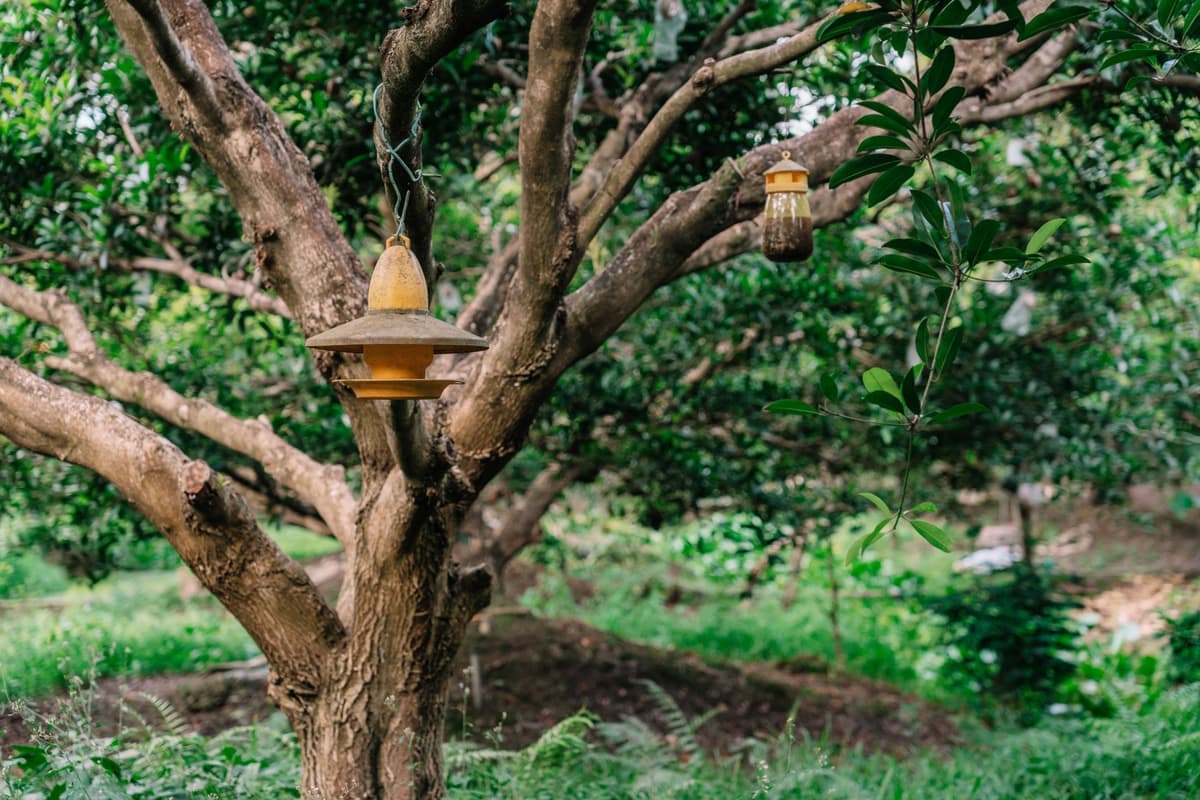
A camera feeder is a small feeder with a solar-powered camera and a species-identifying app. Buy one for the photographs, not for the birds — capacity is small, squirrels are unaffected, and the feature tiers change. The premium units cost several times an ordinary feeder and baffle.
Seed & Sprig earns a commission when you buy through the links on this page, at no extra cost to you. It does not change which products we pick or the order we put them in — here is how we pick and here is how we are funded.
Quick picks
| # | Product | Best for | Price |
|---|---|---|---|
| 1 | 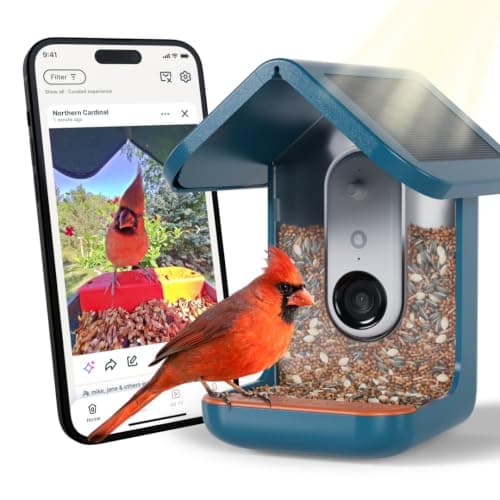 Bird Buddy Pro Solar Smart Bird Feeder 2K and a solar roof from the name with the deepest species data behind it. | Best overall | $239.99 · View on Amazon #ad How we are funded · Price as of September 16, 2026 |
| 2 | 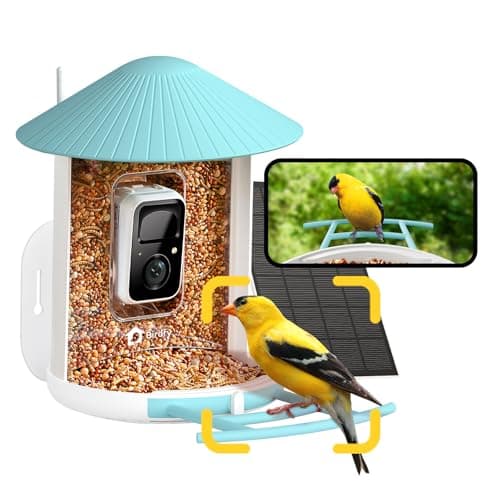 NETVUE Birdfy AI Smart Bird Feeder Camera, Solar Solar, auto-capture, 6000+ species claimed — usually under the equivalent Bird Buddy. | Best alternative | $149.99 · View on Amazon #ad How we are funded · Price as of September 16, 2026 |
| 3 | 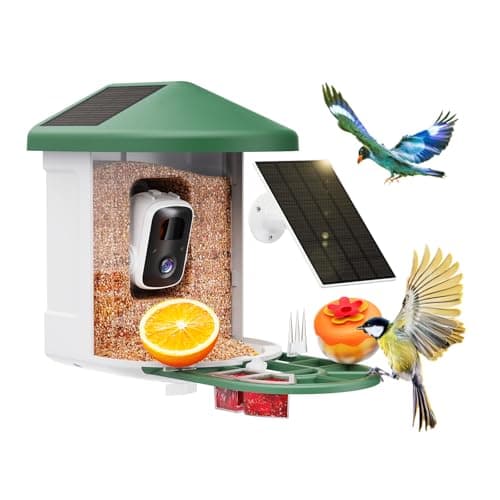 HARYMOR Smart Bird Feeder with Camera One of the few listings that publishes a capacity figure: 2 liters. | Best budget pick | $99.99 · View on Amazon #ad How we are funded · Price as of September 16, 2026 |
| 4 | 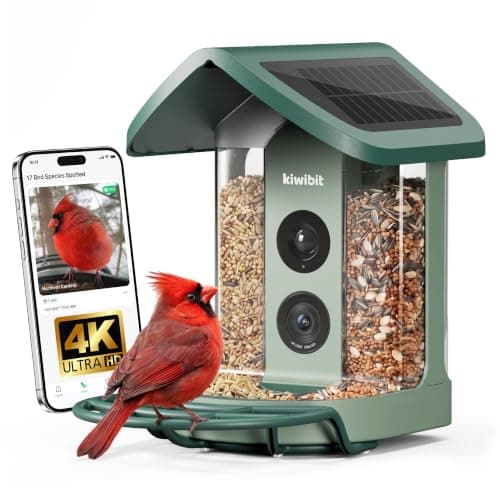 Kiwibit Solar Smart Bird Feeder with Camera Listed at 4K HDR rather than the 2K the bigger names quote. | Highest published resolution | $179.97 · View on Amazon #ad How we are funded · Price as of September 16, 2026 |
| 5 | 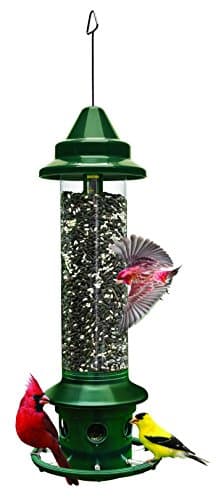 Brome Squirrel Buster Plus If the goal is more birds rather than photographs, this is the better spend. | What to buy instead, for most people | $124.80 · View on Amazon #ad How we are funded · Price as of September 16, 2026 |
Rows link to the full write-up further down this page. The price button goes to Amazon.
This is now the most-searched thing in backyard bird feeding, and it is worth saying plainly at the top: a camera feeder is a camera product, not a feeding upgrade. The birds do not care. What you are buying is the ability to see a chickadee's face from a few inches away, get a push notification that says what it was, and send the clip to someone.
That is a genuinely lovely thing and we are not sniffy about it. But it costs several times what a good feeder and a baffle cost, and the category has a specific honesty problem this page is built around.
The specification problem
Almost every product on this site is judged against figures the manufacturer publishes — capacity in pounds, port counts, dimensions, warranty terms. Camera feeders are the one category where those figures mostly do not exist.
Look at what the listings for the premium units actually commit to: resolution, solar, AI identification. Look at what they do not: seed capacity, dimensions, sensor size, battery capacity in mAh, how long it runs without sun. Two of the five picks below do not publish a capacity figure at all, and one of the cheapest ones does.
So the comparison table on this page is shorter than we would like, and every row in it is something a listing states. We have not invented a spec to fill a gap, and where a figure is missing the table says so.
| Pick | Video | Power | Published capacity |
|---|---|---|---|
| Bird Buddy Pro | 2K | Solar roof | Not published |
| NETVUE Birdfy | AI camera, auto-capture | Solar | Not published |
| HARYMOR | 2K HD | Solar | 2 L |
| Kiwibit | 4K HDR | Solar | Not published |
One warning about that last column on the right of the resolution figures: 4K on a listing is not the same as a better picture. Sensor size, lens quality and low-light behavior decide how the footage looks, and none of the three is published by any of these. A higher number is a reason to look, not a reason to buy.
How we ranked these
On published listing specifications and on how the product behaves as a feeder, which is the half of the job the category tends to ignore. No testing claim — we have not run one. Within that we weighed: whether it is solar (because a feeder you have to unmount and recharge gets abandoned by February), whether the listing publishes enough to judge it, what the subscription position is, and how much seed it holds relative to how often you want to be out there. Full criteria here.
Cleaning matters here more than the category admits. Project FeederWatch asks for seed feeders to be cleaned every week or two, and more often in heavy use or wet weather. A camera feeder is a sealed plastic box with electronics in it, which makes that harder than it is on a feeder whose base twists off. The cleaning routine is here, and it applies to these exactly as it applies to everything else.
The subscription question
This is the part people get caught by, and it is the part we can be least precise about, because the terms change.
Broadly: the hardware gets you the feeder and the camera. Live viewing, storage of past clips, and the better identification features sit in tiers, and where the line falls between free and paid has moved more than once on more than one brand. Some cheaper listings advertise "no subscription" as their headline feature, which tells you how much it matters to buyers.
Our advice is specific: decide what you need before you shop, then check the current terms on the maker's own site on the day you buy. Do not buy on the strength of a review's description of a free tier, including this one. We are not going to print a feature matrix that will be wrong in three months.
The three things nobody mentions
They hold very little seed. A camera feeder is sized around a camera and a perch, not around a week of feeding. If you are used to filling a twelve-pound hopper and walking away, this is a daily or near-daily object. That is fine in spring and tedious in January.
They are squirrel food. Nothing about the electronics changes the mechanics. These hang, they are light, they are plastic, and the seed sits behind a lid designed to be easy to open. Our position on squirrel-proofing applies unchanged: it is the pole and the baffle that do the work, not the feeder.
Wi-Fi reaches less far than you think. The correct place for a bird feeder — about ten feet from cover, well away from the house — is frequently the worst place in the yard for signal. FeederWatch's placement guidance and your router are in direct conflict, and the feeder usually loses. The placement rules are here, and we would not compromise them to get a bar of signal.
Who should actually buy one
Three situations, honestly.
- You want the photographs. This is the real use case and it is a good one. Nothing else gets you those images.
- You cannot get to the window. A camera feeder is genuinely excellent for someone with limited mobility, or a feeder sited where nobody can watch it.
- You want help with identification. The species ID is the feature that converts people, and for a beginner it is a real teaching tool.
And who should not: anyone whose actual complaint is that not enough birds are coming. A camera does not fix that, and the causes are almost always placement, seed or simple newness — work through that list first. Anyone with an established squirrel problem should buy a baffle before a camera. And anyone buying their genuinely first feeder is better served by a plain tube and a pole, at a fraction of the price, with the camera as next year's upgrade.
Where to put it
The same rules as any feeder, with one addition. FeederWatch asks for feeders close to natural cover such as trees or shrubs at roughly ten feet from dense branches — near enough that a nervous bird has an escape route, far enough that a squirrel has nothing to jump from.
The addition is light. A camera pointing into the afternoon sun produces silhouettes, and a camera in deep shade produces noise. East-facing, with the sun behind the camera for the morning rush, is the orientation that actually produces the pictures you bought it for. Nobody's listing mentions this and it makes more difference than the resolution figure does.
What each pick costs you
- Bird Buddy Pro is the most expensive mainstream option, and its listing does not publish seed capacity — you are buying on the brand and the app.
- The Birdfy puts cloud storage and some AI behind plans that have moved before; check the current terms rather than any review's.
- The HARYMOR is a less established brand, and this is a product category where the whole thing stops working if an app stops being maintained.
- The Kiwibit quotes the highest resolution and publishes nothing about the sensor or lens that would tell you whether that resolution is worth anything.
- The Squirrel Buster Plus has no camera at all, which is the point: it is here as the honest comparison for what the same money buys in feeding terms.
None of that is a reason not to buy one. It is the reason to buy one for the right reason — the pictures — and to keep a proper feeder on a baffled pole doing the actual work of feeding your birds.
The picks in full
#1 · Best overall
Bird Buddy Pro Solar Smart Bird Feeder
Bird Buddy · The camera feeder to buy if the photos are the point
The reference smart feeder: a 2K camera in a proper feeder body with a solar roof, and the one whose bird identification most people are actually buying.
Published specifications
- Camera
- 2K video, per the listing
- Power
- Solar roof included on this configuration
- Identification
- AI bird ID
- Seed capacity
- Not published on the listing
- Subscription
- Free tier exists; extended features are paid — check current terms
What it does well
- The best-known name in the category, which matters for app support and species data
- Solar roof removes the recharging chore that kills most camera feeders
- It is a real feeder, not a camera bolted to a box
What it does not
- The most expensive way to feed birds by a wide margin — a tube feeder and a baffle costs a fraction
- Amazon's listing does not publish seed capacity, and it is small compared with an ordinary hopper
- Feature tiers change; confirm what the free tier includes before you buy on that basis
Specifications above come from the manufacturer's own published listing: Bird Buddy Pro — published listing (camera, solar, AI ID).
#ad How we are funded · Price as of September 16, 2026
#2 · Best alternative
NETVUE Birdfy AI Smart Bird Feeder Camera, Solar
NETVUE · The main Bird Buddy alternative, usually for less money
The other serious name in the category: solar, automatic capture, and a species library the listing puts at 6000+ — generally cheaper than the equivalent Bird Buddy.
Published specifications
- Camera
- AI camera with auto capture, per the listing
- Power
- Solar powered
- Identification
- Listing claims 6000+ bird species
- Storage
- Cloud storage offered; terms change, check current
- Seed capacity
- Not published on the listing
What it does well
- Usually undercuts Bird Buddy for a comparable feature set
- Auto-capture means you are not relying on catching birds live
- Solar, so no battery routine
What it does not
- Cloud storage and AI features sit behind plans that change — read the current terms, not a review's
- Listing does not publish seed capacity
- Squirrels treat it like any other unbaffled hanging feeder
Specifications above come from the manufacturer's own published listing: NETVUE Birdfy — published listing (solar, AI capture, species count).
#ad How we are funded · Price as of September 16, 2026
#3 · Best budget pick
HARYMOR Smart Bird Feeder with Camera
HARYMOR · Trying the category without spending Bird Buddy money
The budget entry point: solar, 2K, AI identification and — unusually for this price — a published 2L capacity, which is more seed than the premium units admit to.
Published specifications
- Camera
- 2K HD video, live stream
- Power
- Solar powered
- Seed capacity
- 2 L, per the listing
- Alerts
- Instant arrival alerts
- Identification
- AI species identification
What it does well
- Roughly a third of the price of the premium units
- One of the few listings in the category that publishes a capacity figure
- Solar, so it is not a recharging chore
What it does not
- A less established brand, which matters when the whole product depends on an app staying supported
- Cheaper cameras in this category generally mean weaker low-light footage
- Same squirrel exposure as any hanging feeder
Specifications above come from the manufacturer's own published listing: HARYMOR smart feeder — published listing (2K, solar, 2L capacity).
#ad How we are funded · Price as of September 16, 2026
#4 · Highest published resolution
Kiwibit Solar Smart Bird Feeder with Camera
Kiwibit · The sharpest published resolution in the category
Listed at 4K HDR rather than the 2K the bigger names quote, at a price between the budget units and the premium ones.
Published specifications
- Camera
- 4K HDR live video, per the listing
- Power
- Solar
- Identification
- AI bird ID
- Seed capacity
- Not published on the listing
What it does well
- Higher published resolution than Bird Buddy or Birdfy quote
- Solar, mid-range price
What it does not
- Resolution on a listing is not the same as image quality — sensor and lens matter more, and neither is published
- Smaller brand with a shorter support track record
- No published capacity
Specifications above come from the manufacturer's own published listing: Kiwibit solar smart feeder — published listing (4K HDR, solar, AI ID).
#ad How we are funded · Price as of September 16, 2026
#5 · What to buy instead, for most people
Brome Squirrel Buster Plus
Brome · The one feeder to buy if you only buy one
A weight-closing tube feeder with a large capacity and a cardinal ring, and the closest thing to a genuinely squirrel-resistant feeder that a beginner can hang up and stop thinking about.
Published specifications
- Seed capacity
- 5.1 lb
- Height
- 28" base to hanger
- Feeding ports
- 6, plus a cardinal ring
- Mechanism
- Weight-adjustable spring shroud
- Materials
- Chew-proof, UV-resistant components
- Warranty
- Brome Lifetime Care
What it does well
- The spring tension is adjustable, so you can shut out heavy birds as well as squirrels
- Comes apart by hand for cleaning, which means it actually gets cleaned
- 5.1 lb is enough that a busy fall week does not mean daily refills
What it does not
- The most expensive feeder in this roundup by a wide margin
- The shroud collects seed dust and needs a full strip-down every couple of weeks
- A squirrel that can reach the top hanger still wins, so this is not a substitute for a baffle
Specifications above come from the manufacturer's own published listing: Brome — Squirrel Buster Plus (manufacturer store).
#ad How we are funded · Price as of September 16, 2026
Common questions
Are bird feeders with cameras worth it?
For photographs and species identification, yes — nothing else does that. As a feeding upgrade, no: capacity is small, squirrels are unaffected, and the same money buys a good feeder, a pole and a baffle several times over.
Do smart bird feeders need a subscription?
The hardware works without one, but live viewing, clip storage and the better identification features sit in paid tiers on most brands, and where that line falls has changed more than once. Check the maker's current terms on the day you buy.
Are camera bird feeders squirrel proof?
No. They are light, hanging, plastic and easy to open. None of the listings publishes a weight-closing mechanism. Put one on a baffled pole like anything else.
How much seed does a camera bird feeder hold?
Less than you expect, and most listings do not publish the figure at all — one of our budget picks publishes 2 liters and the premium units publish nothing. Expect to refill far more often than with a hopper.
Do they work without good Wi-Fi?
Not well, and the correct placement for a feeder — about ten feet from cover, away from the house — is often the worst spot for signal. Check coverage at the spot before you buy, not after.