Setup & Placement
Deck rail bird feeders and mounts
No post hole, no drilling, no landlord conversation. Just measure your railing before you buy anything.
By Scooter M. · Published · Last updated
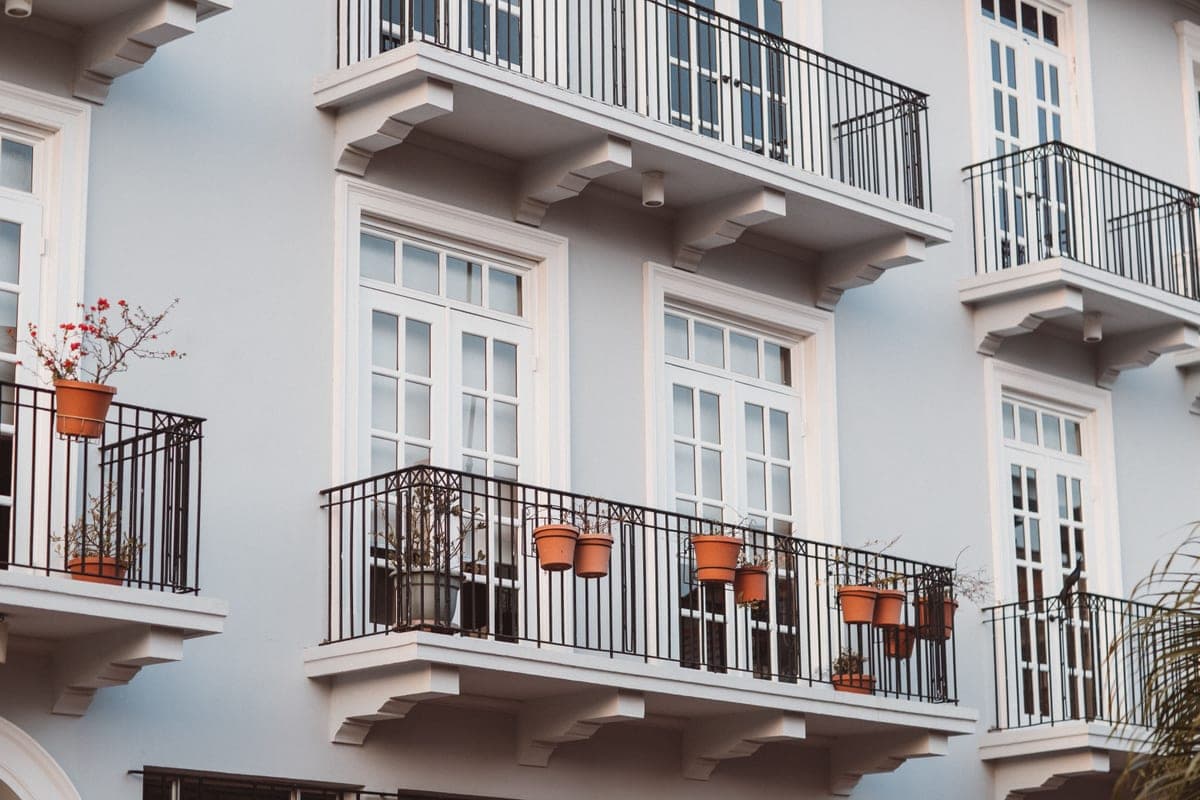
Clamp a deck hook to the railing rather than buying a rail-mounted feeder. Measure the rail first: most clamps fit up to about two inches. Choose reach over height, hang the feeder out past the boards, and accept that a deck rail is a squirrel highway.
Seed & Sprig earns a commission when you buy through the links on this page, at no extra cost to you. It does not change which products we pick or the order we put them in — here is how we pick and here is how we are funded.
Quick picks
| # | Product | Best for | Price |
|---|---|---|---|
| 1 | 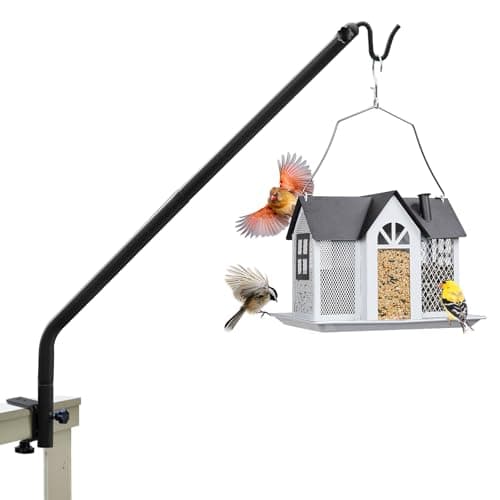 Kingsyard Adjustable Deck Hook, 27-39 inch Telescopes from 27 to 39 inches and rotates, so you can swing it in to refill. | Best overall | $18.99 · View on Amazon #ad How we are funded · Price as of September 21, 2026 |
| 2 | 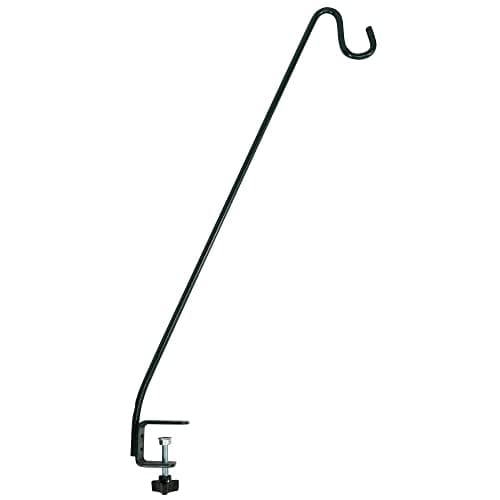 More Birds Deck Hook, 13 inch Fixed 13-inch reach, nothing to work loose, from an actual bird-feeding brand. | Best simple hook | $18.98 · View on Amazon #ad How we are funded · Price as of September 21, 2026 |
| 3 | 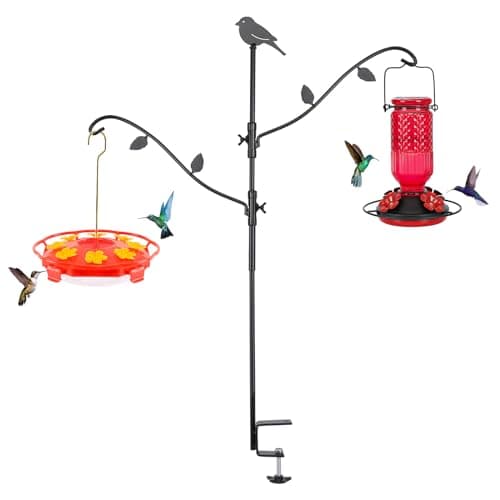 FEED GARDEN Deck Bird Feeder Pole, 42 inch A 41-inch upright with several hooks, clamped to the rail. The closest thing to a pole system on a deck. | Best whole station | $22.99 · View on Amazon #ad How we are funded · Price as of September 21, 2026 |
| 4 | 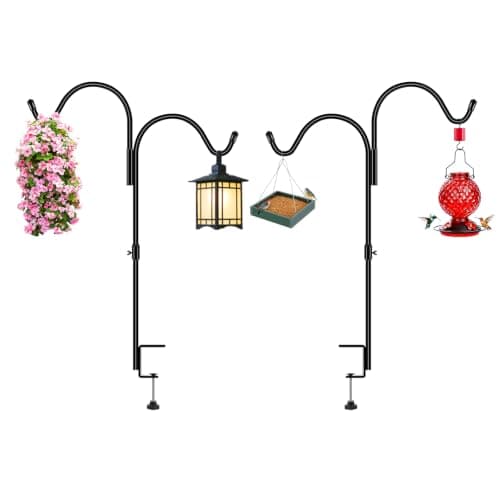 Gtongoko Double Deck Hook, 35 inch (2-pack) Clamps up to about three inches, which is where the other hooks stop. | Best for thick railings | $35.99 · View on Amazon #ad How we are funded · Price as of September 21, 2026 |
| 5 | 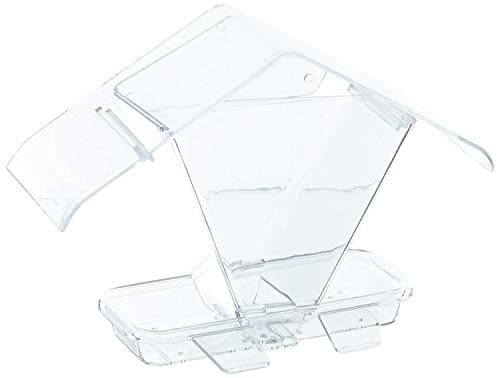 Aspects Window Cafe Window Feeder (ASP155) Small, sheltered and refillable from indoors. A deck rail does not need a big hopper. | Best feeder to hang on one | $29.96 · View on Amazon #ad How we are funded · Price as of September 21, 2026 |
| 6 | 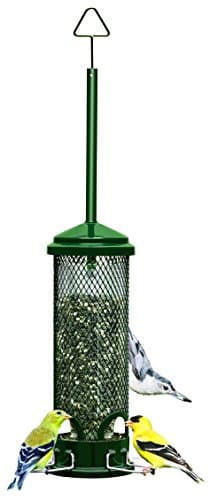 Brome Squirrel Buster Mini A weight mechanism is the only thing that helps when the squirrel arrives on foot. | Best if squirrels walk the rail | $36.98 · View on Amazon #ad How we are funded · Price as of September 21, 2026 |
Rows link to the full write-up further down this page. The price button goes to Amazon.
A deck rail is where a great many people start feeding birds, usually because there is no lawn to put a pole in, or no permission to dig one. The hardware for it is cheap and it works. The catch is that a railing solves the mounting problem and creates two others, and almost nothing sold for deck feeding acknowledges either.
This page covers the mounts — the clamp-on hooks and rail poles that hold a feeder — and what to hang on them. If your situation is a balcony rather than a deck, our balcony and small-space guide covers the wider question of feeding in a confined space, including neighbors and noise.
Measure the railing first
This is the single most common returned-item mistake in the category, and it takes thirty seconds to avoid. Every clamp has a maximum thickness, and they cluster tightly:
| Mount | Fits rails up to | Reach or height |
|---|---|---|
| More Birds deck hook | 2" | 13" reach |
| Kingsyard adjustable hook | 2.2" | 27-39" telescoping |
| FEED GARDEN deck pole | 2.1" | 41" tall, 29.9" wide |
| Gtongoko double hook | 3.07" | 35" tall, two hooks each |
A standard 2x4 laid flat is about an inch and a half thick, and almost any clamp handles it. A 2x6 rail cap on edge, a composite rail with a wide top, or a doubled timber cap can easily exceed two inches, and at that point most of these hooks simply will not close. Measure the actual top rail with a tape before you order, not the post.
Reach matters more than height
The instinct is to buy the tallest mount. The better instinct is to buy the one that holds the feeder furthest out from the deck.
Everything that falls out of a feeder lands directly below it. On a lawn that is a patch of hulls you rake occasionally. On a deck it is hulls, droppings and wet seed on the boards you walk on, and it stains. A hook that holds the feeder a foot or more past the edge of the deck puts the mess on the ground below instead, which is the single biggest quality-of-life difference between a good deck setup and one you quietly dismantle in spring.
A rotating arm is the other feature worth paying for. Refilling a feeder that hangs out over a drop means leaning over the railing; an arm that swings in brings the feeder to you. On an upper-floor deck that is a safety feature, not a convenience.
How we chose these
On published listing specifications — clamp capacity, reach, height, materials — checked against live listings in September 2026 so that everything here is purchasable. We have not load-tested these mounts and make no claim to have done so; where a maker publishes no weight rating, we say so rather than inventing one. Our ranking weighed clamp range first (a mount that does not fit is worthless), then reach past the deck edge, then whether the arm rotates for refilling, then build quality as far as published materials allow. Our full criteria are here.
The squirrel problem is different on a deck
On a pole in open ground, a squirrel has to climb, and a baffle stops climbing. On a deck, the squirrel arrives on foot along the railing, and there is nothing to baffle. Every conventional defense on this site assumes a vertical approach that a deck does not have.
That leaves three things that actually help:
- A weight-activated feeder. The mechanism does not care how the squirrel got there. This is the only hardware answer that genuinely works on a rail.
- Distance past the rail. A long hook with the feeder hanging clear of the post makes the approach awkward. It does not defeat a determined squirrel, but it turns a casual walk-up into a stretch.
- Seed choice. Safflower is worth trying on a deck precisely because the hardware options are so limited. Most squirrels leave it alone, and cardinals take it.
What does not work is a cage. A cage keeps a squirrel from reaching the seed through the bars, but on a rail the squirrel simply sits on the feeder and works at it all day, because nothing is making it leave.
Windows, which decks have a lot of
Deck feeding puts birds close to glass, and that raises the one risk on this site that is not about money. The American Bird Conservancy's guidance on preventing collisions is worth reading before you site a feeder near a sliding door.
The practical rule we use throughout the site: feeders belong either within about three feet of the glass, so a startled bird cannot build up speed, or more than thirty feet away. The middle distance is the dangerous one, and a deck rail eight feet from a patio door sits squarely in it. If that is your only option, move the feeder closer to the glass rather than further, and treat the window itself — the options are covered here.
What to hang on it
Smaller than you think. A deck feeder is refilled from two steps away, so the capacity argument that justifies a big hopper in a yard does not apply; a large feeder on a rail hook is mostly a lot of seed sitting in the weather.
Three sensible choices, depending on what bothers you most:
- A small tube or window-style feeder if you want minimal mess and close viewing.
- A weight-closing mini feeder if squirrels patrol the rail.
- A no-mess seed in whatever you hang, because hulled seed drops no shells, and on a deck the shells are the whole problem. It costs more per pound and it is worth it here in a way it is not on a lawn.
Fitting it so it stays put
A clamp holding a full feeder on the end of a long arm is under more load than it looks, and the failure is always the same: the clamp creeps, the arm droops, and one windy night the feeder is on the lawn below.
- Tighten onto the flat, not the edge. A clamp gripping the rounded corner of a rail cap has a fraction of the contact area it should. Position it on the flattest part of the top rail.
- Protect the timber. A strip of rubber or an offcut of inner tube between clamp and rail stops the jaws biting into a painted or composite surface, and it improves grip at the same time. This matters most on a rented deck where a dent is a deposit conversation.
- Re-check after the first week and after every gale. Thermal movement and vibration back a hand-tightened clamp off slowly. Ten seconds with your hand on the arm tells you everything.
- Hang the feeder from the arm's inner hook if there is a choice. Every inch further out multiplies the leverage on the clamp.
On the question of weight: most of these mounts publish no rating at all, and the two that do are modest. Treat a big hopper full of seed as out of scope for a rail clamp and use a small feeder, which is the right choice on a deck anyway.
Sun, shade and where on the rail
Which stretch of railing you choose changes the result more than the hardware does.
Birds want cover within a short flight. A feeder on the corner of a deck nearest a shrub, a small tree or even a trellis gets used far sooner than one on the open side, because small birds stage in cover before dropping to a feeder and leave the same way. If your deck has no cover at all within a few yards, expect it to take longer to be found — the same patience rules apply as anywhere else.
Avoid the hottest, most exposed stretch. A south-facing rail in full afternoon sun bakes seed, accelerates spoilage and makes suet unusable for months of the year. Morning sun with afternoon shade is the ideal, and it is usually also the part of the deck you sit on, which is the point of the exercise.
Height matters less on a deck than in a yard, because you are usually already above ground level. What you cannot fix is the rail itself: it is a continuous highway for anything that climbs onto the deck, and nothing about the mount changes that.
Water, which most deck setups skip
A shallow dish of water on a deck rail will out-perform a second feeder, particularly in summer and in freezing weather. Birds need drinking and bathing water year-round and it is scarcer than food in most suburbs.
On a deck the practicalities are easy: a small, shallow dish, changed every day or two, sited where the splashes do not fall on the boards you walk on. Depth is the thing people get wrong — an inch or so at the deepest point suits songbirds, and a deep ornamental bowl is useless to them. Our water guide covers the details, including what to do when it freezes.
Cleaning, and the thing decks make worse
A feeder over decking concentrates droppings and old seed in a small area that people also use. FeederWatch's general advice is to clean feeders every week or two, and more often in heavy use or wet weather; on a deck, treat the boards underneath as part of the same job.
Sweep under the feeder when you refill it. That one habit prevents the wet, blackened patch that makes people give up on deck feeding, and it removes the fallen seed that otherwise draws mice and rats to the deck — which, on a structure attached to your house, is a problem worth taking more seriously than a mess on a lawn. The feeder cleaning routine is here.
Renting, and the people below you
Two constraints apply to deck feeding that never come up in a yard, and both argue for clamps over anything permanent.
A clamp-on hook leaves no holes, no brackets and no marks if you pad the jaws, which keeps a landlord and most homeowners' associations out of the conversation entirely. Anything screwed into a railing is a different discussion, and not one worth having for a bird feeder you may want to move twice in the first month anyway.
The second constraint is whoever is underneath. On an upper-floor deck, everything that falls goes onto someone else's space: hulls, droppings and the seed a jay flicks aside looking for sunflower. That is the strongest argument on this page for hulled no-mess seed and for a catch tray under the feeder, and it is worth sorting out before a neighbor raises it rather than after. Feeders with catch trays are here.
What we would buy
- Standard 2x4 railing, one small feeder: the More Birds hook. Nothing to adjust, nothing to work loose.
- You want the feeder well clear of the boards: the Kingsyard telescoping hook, extended enough to clear the deck edge, swung in to refill.
- Thick composite or capped railing: the Gtongoko pair, which is the only clamp here that takes three inches.
- You want several feeders and have no yard: the FEED GARDEN deck pole, with the caveat that all the mess lands on your deck.
- Squirrels already own the railing: a weight-closing feeder, safflower in it, and patience.
A deck rail will never be as good a feeding site as a baffled pole in open ground — the squirrel defense is weaker and the mess is closer to home. But it is available, it costs very little, and a small feeder on a long hook with hulled seed in it is a genuinely good setup that thousands of people run happily. Start there, and the placement rules still apply as far as your deck allows.
The picks in full
#1 · Best overall
Kingsyard Adjustable Deck Hook, 27-39 inch
Kingsyard · Getting a feeder out past the railing without drilling anything
A telescoping clamp-on hook that adjusts between 27 and 39 inches and rotates, so you can swing the feeder in to refill it and back out over the drop. The most adjustable of the deck hooks we found.
Published specifications
- Length
- Telescopes from 27" to 39"
- Mounting
- Clamp, for railings up to 2.2 inches thick, no tools
- Rotation
- 360 degrees
- Materials
- Powder-coated metal with a rust-resistant finish
- Model
- KY16CAKYDH101CP30A01
What it does well
- The telescoping length lets you move the feeder away from the rail, which is the whole point on a deck
- Rotating the arm means refilling without leaning over the railing
- No drilling, so it suits a rented apartment or a deck you do not want to mark
What it does not
- The clamp fits railings up to 2.2 inches; measure first, because a chunky 4x4 rail cap will not fit
- A long arm plus a full feeder is a lot of leverage on one clamp — check it after windy weather
- Extending it to the full 39 inches makes it harder to reach in bad weather, not easier
Specifications above come from the manufacturer's own published listing: Kingsyard Heavy Duty Deck Hook — published listing (length range, clamp capacity, rotation, materials).
#ad How we are funded · Price as of September 21, 2026
#2 · Best simple hook
More Birds Deck Hook, 13 inch
More Birds · A simple, tidy hook from a bird-feeding brand
A fixed 13-inch clamp-on hook in powder-coated steel. It does one thing, it does not telescope, and for a small feeder on a standard railing that is all that is needed.
Published specifications
- Reach
- 13" from the rail
- Mounting
- Clamps to horizontal railings up to 2 inches thick, no drilling
- Materials
- Powder-coated rust-proof steel
- Model
- 13 inch hook
What it does well
- Fewer moving parts than a telescoping hook, so there is less to work loose
- Thirteen inches is enough to clear most railings and keep spillage off the deck boards
- From an established bird-feeding brand rather than an anonymous listing
What it does not
- No adjustment at all: what you see is the reach you get
- Two-inch railing limit rules out thick rail caps
- A fixed arm means reaching out over the rail to refill, which is awkward on an upper deck
Specifications above come from the manufacturer's own published listing: More Birds Deck Hook 13in — published listing (reach, clamp capacity, materials).
#ad How we are funded · Price as of September 21, 2026
#3 · Best whole station
FEED GARDEN Deck Bird Feeder Pole, 42 inch
FEED GARDEN · A whole feeding station clamped to a deck rail
A 41-inch upright with multiple hooks and a rail clamp: the closest thing to a pole system for people who cannot put a pole in the ground. It is the most feeder capacity you can clamp to a railing.
Published specifications
- Height
- 41" (listed as a 42 inch pole)
- Width
- 29.9" across the arms
- Mounting
- Clamps to a horizontal deck rail up to 2.1 inches thick
- Hooks
- Multiple, adjustable positions
- Materials
- Powder-coated heavy-gauge steel
What it does well
- Several feeders on one mount, which is what a feeding station means for people without a yard
- Adjustable, detachable arms let you move hooks apart as you add feeders
- No tools and no drilling, so it comes off with you when you move
What it does not
- Everything hangs above the deck, so all the spilled seed lands on your boards
- A tall clamped upright catches wind; the 2.1-inch clamp limit is worth measuring for
- No baffle and no way to fit one — squirrels reach a deck rail easily
Specifications above come from the manufacturer's own published listing: FEED GARDEN Deck Bird Feeder Pole — published listing (height, width, clamp capacity, materials).
#ad How we are funded · Price as of September 21, 2026
#4 · Best for thick railings
Gtongoko Double Deck Hook, 35 inch (2-pack)
Gtongoko · Hanging two feeders, or a feeder and a water dish, off one railing
A pair of 35-inch uprights with two hooks each and a clamp that takes a chunkier rail than most, so you can build a small feeding station on a deck without a pole.
Published specifications
- Height
- 35"
- Hooks
- Two per upright; two uprights in the pack
- Mounting
- Clamp for railings up to 3.07 inches thick
- Materials
- Welded steel with a rust-resistant coating
- Assembly
- Tool-free, per the listing
What it does well
- The 3-inch clamp capacity fits deck rails the narrower hooks will not
- Two hooks per upright lets you separate seed and suet, which reduces crowding
- Vertical uprights keep the load close to the rail rather than out on a long arm
What it does not
- Hanging above the rail rather than out past it means more mess lands on your deck
- Two feeders on one railing is a lot of traffic in a small space, and cleaning gets harder
- No published weight limit, so treat heavy hoppers with caution
Specifications above come from the manufacturer's own published listing: Gtongoko Double Deck Hook — published listing (height, hooks, clamp capacity, materials).
#ad How we are funded · Price as of September 21, 2026
#5 · Best feeder to hang on one
Aspects Window Cafe Window Feeder (ASP155)
Aspects · Apartments, offices, and watching birds from two feet away
A hopper-style window feeder on three suction cups whose body slides out for filling, so you are not wrestling a full feeder through an open window.
Published specifications
- Capacity
- 1.5 lb (about 3/4 quart)
- Dimensions
- 9.5" L x 4" W x 6.5" H
- Mounting
- Three suction cups on a roof bracket
- Warranty
- Lifetime guarantee (manufacturer)
What it does well
- The slide-out body means refilling does not mean removing the feeder
- Mounted flush to the glass, it sits in the safest zone for window collisions
- The only feeder type that works for a renter with no yard
What it does not
- Suction cups fail in a hard freeze and need cleaning and re-seating
- Squirrels reach window feeders more often than people expect
Specifications above come from the manufacturer's own published listing: Aspects Window Cafe published specifications.
#ad How we are funded · Price as of September 21, 2026
#6 · Best if squirrels walk the rail
Brome Squirrel Buster Mini
Brome · The cheapest way into a weight-closing feeder
The entry point to Brome's mechanism: four ports, one pound of seed, and the same shroud that closes under a squirrel's weight.
Published specifications
- Seed capacity
- 1 lb
- Feeding ports
- 4
- Materials
- Chew-proof and UV-resistant components, transparent seed tube
- Warranty
- Brome Lifetime Care
What it does well
- The least expensive feeder in Brome's line, so the mechanism is testable without committing
- Tool-free disassembly, same as the bigger models
What it does not
- One pound is a day or two of feeding at a busy station
- Too small to be your only feeder if you want variety
Specifications above come from the manufacturer's own published listing: Brome — Squirrel Buster Mini (manufacturer store).
#ad How we are funded · Price as of September 21, 2026
Common questions
What size railing do deck hooks fit?
Most clamp to rails up to about two inches thick, which covers a standard 2x4 laid flat. Thick composite caps and doubled timber often exceed that, so measure the top rail before ordering.
Can you stop squirrels on a deck rail?
Not with a baffle, because the squirrel walks rather than climbs. A weight-activated feeder is the only hardware that reliably helps, and safflower seed is worth trying alongside it.
Will a deck feeder make a mess?
Yes, unless you plan for it. Hang the feeder out past the deck edge so hulls fall to the ground, use hulled no-mess seed, and sweep underneath when you refill.
Is a rail-mounted tray feeder a good idea?
Rarely. It puts seed directly over your boards and within a squirrel's walking route. A clamp-on hook holding a feeder past the edge costs about the same and avoids both problems.
How far from a window should a deck feeder be?
Either within about three feet of the glass or more than thirty feet away. The middle distance is where collisions happen, and deck feeders often land in it.