Care & Season
Water, and the one thing a feeder cannot do
Birds find food in a freeze. Finding unfrozen water is the harder problem, and it is the one you can solve.
By Scooter M. · Published · Last updated
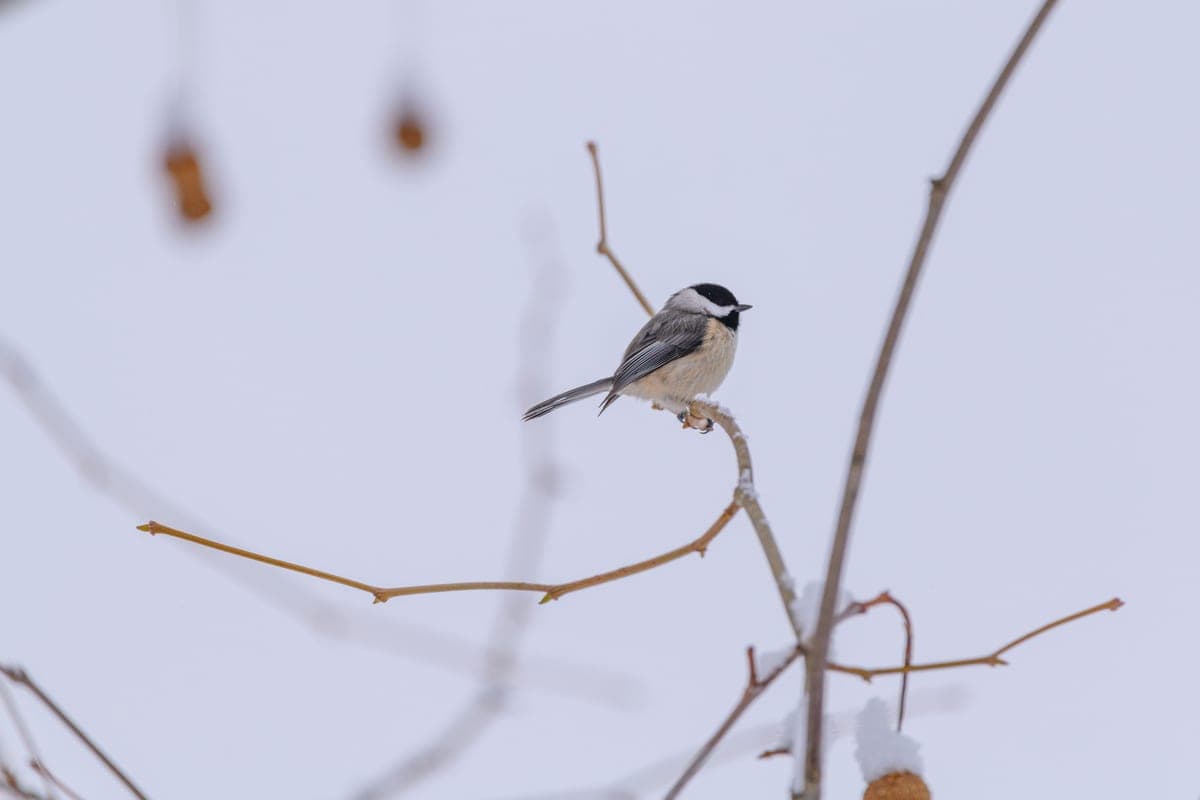
Two inches of water is enough, and in freezing weather it is worth more than another feeder. Either buy a heated bath with the element built in, or drop a thermostatic de-icer into a bath you already own. Both need an outdoor outlet and both need cleaning far more often than a feeder.
Seed & Sprig earns a commission when you buy through the links on this page, at no extra cost to you. It does not change which products we pick or the order we put them in — here is how we pick and here is how we are funded.
Quick picks
| # | Product | Best for | Price |
|---|---|---|---|
| 1 | 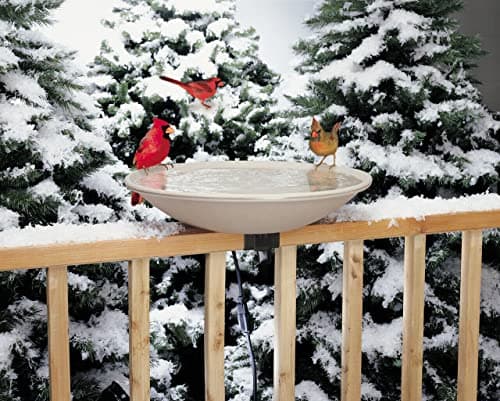 Allied Precision API 650 Heated Bird Bath Twenty inches across, two inches deep, 150 W thermostatic, and it clamps to a deck rail. | Best heated bird bath | $129.99 · View on Amazon #ad How we are funded · Price as of October 22, 2026 |
| 2 | 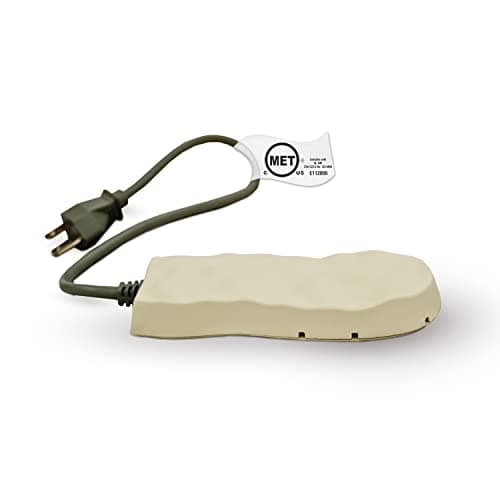 K&H Ice Eliminator / Super Ice Eliminator Bird Bath De-Icer A thermostatic drop-in heater shaped like a rock. Cheaper than replacing the bath. | Best de-icer for a bath you own | $24.99 · View on Amazon #ad How we are funded · Price as of October 22, 2026 |
Rows link to the full write-up further down this page. The price button goes to Amazon.
Almost everything on this site is about food, because that is what people come to backyard bird feeding for. Water is the part that gets skipped, and in one specific set of conditions it does more good than any feeder you own.
The conditions are a hard freeze. Birds are good at finding food in winter — that is what the whole caching, foraging, fat-storing apparatus is for. What they cannot manufacture is liquid water, and in a sustained freeze every puddle, stream edge and gutter is solid. Eating snow costs body heat. An open bath in that week is genuinely unusual.
The specification that matters is depth
Shallow. Songbirds bathe by standing in water and flicking it through their feathers, and a bird that cannot stand will not bathe. Two inches at the deepest point is plenty, and a gently sloping basin that is shallower at the edges is better still because it suits different-sized birds at once.
This is why the heated bath in our picks is a better shape than most decorative baths: its published water depth is two inches across a twenty-inch basin, which is close to ideal for the birds and incidentally makes it fast to tip out and scrub.
| Heated bath | De-icer in your own bath | |
|---|---|---|
| Up-front cost | Higher — you buy the basin too | Lower if you own a bath |
| Depth control | Designed shallow | Whatever your bath is |
| Power | 150 W thermostatic | 50 W to 10 gallons, 80 W above |
| Cord | Longer, designed for the job | Short — 18" on the K&H |
| Looks | Visibly equipment | Hides in a stone bath |
| Best for | Starting from nothing, or a deck rail | A bath you already like |
The two honest constraints
You need an outdoor outlet. This rules out more yards than anything else on this page, and there is no way around it — a heater is a heater. The de-icer we list has an eighteen-inch cord and its manufacturer says not to use an extension cord, which means the bath has to sit essentially at the outlet. Plan the location before you buy the product, not after.
It is the dirtiest thing in the station. An open basin collects droppings, feathers, hulls blown from the feeder and whatever falls out of the tree above it, and unlike seed it is a shared water source. Realistically it wants rinsing every few days in use, which is a much heavier commitment than the every-week-or-two that FeederWatch asks for seed and suet feeders. If you will not do that, do not put one up — a dirty communal water bowl is worse than no water at all. Our cleaning guidance is here, and a bath sits at the demanding end of it.
Where to put it
The same logic as a feeder, with one addition. FeederWatch asks for feeders close to natural cover such as trees or shrubs at roughly ten feet from dense branches, and a bath wants the same — a wet bird is a slow bird, so an escape route matters more here than at a feeder, not less.
The addition is that you do not want it directly under a perch or a feeder, because everything that falls off either lands in it. A few feet to the side of the station, within sight of cover, is the spot. The general placement rules apply otherwise, and if cats are a consideration in your yard, so do the safety rules — a bathing bird is especially vulnerable, so keep the surroundings open enough to see an approach.
What about summer?
Water is genuinely useful year-round, and in a heatwave a shallow bath will pull in birds that ignore your feeder entirely. No heater needed, obviously — but the cleaning problem gets worse rather than better, because warm standing water is exactly where things grow. Rinse and refill daily in hot weather, and site it in some shade so it does not become soup by mid-afternoon. Summer feeding has its own considerations.
It is also worth saying that a bath is the one piece of equipment here that helps birds which will never touch a feeder. Warblers, thrushes and other insect-eaters drink and bathe without any interest in sunflower seed, so a bath genuinely widens the list of birds in your yard rather than adding more of the same.
Things not to do
- Do not add anything to the water to stop it freezing. Antifreeze is lethal, and salt or glycerin coats feathers and destroys their insulation. The only safe answer is heat or fresh water.
- Do not let a de-icer run dry. K&H's own guidance is that the unit must stay submerged; run it dry and you are buying another one.
- Do not go deep for the sake of volume. A bigger reservoir needs less topping up and gets used less, which is the wrong trade.
- Do not put it directly under the feeder. Hulls and droppings will land in it within a day.
Is it worth it?
If you get real freezes and you have an outdoor outlet, yes — it is the single most useful thing you can add to an established feeding station, precisely because so few people do it. If your winters are mild, a plain shallow basin you tip out and refill by hand does most of the job for the price of a bag of seed.
And if you have neither an outlet nor the appetite for the cleaning, the honest answer is to skip it. This is one of the few things in bird feeding where doing it badly is worse than not doing it.
Sizing a de-icer to your bath
If you are going the drop-in route, the only specification that really decides the choice is water volume, and the manufacturer publishes the split. K&H rates its 50 W unit for baths up to ten gallons and its 80 W unit for baths above that.
Most ordinary garden baths sit comfortably under ten gallons, so the smaller unit is the usual answer — and it is the better one, because a de-icer working within its range cycles on and off rather than running continuously. If your bath is genuinely large, the honest advice is to make it smaller rather than to buy the bigger heater: a few flat stones in the basin reduce the volume, create the shallow standing area birds want, and cut the electricity at the same time.
Note also that a de-icer keeps water liquid. It does not warm it to a comfortable temperature and it is not supposed to, and a bath that is genuinely warm is a bad idea for a bird about to go out into freezing air with wet feathers.
Moving water, and why people bother
Drippers, bubblers and small recirculating pumps all do the same thing: they make the water visible and audible from further away than a still basin. Moving water is conspicuous, and a bath that birds notice from the next garden gets used more than one they have to discover.
We are not making a product recommendation here, because we have not read published specifications for a unit we would stand behind, and a moving-water setup is the kind of purchase where pump ratings and winter behavior matter. What is worth saying is the principle: if your bath is being ignored, movement is the most effective single change available, well ahead of moving the bath or changing its shape.
The winter caveat is significant. Pumps and freezing weather do not mix, and most moving water setups have to come out before the first hard freeze — which is precisely when the bath is most valuable. In practice that makes movement a three-season improvement and heat the winter one, and they are separate purchases rather than a single system.
Getting it used in the first place
Baths are slower to be discovered than feeders, and the usual mistake is deciding after a fortnight that it has not worked. Two things speed it up and both are free.
Put it where your birds already are, which means near the feeding station but not directly under it. Birds that are already visiting daily will investigate something new a few feet from a place they trust far sooner than they will find a bath at the other end of the garden.
And keep the water shallow and clean enough to look like water rather than like a container of something. A basin with an inch of clear water in it reads correctly from the air; the same basin with three inches of leaf-stained water does not. The general rules for getting anything new noticed apply here too. Movement is the shortcut: fountains, wigglers and drippers are compared here.
The picks in full
#1 · Best heated bird bath
Allied Precision API 650 Heated Bird Bath
Allied Precision (API) · Open water on a deck rail through a freezing winter
A thermostatically heated plastic basin that clamps to a deck rail, which solves the one thing a feeder cannot: in a hard freeze, water is scarcer than food.
Published specifications
- Diameter
- 20"
- Water depth
- 2"
- Heater
- 150 W, thermostatically controlled
- Mounting
- Included EZ-Tilt deck mount for a 2x4" or 2x6" rail
- Materials
- Weather-resistant plastic
- Cold rating
- Stated as fully tested in sub-zero conditions
What it does well
- Two inches is the right depth for songbirds, which is shallower than most decorative baths
- The deck mount puts it where you can see it and reach it to clean without crossing a frozen lawn
- The thermostat only draws power near freezing rather than heating all winter
What it does not
- It needs a nearby outdoor outlet, which rules out most yards without one
- 150 W is real electricity, and an open bath is the dirtiest thing in a feeding station — plan on rinsing it every few days
- Plastic, not stone, so it looks like equipment rather than garden furniture
Specifications above come from the manufacturer's own published listing: Allied Precision 650 — published dimensions, wattage, mounting and materials.
#ad How we are funded · Price as of October 22, 2026
#2 · Best de-icer for a bath you own
K&H Ice Eliminator / Super Ice Eliminator Bird Bath De-Icer
K&H · Keeping the bath you already own from freezing
A thermostatic drop-in heater shaped like a rock, and the cheaper answer if you already have a bath you like — no need to replace it with a heated one.
Published specifications
- Ice Eliminator
- 50 W, 2.75" x 6.5" — for baths up to 10 gallons
- Super Ice Eliminator
- 80 W, 4.5" x 6.5" — for baths over 10 gallons
- Thermostat
- Turns on and off as needed to keep water from freezing
- Housing
- Heavy-duty aluminum with a paintable enamel rock finish
- Cord
- 18"
- Warranty
- 3 years
What it does well
- K&H states it will not melt plastic baths, rust, or leave stains
- The rock shape disappears in a stone bath instead of looking like an appliance
- Cheaper than replacing a bath you already own
What it does not
- The cord is only 18", so the bath has to sit within reach of an outdoor outlet or a weatherproof cord run
- K&H says not to use an extension cord, which is the exact thing most people reach for
- It has to stay submerged — run it dry and you are replacing it
Specifications above come from the manufacturer's own published listing: K&H Ice Eliminator and Super Ice Eliminator — published wattage, dimensions, cord and warranty.
#ad How we are funded · Price as of October 22, 2026
Common questions
How deep should a bird bath be?
About two inches at the deepest point, shallower at the edges. Songbirds stand to bathe, and a basin they cannot stand in gets used only at the rim.
Do I need a heated bird bath in winter?
If you get sustained freezes, it is the most useful thing you can add — birds can find food in winter far more easily than open water. It needs an outdoor outlet, which is the usual blocker.
Heated bath or a de-icer in the bath I own?
A de-icer is cheaper if you already have a bath you like, provided it is shallow and sits within reach of an outlet — K&H's unit has an eighteen-inch cord and the maker says not to use an extension cord.
Can I put anything in the water to stop it freezing?
No. Antifreeze is lethal, and salt or glycerin ruins the insulating properties of feathers. Heat it or refill it.
How often should a bird bath be cleaned?
Every few days in use, which is considerably more often than a seed feeder. It is an open, shared water source and it collects everything that falls into it.