Care & Season
Feeding birds in summer
You can. The hygiene bar is higher, and one common food becomes a genuine hazard.
By Scooter M. · Published · Last updated

Summer feeding is fine if you keep feeders clean, because warm weather spoils seed and spreads disease faster. Switch plain suet for no-melt dough or take it down entirely: above roughly 70F soft fat can coat a bird's feathers, and feathers that are matted do not insulate or shed water.
Seed & Sprig earns a commission when you buy through the links on this page, at no extra cost to you. It does not change which products we pick or the order we put them in — here is how we pick and here is how we are funded.
“Should bird feeders be used in summer?” is a real question with a real answer: yes, and the conditions attached are about hygiene rather than about whether birds need the food. Warm weather changes the risk profile of a feeder more than it changes the birds.
What changes in the heat
Suet becomes a hazard
This is the one genuinely serious summer rule. Plain rendered suet softens above roughly 70F. Soft fat transfers onto the head and face feathers of birds feeding on it, and matted feathers cannot insulate or shed water properly. Either use a no-melt dough formulation, or take suet down until autumn. More in suet and suet cakes.
Seed spoils faster
Heat plus humidity plus summer thunderstorms is the worst combination for seed. Hulled and no-mess mixes are the most vulnerable, because there is no shell protecting the kernel. Put out less, refill more often, and empty anything that gets rained into. Storage rules here.
Cleaning matters more
The every-week-or-two schedule is a floor, not a ceiling. Project FeederWatch asks for more frequent cleaning during heavy use or wet weather, and a humid July qualifies. Weekly is the sensible summer default. Method here.
Natural food is everywhere
Insects, seeds and fruit are abundant, so feeders are quieter — that is not a fault. Expect less traffic and put out less accordingly.
What is actually worth offering
| Food | Summer verdict | Why |
|---|---|---|
| Black oil sunflower | Yes | Still the widest appeal; put out less at a time |
| No-melt suet dough | Yes | Holds shape when plain suet does not |
| Plain rendered suet | No | Softens and can coat feathers |
| Mealworms | Yes | Nesting adults are feeding protein-hungry young |
| Peanuts | With care | Damp peanuts can grow mold — small amounts, keep dry |
| Hulled no-mess mixes | With care | Spoil fastest of all in humidity |
Water is the real summer offering
In hot, dry weather a shallow dish of clean water often brings more birds than seed does. Keep it shallow, an inch or two, put it near cover, and change and clean it frequently — standing water in the heat goes bad quickly and is a mosquito site if left.
The nesting-season question
Feeding does not stop birds feeding their young appropriately; adults feed nestlings insects because that is what nestlings need. A seed feeder does not change that. If you want to help directly during nesting season, mealworms are the food that matches what the adults are actually collecting — see mealworm feeders.
The unwanted-visitor season
Summer is peak season for the animals a feeder attracts besides birds: rodents in warm weather, raccoons at night, and bears where they occur. Project FeederWatch recommends against any feeding in bear country except when bears are hibernating — which makes summer the season that rule bites. Full detail in rodents and unwanted visitors.
Or take the summer off
Perfectly reasonable. Project FeederWatch's own guidance is that if you cannot follow best practice year-round, limit feeding to the times of year when you can. A clean break from June to September, with the feeders scrubbed and stored, is better than a neglected feeder in a humid August. Restart in early autumn — the calendar is here. Water does more than food in a heatwave, and moving water is what gets a bath noticed.
What we would buy for this
#1 · The summer-safe suet
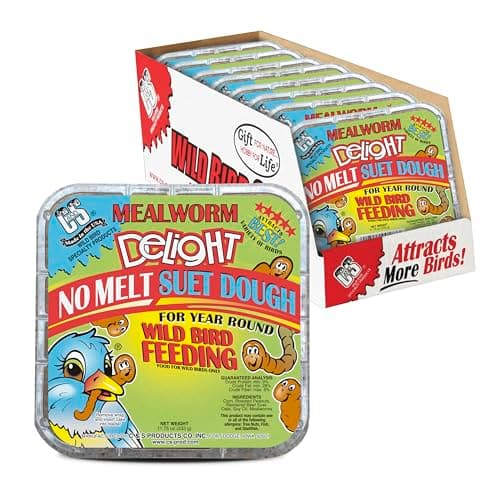
C&S Mealworm Delight No Melt Suet Dough
C&S · Suet that survives a warm afternoon
A no-melt suet dough with mealworms in it, which is the version to buy whenever the temperature climbs, because plain rendered suet turns to grease and coats birds' feathers.
Published specifications
- Ingredients
- Corn, roasted peanuts, rendered beef suet, oats, soy oil, mealworms
- Crude protein
- 11.0% min
- Crude fat
- 24.0% min
- Crude fiber
- 12.0% max
- Format
- Standard cake, fits a single-cake cage
What it does well
- The no-melt formulation holds its shape in warm weather, unlike plain suet
- Mealworms in the dough pull in birds that ignore a plain seed cake
What it does not
- Corn is the first ingredient, so a share of it goes to starlings and grackles
- No suet is truly heatproof; in a hot spell, take it down
Specifications above come from the manufacturer's own published listing: C&S Mealworm Delight published ingredients and analysis.
#ad How we are funded · Price as of October 22, 2026
#2 · Best summer protein
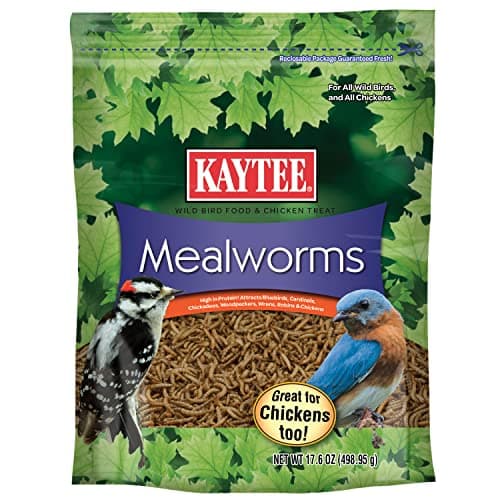
Kaytee Dried Mealworms
Kaytee · Bluebirds, wrens and anything that eats insects rather than seed
Dried mealworms are the one food that brings in the insect-eaters a seed feeder never will, and at 47% protein they earn their price in a cold snap.
Published specifications
- Crude protein
- 47.0% min
- Crude fat
- 25.0% min
- Crude fiber
- 6.0% max
- Moisture
- 5.0% max
What it does well
- The highest protein of anything in this registry by a wide margin
- Dried keeps in a sealed tub; live mealworms do not
What it does not
- Expensive per pound, and easy to over-serve
- Put out a small dish at a time: mealworms left out get damp and moldy fast
Specifications above come from the manufacturer's own published listing: Kaytee mealworms published analysis.
#ad How we are funded · Price as of October 22, 2026
#3 · Best summer feeder
Nature's Way Cedar Platform Tray Feeder (CWF3)
Nature's Way · Cardinals, jays, doves and anything that will not use a tube
An open cedar tray with a removable screen bottom, which is the honest answer for the big ground-feeding birds a tube feeder quietly excludes.
Published specifications
- Dimensions
- 12" x 12" x 2.25"
- Capacity
- 3 quarts
- Materials
- Premium cedar, stainless steel screws, powder-coated galvanized steel seed tray
- Drainage
- Removable screen tray for drainage and airflow
What it does well
- Cardinals and jays use it immediately; they often will not use a small tube port
- The screen bottom drains, which is the difference between a tray and a puddle
- Nothing to break, and it cleans in a minute
What it does not
- Completely open to squirrels, so this one belongs on a baffled pole or nowhere
- Seed is exposed to rain even with drainage, so put out small amounts
Specifications above come from the manufacturer's own published listing: Nature's Way CWF3 published specifications.
Common questions
Should bird feeders be used in summer?
Yes, provided you keep them clean and switch plain suet for a no-melt dough. If you cannot keep up with cleaning in the heat, a summer break is the better option.
Should I stop feeding birds in summer?
Only if you cannot maintain the hygiene. Birds do not become dependent, so stopping is harmless — a neglected feeder is not.
Can I put suet out in summer?
Only a no-melt dough formulation. Plain suet softens above about 70F and can coat a bird's feathers.
What should I feed birds in hot weather?
Small amounts of black oil sunflower, no-melt suet, mealworms in nesting season — and water, which is often more valuable than food in a dry spell.